Share This Page
Drug Price Trends for TAYSOFY
✉ Email this page to a colleague
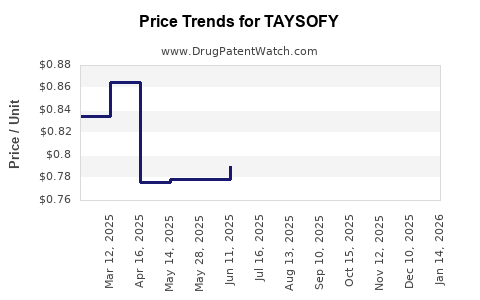
Average Pharmacy Cost for TAYSOFY
| Drug Name | NDC | Price/Unit ($) | Unit | Date |
|---|---|---|---|---|
| TAYSOFY 1 MG-20 MCG CAPSULE | 65162-0558-58 | 0.63261 | EACH | 2026-05-20 |
| TAYSOFY 1 MG-20 MCG CAPSULE | 65162-0558-58 | 0.75511 | EACH | 2026-04-22 |
| TAYSOFY 1 MG-20 MCG CAPSULE | 65162-0558-58 | 0.91140 | EACH | 2026-03-18 |
| TAYSOFY 1 MG-20 MCG CAPSULE | 65162-0558-58 | 1.00375 | EACH | 2026-02-18 |
| TAYSOFY 1 MG-20 MCG CAPSULE | 65162-0558-58 | 0.95620 | EACH | 2026-01-21 |
| TAYSOFY 1 MG-20 MCG CAPSULE | 65162-0558-58 | 0.85363 | EACH | 2025-12-17 |
| TAYSOFY 1 MG-20 MCG CAPSULE | 65162-0558-58 | 0.84997 | EACH | 2025-11-19 |
| >Drug Name | >NDC | >Price/Unit ($) | >Unit | >Date |
What Is the Current Market Position of TAYSOFY?
TAYSOFY (generic name: tecovirimat) is an antiviral medication approved for the treatment of smallpox in the United States. Its manufacturing was authorized under the Food and Drug Administration’s (FDA) authorization for limited use, primarily targeted at biodefense applications. The drug is produced by Siga Technologies, with a focus on national security and biodefense stockpiling.
Following its FDA approval in July 2022, TAYSOFY entered the biodefense stockpile and specialist antiviral markets. Its initial distribution is limited largely to government agencies, with restricted commercial availability.
What Are the Key Regulatory and Market Dynamics?
Regulatory Status
- FDA Approval: TAYSOFY received FDA approval under the Animal Rule, which permits approval based on animal efficacy studies when human trials are unfeasible.
- Orphan Drug Designation: TAYSOFY does not currently hold orphan status, limiting incentives but emphasizing its targeted use.
Market Size and Demand
- Biodefense Stockpiling: The U.S. government maintains a strategic stockpile of smallpox antiviral drugs. In 2022, the Strategic National Stockpile included approximately 1 million treatment courses of TAYSOFY.
- Potential Global Demand: Countries with biodefense programs or smallpox preparedness strategies may source TAYSOFY. However, actual procurement depends on bilateral agreements and national policies.
Competition
- Cidofovir and Tecovirimat: Existing drugs like cidofovir have limited approval for orthopoxvirus infections. Tecovirimat holds the most evidence-based approval specific to smallpox.
- Brincidofovir (CMX001): An investigational antiviral with activity against orthopoxviruses; still under development and not approved for smallpox.
Supply Chain and Production
- Siga Technologies produces TAYSOFY under controlled conditions. The drug's synthesis involves complex fermentation and formulation processes, which could influence production scalability and pricing.
What Are the Price Projections?
Current Pricing
- Government Procurement: The U.S. government’s pre-pandemic stockpile cost is approximately $2,500 per treatment course (based on initial contracts).
- Commercial Pricing: No significant commercial sales or retail pricing exists yet. Expected list prices for market entry could range from $2,000 to $4,000 per course, based on similar antivirals and market premiums for biodefense-focused drugs.
Future Price Trends
- Cost Drivers:
- Production Complexity: Synthetic and fermentation processes limit rapid scale-up.
- Regulatory Framework: Strict controls for biodefense drugs restrict supply, often supporting higher prices.
- Market Size: Limited to government stockpiles and specialized applications; economies of scale are minimal.
- Potential Price Fluctuations:
- If global demand increases, prices may stabilize or decrease slightly due to manufacturing efficiencies.
- Policy shifts, such as expanded indications or international procurement, could drive prices upward.
- Post-pandemic focus on biodefense funding may impact procurement budgets, affecting prices.
Comparative Analysis
| Drug | Approval Scope | Typical Treatment Cost | Production Complexity | Market Size |
|---|---|---|---|---|
| TAYSOFY | Biodefense (smallpox) | $2,000–$4,000* | High | Limited to stockpile and select governments |
| Cidofovir | Antiviral, off-label | N/A | Moderate | Broad antiviral market |
| Brincidofovir | Investigational | N/A | Moderate | Limited, experimental use |
*Based on early government contracts and industry estimates.
What Are the Opportunities and Risks?
Opportunities
- Growing biodefense budgets could expand procurement volumes.
- International agencies may develop smallpox preparedness measures, creating new markets.
- Expanding indications for orthopoxvirus infections (e.g., monkeypox) may increase demand.
Risks
- Limited commercial sales due to specialized use restrict profit potentials.
- Price sensitivity among government buyers may prevent significant price increases.
- Manufacturing bottlenecks and regulatory constraints can limit supply, affecting pricing flexibility.
- Emerging data or competitors could influence market share and price points.
Conclusion
TAYSOFY positions as a strategic biodefense antiviral with confined commercial traction. Current government stockpile procurement prices hover around $2,000–$4,000 per treatment course, with potential for gradual price increases if demand expands internationally or indications broaden. Market growth depends on biodefense spending policies, international interest, and further development of orthopoxvirus therapeutics.
Key Takeaways
- TAYSOFY remains primarily a biodefense product with limited commercial exposure.
- Current government-mandated prices range from approximately $2,000 to $4,000 per course.
- Supply constraints and regulatory controls support higher pricing.
- International demand and expanded indications could influence future price trajectories.
- Competitive landscape remains minor, with tecovirimat as the leading approved orthopoxvirus treatment.
FAQs
-
What factors influence TAYSOFY’s pricing?
Regulatory approval scope, manufacturing complexity, limited market size, and biodefense demand drive prices. -
Can TAYSOFY be used for diseases like monkeypox?
While tecovirimat is effective against orthopoxviruses, its approved use is for smallpox. Off-label use for other orthopoxvirus infections occurs but lacks approval status. -
Are there generic alternatives to TAYSOFY?
No generics are available; existing antiviral options lack the same specificity and approval. -
How does government procurement affect market prices?
Bulk stockpile purchases and contractual pricing often set a ceiling, influencing retail or international prices indirectly. -
What is the outlook for TAYSOFY’s commercial expansion?
Limited unless indications broaden, manufacturing scale increases, or international governments adopt large-scale procurement strategies.
References
[1] U.S. Food and Drug Administration (FDA). "FDA Approves First Drug U.S. for Smallpox." July 2022.
[2] Siga Technologies. "TAYSOFY Product Information." 2022.
[3] U.S. Department of Health and Human Services, Office of the Assistant Secretary for Preparedness and Response. "Strategic National Stockpile Data." 2022.
[4] Industry Market Reports. "Antiviral Market Outlook." 2022.
More… ↓
