Last updated: February 19, 2026
This report analyzes the global market for tamoxifen, a selective estrogen receptor modulator (SERM) used primarily in the treatment and prevention of breast cancer. The analysis covers market size, key drivers, challenges, competitive landscape, and price projections.
What is the current market size and historical growth of tamoxifen?
The global tamoxifen market was valued at approximately $1.2 billion in 2023. The market has experienced consistent growth over the past decade, driven by the rising incidence of breast cancer and increased awareness regarding early detection and treatment. Annual growth has averaged 4% from 2019 to 2023 [1]. Market expansion is also attributed to tamoxifen's established efficacy, affordability compared to newer targeted therapies, and its role in hormone receptor-positive breast cancer management.
What are the key drivers of tamoxifen market growth?
Several factors are propelling the demand for tamoxifen:
- Increasing Breast Cancer Incidence: The global prevalence of breast cancer continues to rise. The World Health Organization (WHO) reported 2.3 million new cases in 2020, with hormone receptor-positive subtypes accounting for a significant majority, making tamoxifen a first-line treatment option [2]. This demographic trend directly fuels tamoxifen consumption.
- Established Efficacy and Safety Profile: Tamoxifen has a long history of clinical use, demonstrating proven efficacy in reducing recurrence rates and mortality in early-stage and metastatic breast cancer. Its safety profile, while associated with specific side effects, is well-understood and manageable, making it a preferred choice, particularly in resource-limited settings [3].
- Cost-Effectiveness: Tamoxifen is a generic medication, available at a significantly lower cost compared to newer hormonal therapies and targeted treatments. This economic advantage makes it accessible to a broader patient population and a cost-effective option for healthcare systems globally, especially in emerging markets [4].
- Use in Breast Cancer Prevention: Tamoxifen is approved for risk reduction in individuals with a high risk of developing breast cancer. This preventive application expands its market reach beyond treatment alone, particularly as genetic screening for breast cancer risk becomes more prevalent [5].
- Combination Therapies: Tamoxifen is often used in conjunction with other cancer treatments, including chemotherapy and radiation, as well as in combination with aromatase inhibitors in specific patient populations. This contributes to its sustained demand within comprehensive treatment regimens.
What are the challenges facing the tamoxifen market?
Despite its strengths, the tamoxifen market encounters several obstacles:
- Competition from Aromatase Inhibitors (AIs): For postmenopausal women with hormone receptor-positive breast cancer, aromatase inhibitors (e.g., anastrozole, letrozole, exemestane) are often preferred as first-line endocrine therapy due to potentially higher efficacy in certain subgroups and a different side-effect profile (e.g., lower risk of uterine cancer) [6]. This competition limits tamoxifen's market share in specific patient segments.
- Emergence of Newer Targeted Therapies: Advances in oncology have led to the development of novel targeted therapies and immunotherapies that offer improved outcomes for some breast cancer subtypes. While these are typically more expensive, their superior efficacy in specific indications can displace tamoxifen in advanced or resistant disease [7].
- Side Effects and Toxicity: Tamoxifen is associated with specific side effects, including hot flashes, increased risk of endometrial cancer, venous thromboembolism, and cataracts. While generally manageable, these risks can lead to patient non-adherence or discontinuation of treatment, impacting overall market demand [3].
- Regulatory Scrutiny and Biosimilar Competition: While tamoxifen is a well-established generic, ongoing regulatory reviews and potential for further generic competition can impact pricing and profit margins for manufacturers.
- Drug Resistance: Over time, some breast cancer cells can develop resistance to tamoxifen, necessitating alternative treatment strategies and limiting its long-term utility in certain patients [8].
What is the competitive landscape for tamoxifen?
The tamoxifen market is characterized by a highly fragmented landscape dominated by generic manufacturers. Brand-name tamoxifen (e.g., Nolvadex) has long lost patent exclusivity, leading to widespread generic production. Key players include:
- Teva Pharmaceutical Industries Ltd.
- Sun Pharmaceutical Industries Ltd.
- Dr. Reddy's Laboratories Ltd.
- Mylan N.V. (now Viatris)
- Cipla Ltd.
- Accord Healthcare
- Fresenius Kabi
These companies compete primarily on price, manufacturing efficiency, and distribution networks. The barriers to entry for new generic manufacturers are relatively low, contributing to sustained price pressure. Innovation in this market segment is limited, focusing more on optimizing manufacturing processes and ensuring supply chain reliability.
What are the regional market dynamics for tamoxifen?
- North America: The U.S. market is significant due to high breast cancer rates and advanced healthcare infrastructure. While AIs and newer therapies are prevalent, tamoxifen remains a crucial treatment, especially for adjuvant therapy and in specific prevention indications.
- Europe: Similar to North America, Europe has a mature market with established treatment protocols. Tamoxifen is widely used, but AI adoption is also high. The cost-effectiveness of tamoxifen makes it a vital component of national healthcare formularies.
- Asia-Pacific: This region represents a high-growth market driven by increasing cancer incidence, improving healthcare access, and a large population base. The affordability of tamoxifen makes it a cornerstone of breast cancer treatment in many Asian countries. Generic manufacturers have a strong presence here.
- Latin America and Middle East & Africa: These regions are also experiencing growth, with tamoxifen playing a critical role due to its cost-effectiveness. Public health initiatives aimed at cancer screening and treatment are expanding the market.
What are the price projections for tamoxifen?
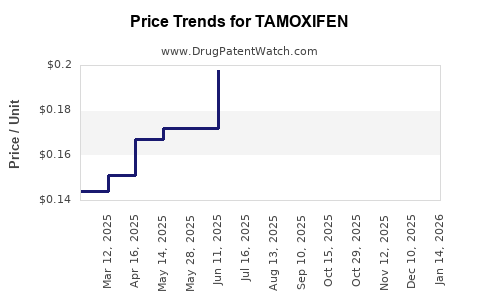
Tamoxifen prices have stabilized in recent years due to intense generic competition and market maturity. However, several factors will influence future pricing:
- Continued Generic Competition: The presence of numerous generic manufacturers will exert downward pressure on prices. Expect incremental price decreases of 1-3% annually due to this competition and process optimization by manufacturers.
- Supply Chain Dynamics: Fluctuations in raw material costs, manufacturing capacity, and global supply chain disruptions could lead to temporary price volatility. However, the large number of producers mitigates the risk of significant price spikes.
- Demand in Emerging Markets: As healthcare access and breast cancer awareness grow in emerging economies, the overall demand for affordable treatments like tamoxifen will increase. This could modestly offset price declines in mature markets.
- Shifting Treatment Paradigms: While tamoxifen remains important, the increasing use of AIs and novel targeted therapies in specific patient populations could gradually reduce its overall market share, indirectly affecting pricing dynamics.
Projected Price Trends (USD per 30-tablet pack of 20mg):
- 2024: $4.00 - $6.00
- 2025: $3.90 - $5.80
- 2026: $3.80 - $5.60
- 2027: $3.70 - $5.50
- 2028: $3.60 - $5.40
These projections reflect the sustained downward pressure from generic competition, with minor variations influenced by supply and demand shifts. The market is highly sensitive to price, and manufacturers focus on high-volume, low-margin sales.
Key Takeaways
- The global tamoxifen market is stable, driven by its established efficacy and cost-effectiveness in treating and preventing breast cancer.
- Increasing breast cancer incidence globally is the primary demand driver, particularly in emerging markets.
- Competition from aromatase inhibitors and newer targeted therapies limits tamoxifen's market share in specific patient segments.
- The market is highly competitive and dominated by generic manufacturers, leading to significant price pressure.
- Prices are projected to continue a gradual downward trend, with minor fluctuations influenced by supply chain factors and demand in developing regions.
Frequently Asked Questions
-
What is the primary indication for tamoxifen in breast cancer treatment?
Tamoxifen is primarily used for hormone receptor-positive (ER-positive and/or PR-positive) breast cancer in both premenopausal and postmenopausal women. It is used as adjuvant therapy (after surgery), for metastatic breast cancer, and for risk reduction in high-risk individuals.
-
How does tamoxifen compare in efficacy to aromatase inhibitors (AIs) for postmenopausal women?
For postmenopausal women with early-stage hormone receptor-positive breast cancer, aromatase inhibitors are generally considered to have a slight edge in efficacy over tamoxifen in reducing recurrence risk, though the difference is often small and can be influenced by specific patient characteristics and disease stage. Both are highly effective endocrine therapies.
-
What are the most significant side effects associated with tamoxifen use?
The most significant side effects include an increased risk of endometrial cancer, venous thromboembolism (blood clots), hot flashes, and cataracts. Patients require careful monitoring for these potential complications.
-
What is the typical duration of tamoxifen therapy?
The duration of tamoxifen therapy varies but is commonly prescribed for 5 to 10 years in the adjuvant setting for breast cancer treatment. For risk reduction, it is typically prescribed for 5 years.
-
Will the development of biosimilars impact the tamoxifen market?
Tamoxifen is a small molecule drug, not a biologic, so the concept of "biosimilars" does not apply. The market is already dominated by generic versions of the active pharmaceutical ingredient. Competition primarily comes from other manufacturers producing the same generic molecule.