Share This Page
Drug Price Trends for SUMATRIPTAN-NAPROXEN
✉ Email this page to a colleague
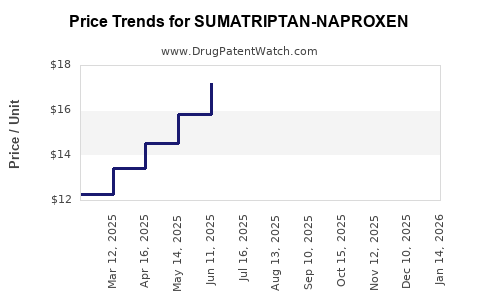
Average Pharmacy Cost for SUMATRIPTAN-NAPROXEN
| Drug Name | NDC | Price/Unit ($) | Unit | Date |
|---|---|---|---|---|
| SUMATRIPTAN-NAPROXEN 85-500 MG | 16714-0891-01 | 11.12970 | EACH | 2026-07-22 |
| SUMATRIPTAN-NAPROXEN 85-500 MG | 47335-0410-22 | 11.12970 | EACH | 2026-07-22 |
| SUMATRIPTAN-NAPROXEN 85-500 MG | 65862-0928-36 | 11.12970 | EACH | 2026-07-22 |
| SUMATRIPTAN-NAPROXEN 85-500 MG | 16714-0891-01 | 11.58653 | EACH | 2026-06-17 |
| >Drug Name | >NDC | >Price/Unit ($) | >Unit | >Date |
Market Analysis and Price Projections for Sumatriptan-Naproxen
What is the current market landscape for sumatriptan-naproxen combination drugs?
Sumatriptan-naproxen combination drugs are designed to treat migraines by combining a triptan (sumatriptan) with an NSAID (naproxen) to provide rapid relief and reduce recurrence. Currently, the primary marketed product is Treximet (approved in the US since 2007), manufactured by GlaxoSmithKline.
The segment caters mainly to migraine sufferers requiring combination therapy due to frequent or severe attacks. Market demand is influenced by migraine prevalence, medication accessibility, and evolving prescribing guidelines.
How competitive is the market for sumatriptan-naproxen?
The market comprises:
- Generic versions: Several generics introduced post-royalty expiry, intensifying price competition.
- Brand products: Treximet remains the dominant branded product, retaining rebate negotiations and higher pricing.
- Alternative treatments: Other triptans and NSAIDs, as well as non-pharmacologic interventions, act as substitutes.
Market penetration is particularly high in North America and Europe, where insurance coverage favors branded drugs, although increasing availability of generics reduces average prices.
What are the key factors driving demand for sumatriptan-naproxen?
- Increasing migraine prevalence: Approximately 1 in 7 people globally experience migraines annually [1].
- Patient preference for combination therapy: Offers symptom relief and reduces the need for multiple medications.
- Physician prescribing patterns: Preference for rapid-acting formulations for severe cases.
- Brand recognition and insurance coverage: Positive reimbursement terms or formulary placements bolster sales of Treximet.
What are the price trends and projections for sumatriptan-naproxen?
Historical pricing (US retail, per tablet):
| Year | Brand (Treximet) | Generic versions |
|---|---|---|
| 2013 | ~$10 | N/A |
| 2016 | ~$12 | ~$4–$6 |
| 2020 | ~$16 | ~$2–$4 |
| 2023 | ~$18 | ~$1–$3 |
The price gap between Treximet and generics has narrowed. Recent trends show continued price declines for generics and stabilization or slight increases for the branded product.
Future price projections (next 3–5 years):
- Branded (Treximet): Prices expected to stabilize between $16–$20 per tablet, factoring in inflation, manufacturer pricing strategies, and insurance negotiations.
- Generics: Anticipated to remain below $3 per tablet, further driven down by increased competition and manufacturing efficiencies.
Market volume forecast:
CAGR (Compound Annual Growth Rate) for the treatment segment is projected at 3–4% over the next five years, driven mainly by increased diagnostic rates and expanding insurance coverage.
Pricing drivers:
- Patent expirations and generic entry will exert downwards pressure on branded prices.
- Regulatory policies in different regions may impact drug accessibility and pricing.
- Cost-sharing dynamics between payers and manufacturers will influence consumer prices.
How do regional differences influence market and pricing strategies?
- United States: High reimbursement levels support higher prices; generic availability reduces costs.
- Europe: Price controls and reimbursement limits suppress retail prices; some countries favor generics.
- Asia-Pacific: Growing economic capacity increases demand; price sensitivity remains high, favoring generics.
What are the implications for stakeholders?
- Pharmaceutical companies: Focus on lifecycle management, such as reformulation or delivering premium formulations.
- Payers: Emphasize cost-containment strategies, encouraging generics adoption.
- Patients: Price reductions through generics improve access, expanding market size.
What are the obstacles and opportunities?
- Obstacles: Tightening regulatory environments, patent litigations, and high-cost R&D investments.
- Opportunities: Development of new fixed-dose combinations, innovative delivery systems, and expanding indications.
Summary of key data points:
- Market size (2023): Estimated global sales of sumatriptan-naproxen combination drugs approximately $1.5 billion.
- Projected growth: 3–4% CAGR over the next five years.
- Price range (2023): $1–$20 per tablet depending on brand and region.
- Leading product: Treximet, with continued dominance in North America.
Key Takeaways
- The market is mature with significant generic penetration, exerting downward pressure on prices.
- Branded drugs like Treximet retain higher prices due to brand loyalty and formulary positioning.
- Demand growth remains steady, fueled by migraine prevalence and treatment preferences.
- Regulatory and reimbursement policies heavily influence regional pricing strategies.
- Innovations and lifecycle management are critical for future market growth.
FAQs
1. What factors influence the price of sumatriptan-naproxen drugs?
Pricing is driven by patent status, generic competition, regional regulations, insurance reimbursement policies, and manufacturer pricing strategies.
2. How will generic entry affect the market?
Increased generics will lower overall prices, especially for branded drugs, and may reduce profit margins for manufacturers.
3. What regions are most significant for market growth?
North America and Europe dominate due to high migraine prevalence and healthcare spending; Asia-Pacific shows growing demand.
4. Are there new formulations or combinations in development?
Yes, ongoing research focuses on new delivery systems, combination drugs targeting other migraine pathways, and extended-release formulations.
5. How does healthcare policy impact future prices?
Price controls and reimbursement negotiations in various regions will likely continue to pressure drug prices downward over time.
References
- Vos, T., et al. (2019). Global, regional, and national incidence, prevalence, and years lived with disability for 354 diseases and injuries. The Lancet, 394(10125), 1783–1858.
More… ↓
