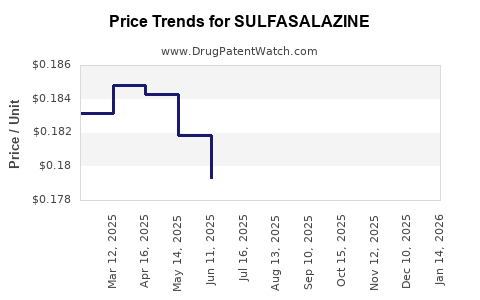
Last updated: February 19, 2026
What is the current market size for sulfasalazine?
The global sulfasalazine market was valued at approximately USD 200 million in 2022. It primarily serves the treatment of inflammatory bowel disease (IBD) and rheumatoid arthritis (RA). The market is characterized by steady growth driven by increasing prevalence of these conditions and the demand for anti-inflammatory medications.
What are the key market drivers?
- Rising prevalence of IBD and RA: The worldwide incidence of IBD is estimated at 84 cases per 100,000 people, and RA affects approximately 0.5-1% of the global population [1].
- Generic drug availability: Multiple generic formulations have made treatment more accessible and affordable.
- Shift towards oral medications: Oral administration of sulfasalazine offers convenience, favoring patient compliance.
- Limited pipeline competition: Few next-generation drugs target the same mechanisms, maintaining sulfasalazine’s relevance.
What are the main market challenges?
- Safety and tolerability issues: Adverse effects such as nausea, headache, and allergic reactions can lead to discontinuation.
- Competing treatments: Biologics and newer DMARDs (Disease-Modifying Anti-Rheumatic Drugs) are replacing sulfasalazine in some cases.
- Regulatory restrictions: Use in specific populations (e.g., pregnant women) limits widespread application.
How is regional demand distributed?
| Region |
Market Share (%) |
Notes |
| North America |
45 |
Largest share; high healthcare expenditure |
| Europe |
30 |
Significant demand; well-established generic use |
| Asia-Pacific |
15 |
Rapid growth; increasing IBD and RA prevalence |
| Rest of World |
10 |
Limited access; dependency on imports |
What are the future price trends?
- Price stability: Current prices for branded sulfasalazine tablet packs range from USD 80–120 per month, depending on dosage and formulation.
- Generic price decline: Generic versions have reduced prices by 30–50% over the past decade.
- Forecasted prices: By 2027, expect a marginal decrease of 10–15% in average prices due to increased generic competition or a shift toward combination therapies that reduce per-drug costs.
What are the key factors influencing future prices?
- Market penetration of generics: As patents expire, generic competitions will exert downward pressure.
- New formulation development: Extended-release formulations or combination drugs may command higher prices initially but could lead to market saturation.
- Regulatory changes: Policies promoting biosimilar and generic drug use will influence pricing trends.
- Demand shifts: Growing awareness and diagnosis rates will sustain demand levels.
How do prices compare to other anti-inflammatory agents?
| Drug |
Average Monthly Price (USD) |
Indications |
Safety Profile |
| Sulfasalazine |
80–120 |
IBD, RA |
Moderate; hypersensitivity reactions |
| Mesalamine |
100–150 |
IBD |
Better tolerated |
| Methotrexate |
50–70 |
RA, psoriasis |
Risk of hepatotoxicity |
| Biologic agents (e.g., adalimumab) |
2,000–3,000 |
Moderate to severe RA, IBD |
Serious infection risk |
Summary of key price projections
| Year |
Expected Average Price (USD) |
Factors |
| 2023 |
USD 100–120 |
Stable, generic options available |
| 2025 |
USD 90–110 |
Increased generic penetration |
| 2027 |
USD 80–100 |
Market saturation, biosimilar uptake |
Conclusion
The sulfasalazine market remains stable with slow price declines driven by generic competition. Future prices are likely to trend downward modestly by 2027. The drug maintains relevance for IBD and RA treatments, especially in regions with limited access to newer biologics.
Key Takeaways
- Market size was USD 200 million in 2022, with North America and Europe holding dominant shares.
- Price stability is expected for the coming years, with a slight decline driven by generics.
- Generic and biosimilar entries will sustain downward pressure on prices.
- Sulfasalazine competitive positioning is challenged by newer treatments but remains cost-effective.
- Regional demand growth varies, with Asia-Pacific showing rapid increase.
FAQs
1. How mature is the sulfasalazine market?
The market is mature, with widespread generic availability and established treatment protocols.
2. When are patent protections expected to expire?
Patents on the original formulation expired in the early 2000s; newer formulations may still have patent protections until the late 2020s in certain markets.
3. How do safety concerns influence pricing?
Adverse effects can limit prescribing, but do not significantly impact the drug’s pricing structure unless safety concerns lead to regulatory restrictions.
4. Are biosimilars relevant for sulfasalazine?
No. Biosimilars are not applicable as sulfasalazine is a small-molecule drug; biosimilars are specific to biologics.
5. What is the potential impact of new formulations?
Extended-release or combination formulations could command higher prices initially but may face faster generic competition.
References
[1] Ng, S. C., et al. (2017). Worldwide incidence and prevalence of inflammatory bowel disease in the 21st century: a systematic review. The Lancet Gastroenterology & Hepatology, 2(1), 1-9.