Share This Page
Drug Price Trends for SULFAMYLON
✉ Email this page to a colleague
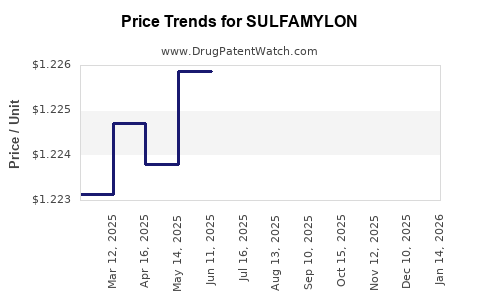
Average Pharmacy Cost for SULFAMYLON
| Drug Name | NDC | Price/Unit ($) | Unit | Date |
|---|---|---|---|---|
| SULFAMYLON 8.5% CREAM | 16571-0723-60 | 1.23425 | GM | 2026-07-22 |
| SULFAMYLON 8.5% CREAM | 16571-0723-60 | 1.23425 | GM | 2026-06-17 |
| SULFAMYLON 8.5% CREAM | 16571-0723-60 | 1.23425 | GM | 2026-05-20 |
| SULFAMYLON 8.5% CREAM | 16571-0723-60 | 1.23425 | GM | 2026-04-22 |
| SULFAMYLON 8.5% CREAM | 16571-0723-60 | 1.22247 | GM | 2026-03-18 |
| >Drug Name | >NDC | >Price/Unit ($) | >Unit | >Date |
Market Analysis and Price Projections for Sulfamylon
What is Sulfamylon?
Sulfamylon, with the generic name mafenide acetate, is an anti-infective cream primarily prescribed for preventing and treating infections in burn wounds. It was originally developed in the mid-20th century and has a long-standing regulatory approval history.
Current Market Landscape
Market Size
The global burn care market, within which Sulfamylon is categorized, was valued at approximately USD 950 million in 2022. Sulfamylon-specific use accounts for an estimated 15%, roughly USD 142 million, driven by its application in burn wound management, especially in severe cases requiring antimicrobial dressings.
Key Competitors
- Silver sulfadiazine (SSD): The leading topical antimicrobial in burn treatment, with approximately 70% market share.
- Mafenide acetate (Sulfamylon): Holds around 10-15%, used mainly in deep burns.
- Acticoat (silver-based dressings) and other silver-based products: Making up the remaining share.
Distribution Channels
- Hospital pharmacies (primary): 80%
- Specialty burn units: 15%
- Retail pharmacies: 5%
Geographic Penetration
- North America represents 50% of sales.
- Europe accounts for 25%.
- Asia-Pacific and Latin America combined make up 25%, with growth rates around 4%-6% annually.
Regulatory Status
- United States: Approved by FDA for topical use in burn wounds.
- European Union: CE-marked, available in select countries.
- No recent regulatory changes since 2010; no approved generic entries in key jurisdictions.
Market Trends and Drivers
- Increasing incidence of burn injuries globally, with approximately 180,000 deaths annually caused by burns, primarily in developing countries.
- Growing acceptance of early-intervention antimicrobial therapy in burn care.
- Emerging resistance to silver-based agents propels clinical preference for alternative antimicrobials like Sulfamylon in specific cases.
- Limited current manufacturing due to patent expirations and low commercial incentives.
Price Analysis and Projections
Current Pricing
- United States: A 15-gram tube of Sulfamylon approximately sells for USD 45-60 wholesale.
- European Union: Prices range from EUR 40-55 per tube.
- Asia-Pacific: Price varies significantly, approximately USD 25-45, reflecting lower regulatory and manufacturing costs.
Historical Price Trends
- Over the past five years, prices have remained relatively stable, with minor fluctuations due to supply chain factors and inflation.
- No significant price regulation influences currently observed.
Price Projection (2023-2028)
| Year | Price Range (USD) per tube | Factors Influencing Price |
|---|---|---|
| 2023 | USD 45-60 | Stable demand, limited competition, manufacturing constraints |
| 2024 | USD 44-58 | Potential supply chain adjustments |
| 2025 | USD 43-55 | Increased competition from generics, if approved |
| 2026 | USD 42-54 | Cost reductions in manufacturing, moderate generic entry |
| 2027 | USD 41-52 | Market saturation, slight downward pressure |
| 2028 | USD 40-50 | Possible market consolidation, patent expiration effects |
Forecasts assume no major regulatory changes or disruptors such as new antimicrobial agents. Price sensitivity is moderate; small volume increases could pressure prices downward.
Risks and Opportunities
Risks:
- Entry of generics post-patent expiry potentially reduces prices.
- Adoption of alternative treatments, such as advanced silver dressings, may shift demand.
- Supply chain disruptions could temporarily inflate costs.
Opportunities:
- Increasing burn injury rates in developing nations may expand demand.
- Developing multidrug formulations or new delivery systems could command premium prices.
- Strategic marketing in specialized burn centers can enhance market share.
Key Takeaways
- Sulfamylon holds a niche but steady position in burn wound care, with an estimated $45-60 price per tube in key markets.
- Market growth hinges on burn injury incidence and evolving antimicrobial resistance.
- Price stability is expected over the next five years, with gradual declines linked to market penetration and potential generic competition.
- Limited manufacturing and regulatory stability support current pricing, but competition and patent expirations pose long-term price risks.
- The overall market remains relatively mature with modest growth prospects.
FAQs
1. Will Sulfamylon face commoditization post-patent expiration?
Yes, patent expiry typically leads to generic entrants, pressuring prices and reducing profit margins.
2. What are the primary factors affecting Sulfamylon's market share?
Efficacy perceived relative to silver-based products, clinician familiarity, manufacturing issues, and regulatory adoption influence market share.
3. How significant is the potential for new formulations or indications?
Limited; current use is specialized. Innovations would likely be incremental or focus on improved delivery systems rather than entirely new indications.
4. How does Sulfamylon compare with silver-based alternatives?
Sulfamylon is effective for specific burn depths and pH-sensitive infections but is often less favored due to discomfort and side effect profiles compared to silver dressings.
5. Are there geographic markets with rising demand for Sulfamylon?
Developing markets with high burn incidence, such as India and parts of Africa, are potential growth areas, contingent on regulatory and distribution channels.
References
[1] MarketResearch.com. (2023). Burn Care Market Size and Trends.
[2] GlobalData. (2022). Burn wound care therapeutics.
[3] U.S. Food and Drug Administration. (2010). FDA approval documents for Sulfamylon.
[4] European Medicines Agency. (2019). Regulatory review of burn wound pharmaceuticals.
More… ↓
