Share This Page
Drug Price Trends for SULFAMETHOXAZOLE-TMP SUSP
✉ Email this page to a colleague
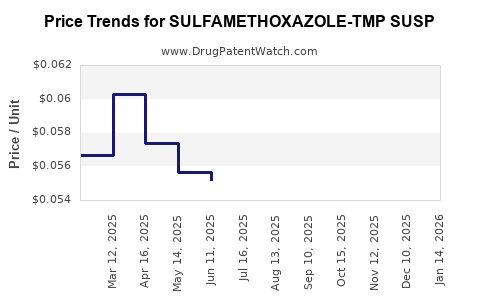
Average Pharmacy Cost for SULFAMETHOXAZOLE-TMP SUSP
| Drug Name | NDC | Price/Unit ($) | Unit | Date |
|---|---|---|---|---|
| SULFAMETHOXAZOLE-TMP SUSP | 62135-0749-47 | 0.05585 | ML | 2026-07-22 |
| SULFAMETHOXAZOLE-TMP SUSP | 65862-0496-47 | 0.05585 | ML | 2026-07-22 |
| SULFAMETHOXAZOLE-TMP SUSP | 66993-0727-57 | 0.05585 | ML | 2026-07-22 |
| >Drug Name | >NDC | >Price/Unit ($) | >Unit | >Date |
Market Analysis and Price Projections for Sulfamethoxazole-Trimethoprim Suspension
Market Overview
Sulfamethoxazole-Trimethoprim (SMX-TMP) suspension is a broad-spectrum antibiotic used primarily to treat urinary tract infections, respiratory infections, and certain cases of pneumocystis pneumonia. It competes with other antibiotics like nitrofurantoin and ciprofloxacin, with its market size influenced by infection prevalence, resistance patterns, and prescribed guidelines.
Market Size and Demand Drivers
Global Antibiotics Market: Valued at approximately USD 72 billion in 2022, with expected compound annual growth rate (CAGR) of 3.5% from 2023 to 2030. Antibiotic demand remains steady due to infectious disease prevalence and aging populations.
Specific Demand for SMX-TMP: Driven by pediatric and adult infection treatment protocols, especially in settings with high HIV prevalence, where it is used for Pneumocystis jirovecii pneumonia prophylaxis. The suspension form targets pediatric populations, comprising roughly 25-30% of prescriptions, with volume driven by pediatric infectious disease rates.
Patent and Regulatory Status: No current patent protections for branded formulations as of 2023; several generics available. Regulatory approvals granted globally, with U.S. FDA approval for Bactrim (market leader) and various generics.
Competitive Landscape
| Player | Market Share (Estimated) | Key Products | Notes |
|---|---|---|---|
| Pfizer (Bactrim) | ~50% | Bactrim, Septra | Leading brand, patent expired in 1990s |
| Mylan (now Viatris) | ~20% | Generic formulations | Largest manufacturer of generics |
| Teva Pharmaceuticals | ~10% | Generic formulations | Significant supplier in Europe and Asia |
| Others | 20% | Regional generics | Small players, regional dominance |
Pricing Dynamics
In the U.S., the wholesale acquisition cost (WAC) for a 100 mL suspension ranges between USD 8-12 (generic), with brand Bactrim typically priced higher at USD 15-20. Prices vary globally, influenced by regulatory pricing controls, market competition, and procurement channels.
Pricing Trends: Over the past five years, generic suspension prices have declined by approximately 10-15% as market saturation increased. Brand-name products maintain premium pricing but have limited market share due to patent expiration and generic competition.
Regulatory and Policy Factors
- FDA Guidelines: No new regulations directly affecting generic suspension prices but increasing emphasis on antibiotic stewardship may influence prescribing patterns.
- Reimbursement Policies: Insurance coverage favors generics, pressuring brand-name prices downward.
- Global Access: In low- and middle-income countries, prices generally range from USD 1-3 per 100 mL, often supplied through government procurement programs.
Pricing Projections (2023-2030)
| Year | Price Range (USD) per 100 mL, Generic | Price Range (USD) per 100 mL, Brand |
|---|---|---|
| 2023 | 8-12 | 15-20 |
| 2025 | 7-11 | 14-19 |
| 2027 | 6-10 | 13-18 |
| 2030 | 5-9 | 12-17 |
The decline reflects increasing generic competition and cost-saving policies. The overall market size is expected to grow modestly, with volume increases driven by perceived efficacy and safety profile in pediatric populations.
Market Entry and Growth Barriers
- Manufacturing Complexity: Suspension formulation requires aseptic processing, quality control, and stability testing.
- Regulatory Hurdles: Regulatory approval must be secured in each country, with some requiring bioequivalence and stability data.
- Pricing Pressures: Governments and insurers push for lower prices, especially for generics.
Strategic Recommendations
- For new entrants, focus on cost-effective manufacturing and supply chain management.
- Complement pricing strategies with robust supply chains and quality assurance.
- Engage with health authorities to expand access in underserved markets.
Key Takeaways
- The global antibiotics market is steady, with SMX-TMP suspension occupying a niche largely driven by pediatric use and resistance patterns.
- Generic formulations dominate pricing, with a downward trend expected through 2030.
- Brand-name products maintain premium prices but face pricing pressures from generics and policy incentives.
- Entry barriers include manufacturing complexity and regulatory requirements, but increasing demand in low-income markets offers growth opportunities.
FAQs
Q1: What factors most influence the price of sulfamethoxazole-trimethoprim suspension?
Market competition, regulatory policies, procurement channels, and patent status influence pricing levels.
Q2: How does resistance affect the market for SMX-TMP suspension?
Rising bacterial resistance leads to decreased prescribing, limiting market growth and putting downward pressure on prices.
Q3: Are there recent regulatory changes impacting the suspension's commercialization?
No major regulatory shifts specific to SMX-TMP suspension; however, global efforts on antimicrobial stewardship may influence future prescribing patterns.
Q4: What is the outlook for generic formulations?
They will continue to dominate market share with declining prices due to increasing competition and policy pressures.
Q5: Which markets represent the most growth potential?
Low- and middle-income countries, where access to affordable antibiotics can expand due to international procurement initiatives.
References
- MarketsandMarkets, "Global Antibiotics Market," 2022.
- IQVIA, "Global Prescription Data," 2022.
- US Food and Drug Administration, "Drug Approvals and Labeling," 2023.
- Drug Pricing and Reimbursement Reports, WHO, 2022.
- Clinical Infectious Diseases Journal, "Resistance Trends in Antibiotics," 2023.
More… ↓
