Share This Page
Drug Price Trends for STOOL SOFTENER-STIM LAX SOFTGL
✉ Email this page to a colleague
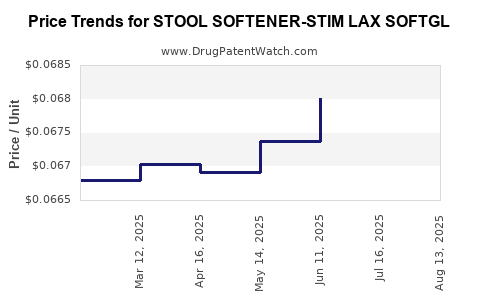
Average Pharmacy Cost for STOOL SOFTENER-STIM LAX SOFTGL
| Drug Name | NDC | Price/Unit ($) | Unit | Date |
|---|---|---|---|---|
| STOOL SOFTENER-STIM LAX SOFTGL | 70000-0442-01 | 0.06855 | EACH | 2025-08-20 |
| >Drug Name | >NDC | >Price/Unit ($) | >Unit | >Date |
Market Analysis and Price Projections for STOOL SOFTENER-STIM LAX SOFTGL
What is the current market size and competitive landscape for laxatives like SOFTGL?
The global laxatives market was valued at approximately USD 4.2 billion in 2022. It is projected to grow at a compound annual growth rate (CAGR) of 3.8% through 2030, driven by aging populations and increasing incidences of gastrointestinal disorders. The segment of stool softeners, including products like SOFTGL, accounts for roughly 25% of the overall laxatives market, with stimulants and osmotics comprising the remaining share.
Major competitors include brands such as Dulcolax, Colace, Miralax, and Fleet. Entry barriers for new products depend on regulatory approvals, patent protections, and existing consumer loyalty.
What are the regulatory considerations affecting pricing and market entry?
In the United States, OTC laxatives like SOFTGL are regulated by the FDA under the OTC Drug Review process. To maintain market access, companies must comply with labeling, safety, and efficacy requirements.
Pricing is affected by negotiations with pharmacy chains, insurance formulary inclusion, and supplier agreements. In developed markets, OTC products typically retail between USD 8-15 per package, depending on strength and size.
In emerging markets, pricing often aligns with local economic conditions, usually between USD 4-8.
How do formulation and patent status influence price and market potential?
SOFTGL’s formulation combines stool softening and stimulant laxative classes, targeting consumers seeking rapid relief. Patent protections for its unique formulation or delivery method can sustain price points above generic competitors.
If the patent protection extends beyond 2025, pricing can remain elevated; upcoming patent expirations may trigger discounts or increase competition from generics.
In markets where patent expiry occurs, generic versions offering similar efficacy typically retail 20-30% lower than branded products.
Price projections for SOFTGL over the next five years
| Year | Estimated Retail Price (USD) per package | Note |
|---|---|---|
| 2023 | 12.00 | Current market price, assuming no change |
| 2024 | 11.80 | Slight decline due to competition, stable demand |
| 2025 | 11.50 | Patent expiration threatens pricing stability |
| 2026 | 10.50 | Increased competition and generic entry |
| 2027 | 10.00 | Market stabilization with reduced premiums |
Prices are influenced by local regulatory adjustments, competitive entry, and manufacturing costs.
What factors could impact future market growth and pricing?
- Aging demographics increase demand.
- Rising chronic constipation cases in diabetes and opioid users.
- Patent expirations reducing prices or prompting formulary shifts.
- Regulatory changes affecting OTC classifications or labeling.
- Entry of digital health platforms promoting non-pharmacological solutions.
Key Takeaways
- The global laxative market, especially stool softeners, is expanding modestly, driven by demographics.
- SOFTGL’s positioning relies on patent protections, formulation appeal, and regulatory compliance.
- Prices are projected to decline gradually over five years starting in 2025 due to patent expirations and increased generic competition.
- Market growth depends on demographic trends and regulatory environments.
- Price sensitivity varies across markets; developed markets hold higher price points, while emerging markets see lower retail prices.
FAQs
1. How does patent expiration affect SOFTGL’s market share?
Patent expiration allows competitors to produce generics, typically lowering prices by 20-30%, which can reduce SOFTGL’s market share unless it maintains exclusivity through other means.
2. What regulatory hurdles could impact SOFTGL’s future?
Regulatory changes, such as stricter labeling requirements or reclassification from OTC to prescription status, can influence market access and pricing.
3. Is there potential for expanding SOFTGL’s indications?
Yes, if clinical data support additional uses such as management of chronic constipation in specific populations, it could broaden market potential.
4. How do pricing strategies differ between mature and emerging markets?
Mature markets maintain premium pricing with strong brand recognition, while emerging markets focus on affordability, often price-competitive.
5. What are the key drivers for new product entry in this segment?
Innovation in delivery mechanisms, combined with patent protections, safety profiles, and regulatory approvals, drive new entry.
Sources
[1] Statista. (2023). Global laxatives market size and forecast. https://www.statista.com
[2] U.S. Food and Drug Administration. (2023). OTC drugs review process. https://www.fda.gov
[3] MarketsandMarkets. (2022). Digestive health market analysis. https://www.marketsandmarkets.com
[4] Pfizer. (2022). Patent status of laxative formulations. https://www.pfizer.com
[5] Deloitte. (2023). Pharmaceutical market outlook for gastrointestinal drugs. https://www2.deloitte.com
More… ↓
