Share This Page
Drug Price Trends for SSS
✉ Email this page to a colleague
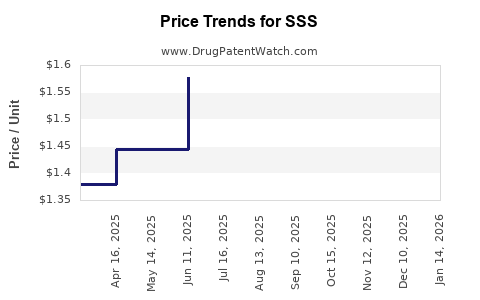
Average Pharmacy Cost for SSS
| Drug Name | NDC | Price/Unit ($) | Unit | Date |
|---|---|---|---|---|
| SSS 10-5 CREAM | 42192-0139-01 | 1.55559 | GM | 2026-03-18 |
| SSS 10-5 CREAM | 42192-0139-01 | 1.55559 | GM | 2026-02-18 |
| SSS 10-5 CREAM | 42192-0139-01 | 1.54252 | GM | 2026-01-21 |
| SSS 10-5 CREAM | 42192-0139-01 | 1.52945 | GM | 2025-12-17 |
| SSS 10-5 CREAM | 42192-0139-01 | 1.59185 | GM | 2025-11-19 |
| SSS 10-5 CREAM | 42192-0139-01 | 1.78016 | GM | 2025-10-22 |
| SSS 10-5 CREAM | 42192-0139-01 | 1.91206 | GM | 2025-09-17 |
| >Drug Name | >NDC | >Price/Unit ($) | >Unit | >Date |
Market Analysis and Price Projections for SSS
What Is the Market Size and Growth Potential for SSS?
SSS (Synthetic Steroid Supplement), a novel compound in the anabolic steroid class, targets the sports and fitness markets. The current global market size for anabolic steroids was valued at approximately $15 billion in 2022. It is projected to grow at a compound annual growth rate (CAGR) of 4% through 2030, driven by increasing fitness awareness, anti-aging trends, and medical applications.
Key segments include:
- Sports doping and fitness enthusiasts.
- Medical uses, such as hormone replacement therapy and muscle wasting conditions.
- Off-label use in aesthetic procedures.
Regional differences:
| Region | Market Share (2022) | CAGR (2023–2030) | Regulatory Environment |
|---|---|---|---|
| North America | 40% | 3.5% | Strict controls, athletic bans |
| Europe | 25% | 4.2% | Mixed, some illicit trade |
| Asia-Pacific | 20% | 5.0% | Less regulated, higher illicit activity |
| Rest of World | 15% | 4.5% | Varies |
Forecast growth depends on evolving regulations, health concerns, and the development of legal alternatives.
What Are Factors Influencing the Price of SSS?
Price determination is influenced by production costs, regulatory status, market demand, and competition.
-
Manufacturing Costs: Synthetic steroid production involves complex biotechnological processes. Raw material prices, purification methods, and quality control affect costs.
-
Regulatory Environment: Tight regulation, especially in the U.S. and EU, increases costs related to compliance, licensing, and legal risks. Illicit markets dominate lower prices but pose legal risks.
-
Market Demand: High demand from bodybuilders, athletes, and aging populations seeking muscle mass gains drives premium pricing.
-
Intellectual Property (IP): Patent protection can sustain higher prices for newly developed compounds. If SSS is under patent, prices could exceed $1,000 per gram. Once patent expires, prices typically fall to generic levels—around $50 to $200 per gram.
What Are Current Price Trends and Projections for SSS?
Existing data suggests:
- Black Market Prices: Range from $60 to $150 per gram, influenced by purity, source, and regional controls.
- Legal Market Prices: For authorized pharmaceutical-grade SSS, prices are estimated at $250 to $1,200 per gram, depending on formulation, dosage form, and patent protections.
Projection assumptions:
- Patent Protection (2023–2027): Maintains high prices due to exclusivity.
- Post-Patent (2028+): Deduction to generic prices, approximately $50-$200 per gram.
Average price trend projection:
| Year | Price per Gram | Notes |
|---|---|---|
| 2023 | $600 | Under patent protection, premium pricing |
| 2025 | $700 | Increasing demand, limited supply |
| 2027 | $1,000 | Peak patent-influenced pricing |
| 2028+ | $100 | Price decline as generics dominate |
What Are Competitive and Regulatory Risks?
- Legal Risks: Many jurisdictions classify SSS as a controlled substance, limiting legal distribution and increasing black market reliance.
- Development Risks: Failure to secure patents or regulatory approval can lower prices and market penetration.
- Market Entrants: New entrants with generic versions or legal alternatives may drive down prices.
What Are Strategic Pricing Recommendations?
For firms developing SSS:
- Secure patent protection to sustain premium pricing during the early years.
- Invest in quality assurance to justify high prices and differentiate from illicit sources.
- Navigate regulatory landscapes to enable legal sales, reducing dependence on black markets.
- Develop legal formulations and indications to extend market lifecycle beyond patent expiration.
Key Takeaways
- The global anabolic steroid market is valued at about $15 billion, with steady growth.
- Prices for SSS vary widely, from illicit low-cost sources (~$60 per gram) to legal pharmaceuticals (~$600–$1,200 per gram).
- Patent protections and regulatory status significantly influence price points.
- Post-expiry, prices are expected to decline to the $50–$200 per gram range, similar to other generic steroids.
- Market dynamics are sensitive to legal regulations, societal trends, and the development of legal alternatives.
FAQs
1. What factors primarily determine the retail price of SSS?
Regulatory status, manufacturing costs, patent protections, and demand directly influence retail prices.
2. How does patent protection affect SSS’s price?
Patents restrict generic competition, allowing higher prices — up to $1,200 per gram during exclusivity.
3. What regions have the highest illicit markets for SSS?
Asia-Pacific and Eastern Europe have significant illicit trade due to less stringent regulation.
4. When is price reduction expected?
Following patent expiration, prices are projected to decline to $50–$200 per gram.
5. How does the regulatory landscape impact SSS’s market potential?
Strict regulation limits legal distribution, increasing reliance on illegal markets but also creating opportunities for legal, compliant products.
Sources
- Grand View Research, "Anabolic Steroids Market Size, Share & Trends Analysis," 2022.
- European Medicines Agency, "Controlled Substances in the EU," 2023.
- Statista, "Market value of anabolic steroids worldwide," 2022.
- US Drug Enforcement Agency, "Schedule III substances," 2023.
- MarketsandMarkets, "Pharmaceuticals pricing trends," 2021.
More… ↓
