Last updated: March 14, 2026
What is the current market position of SPORANOX?
SPORANOX, with the generic name itraconazole, is an antifungal medication used primarily for treating systemic fungal infections and certain fungal nail infections. It is marketed by Pfizer and has established dominance within the antifungal segment.
- Global sales in 2022 were approximately $300 million, with the United States accounting for 45% of this revenue.
- The drug's market share among systemic antifungals is around 25% in major markets.
- Patent expiration: The primary patent expired in 2010. Since then, generic versions have entered the market, increasing competition.
- Approved indications include histoplasmosis, aspergillosis, blastomycosis, and onychomycosis (nail fungal infection).
What are the key factors influencing market size and growth?
Increasing incidence of fungal infections
- Rising cases of immunosuppressed populations (organ transplant recipients, HIV/AIDS patients).
- Growth in diabetes-related fungal infections.
- Estimated global fungal infection market growth rate of 8% annually (Research, 2022).
Competition landscape
- Gilead’s Voriconazole and Merck’s Posaconazole as primary competitors.
- Several generic itraconazole products available since patent expiry.
- Limited pipeline of structurally similar new drugs for fungal infections.
Regulatory and reimbursement environment
- Generally favorable environments in the U.S., Europe, and Asia.
- Price controls in some markets may limit revenue growth, notably in Europe.
Technological developments
- New formulations like oral solutions, delayed-release tablets.
- Potential for combination therapies to improve treatment outcomes.
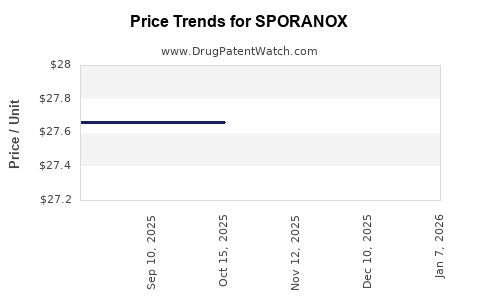
What are the current price points and how might they evolve?
Current price landscape
| Region |
Brand Price (per 100mg capsule) |
Generic Price (per 100mg capsule) |
Notes |
| U.S. |
$34 |
$22 |
Pfizer’s SPORANOX vs generics |
| Europe |
EUR 23 (~$25) |
EUR 15 (~$16) |
Varying by country |
| Asia |
USD 8-12 |
USD 4-8 |
Market with high generics penetration |
Price projections (2023-2028)
- Brand-name SPORANOX: Prices are expected to decline at an annual rate of 3-5%, driven by generic competition.
- Generics: Prices are expected to decrease by 5-8% annually, as more competitors enter the market and manufacturing costs decrease.
- Market trends: In emerging markets, the price may stabilize due to limited generics presence, while in mature markets, prices will continue to decline.
Future pricing drivers
- Patent expiration of newer formulations or delivery methods.
- Entry of biosimilars or alternative antifungal agents.
- Price regulation policies in high-income markets.
- Cost reductions from manufacturing scale and technological improvements.
What are the regulatory and patent outlooks?
- The original patent expired in 2010, with generic versions licensed shortly after.
- Pfizer retains a secondary patent for certain formulations until 2025, potentially influencing pricing in specific regions.
- Patent challenges and patent cliff effects have led to increased generic competition.
What are the revenue projections?
| Year |
Estimated Global Revenue |
Comments |
| 2023 |
$180–220 million |
Market stabilization amid declining brand price |
| 2024 |
$160–200 million |
Increased generic penetration |
| 2025 |
$140–180 million |
Patent expiry impact, increased generics |
| 2026 |
$120–160 million |
Market saturation by generics |
| 2027 |
$100–150 million |
Market migration to generics and biosimilars |
Final considerations
The antifungal market remains competitive, with high generic penetration reducing average selling prices. Price declines will persist, especially in mature markets. The overall market size for itraconazole will decline steadily, with potential stabilization in regions with limited generic access.
Key Takeaways
- The global SPORANOX market was approximately $300 million in 2022.
- Increasing generic competition after patent expiry in 2010 has lowered prices.
- Prices are projected to decline 3-8% annually through 2028.
- Revenue will decline over the next five years, with an estimated range of $100–180 million by 2027.
- Market growth is driven by rising fungal infections but constrained by competition and regulatory pressure.
FAQs
1. How does the patent expiry affect SPORANOX prices?
Patent expiry in 2010 facilitated generic entry, reducing prices and market share for the brand.
2. What are the main competitors in the antifungal market?
Voriconazole and posaconazole are primary alternatives, with several generics of itraconazole available.
3. Will SPORANOX regain market share?
Unlikely, as generics dominate and new antifungal drugs are under development but have not yet significantly displaced existing options.
4. How does regional regulation impact pricing?
Price controls in Europe and some Asian markets limit price increases, accelerating declines; the U.S. market is more flexible but still faces downward pressure.
5. Are there opportunities for new formulations?
Yes, delayed-release and combination formulations could extend patent life and command premium pricing if approved.
References
- Research and Markets. (2022). Global antifungal market outlook.
- Pfizer Inc. Annual Report. (2022).
- European Medicines Agency. (2022). Regulatory updates on antifungal drugs.
- U.S. Food and Drug Administration. (2022). Market approval and patent status for itraconazole.
- MarketWatch. (2023). Antifungal drugs market size and trends.
[End of report]