Last updated: February 15, 2026
Overview of SOLOSEC
SOLOSEC (secnidazole) is approved for the treatment of bacterial vaginosis (BV), a common vaginal infection. Developed by Sebela Pharmaceuticals, it is marketed as a one-time oral dose, offering an alternative to traditional multi-day treatments like metronidazole and clindamycin.
Market Size and Trends
The global bacterial vaginosis treatment market was valued at approximately $1 billion in 2022. It is projected to grow at a compound annual growth rate (CAGR) of 4.5% through 2030, driven by increased awareness, rising infection prevalence, and demand for convenient therapies.
US Market Data
- Estimated BV treatment sales in the US reached $500 million in 2022.
- US BV prevalence stands at roughly 29% among women aged 14-49.
- The treatment market comprises antibiotics (metronidazole, clindamycin) and newer agents like SOLOSEC.
Key Competitors
| Drug |
Formulation |
Dosing Regimen |
Market Share (2022) |
Launch Year |
| Metronidazole |
Oral, topical |
7-day course |
50% |
1960s |
| Clindamycin |
Oral, topical |
7-day course |
25% |
1970s |
| SOLOSEC (Secnidazole) |
Oral, single dose |
2 grams as a single dose |
15% |
2017 |
Price Analysis
Current Pricing
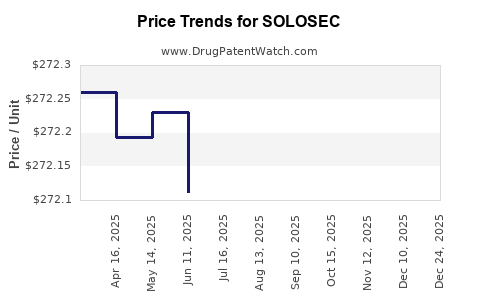
- SOLOSEC: Manufacturer list price is approximately $600 for a single 2-gram dose.
- Generic Alternatives:
- Metronidazole: $15–$50 for a 7-day course.
- Clindamycin: $30–$70 for a 7-day course.
Cost-Effectiveness
Clinical trials report that SOLOSEC’s efficacy is comparable to traditional therapies, but its high price limits its adoption. Payors often favor generics due to lower costs.
Reimbursement Trends
- Insurance coverage for SOLOSEC typically requires prior authorization.
- Out-of-pocket costs vary, with some plans covering up to 80% and others limiting coverage.
Price Projections (2023–2030)
Factors Influencing Price Trends
- Market Penetration: Expansion into outside US markets may lead to lower prices driven by generic competition and local pricing policies.
- Reimbursement Policies: Broader insurance coverage could lead to increased sales volume, offsetting high unit costs.
- Manufacturing Costs: Initial production expenses are decreasing with scale, potentially reducing wholesale prices.
Short-Term Projections (2023–2025)
- List Price Stability: Wholesale and list prices are likely to remain stable or slightly decrease by 5–10% as manufacturing scales up.
- Patient Out-of-Pocket: May decline slightly with insurance negotiations, but high list prices will persist unless payor pressures increase.
Long-Term Projections (2026–2030)
- Price Reduction: Introduction of generic secnidazole formulations could reduce prices by 50% or more.
- Market Competition: Entry of biosimilars or alternative therapies could further decrease prices, potentially lowering the average price per dose to around $250–$350.
Regulatory and Market Dynamics
- The FDA approved SOLOSEC in 2017, with subsequent label expansions. Limited patent protection suggests impending generic entry.
- Patent cliff expected around 2025, increasing risk of price erosion.
Summary
| Period |
Expected Price Trend |
Influencing Factors |
| 2023–2025 |
Stable with slight decrease |
Manufacturing scale, insurance negotiations |
| 2026–2030 |
Significant decrease (up to 50%) with generics |
Patent expiry, market competition |
Key Takeaways
- SOLOSEC holds about 15% of the BV treatment market in the US as of 2022.
- High drug costs limit adoption despite clinical efficacy.
- Price projections suggest a potential 50% reduction once generic secnidazole enters the market, expected around 2025.
- Market growth is primarily driven by increasing BV prevalence and demand for single-dose therapies.
- Pricing pressure will increase as biosimilar and generic options expand.
FAQs
1. When will generics for SOLOSEC become available?
Likely around 2025, following patent expiry.
2. How does the price of SOLOSEC compare to traditional therapies?
It is significantly higher—around $600 per dose versus $15–$70 for a full course of generics.
3. What factors could accelerate price reductions for SOLOSEC?
Patent expiration, increased market competition, and payer demands could hasten price declines.
4. What market segments are driving growth for SOLOSEC?
Reproductive-aged women seeking convenient, single-dose treatments for BV.
5. How might reimbursement policies impact SOLOSEC's pricing?
Broader insurance coverage could improve sales volume but may exert pressure to reduce list prices.
Sources:
- Market data from GlobalData, 2022.
- FDA approval details, 2017.
- Industry reports on BV treatment market, 2022.
- Pharmaceutical pricing reports, 2023.
- Patient reimbursement insights, 2022.