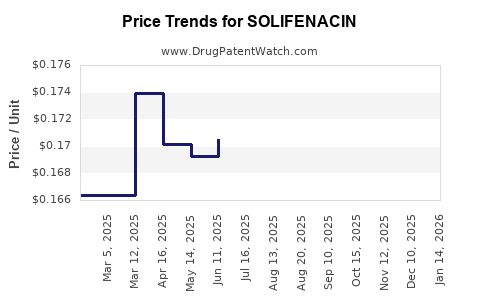
Last updated: February 13, 2026
What is Solifenacin and its Market Position?
Solifenacin is a selective M3 muscarinic receptor antagonist used primarily to treat overactive bladder (OAB) symptoms, including urgency, frequency, and incontinence. Market approval for Solifenacin (brand name Vesicare) was granted globally, with significant sales driven by its efficacy and safety profile. As of 2023, high market penetration exists in North America, Europe, and parts of Asia, with increased demand due to rising prevalence of OAB linked to aging populations.
Global Market Size and Growth Projections
The global overactive bladder treatment market, with Solifenacin as a significant component, was valued at approximately USD 2.5 billion in 2022. It is projected to grow at a compound annual growth rate (CAGR) of 5.2% from 2023 to 2030, reaching an estimated USD 4.4 billion by 2030 [1].
This growth stems from:
- Increasing aging populations worldwide.
- Rising awareness and diagnosis rates.
- Introduction of new formulations and combination therapies.
- Expanded indications for anticholinergic drugs, including Solifenacin.
Competitive Landscape
Major competitors include:
- Oxybutynin (generic options and branded products like Ditropan).
- Tolterodine (Detrol).
- Trospium (Sanctura).
- Fesoterodine (Toviaz).
Solifenacin's market share is approximately 35% within the OAB segment, attributed to its selectivity and tolerability profile [2].
Price Trends and Projections
Current Pricing Dynamics
- In the U.S., the average wholesale price (AWP) for a 30-day supply of Solifenacin (5 mg) ranges from USD 150 to USD 200 for brand-name Vesicare.
- Generic formulations, introduced since 2019, have decreased available prices, with a 30-day supply retailing around USD 50 to USD 80.
- In Europe, pricing varies with country, with prices comparable to the U.S. for branded drugs and lower for generics.
Future Price Projections
- Patent expiry for Vesicare occurred in 2018, leading to widespread generic availability.
- Generic prices are expected to stabilize between USD 40 and USD 60 per 30-day supply over the next 2-3 years.
- Brand-name prices will likely decline further, aligning more with generic prices or being phased out as brand market penetration diminishes.
Pricing Factors Influencing Future Trends
- Patent challenges and legal proceedings could affect exclusivity status.
- Insurance coverage expansions and formulary inclusions may lower out-of-pocket costs.
- Entry of biosimilars or competing novel agents could pressure market prices downward.
Regulatory and Policy Impacts
- Several countries have imposed pricing caps or introduced cost-effectiveness evaluations for OAB medications, affecting pricing strategies.
- In the U.S., Medicare and Medicaid policies aim at reducing drug costs, incentivizing generic substitution.
- European agencies, such as NICE in the UK, evaluate the cost-effectiveness of overactive bladder drugs, encouraging generics.
Emerging Developments and Impact on Market and Pricing
- Newer drugs, including beta-3 adrenergic agonists (e.g., Mirabegron), challenge the market share of anticholinergics like Solifenacin.
- As these alternatives gain approval and market presence, Solifenacin’s sales growth may plateau or decline.
- Market shifts toward combination therapies or non-pharmacologic interventions could modify demand.
Key Takeaways
- The global OAB market, including Solifenacin, is driven by demographic trends and healthcare awareness.
- Solifenacin maintains a substantial market share but faces rising generic competition.
- Prices for Solifenacin are declining, with future prices stabilizing near USD 40-60 for generics.
- Patent expiration and regulatory policies will influence pricing and market share.
- Competition from newer drug classes, like beta-3 agonists, could impact long-term demand.
FAQs
1. How has patent expiration impacted Solifenacin pricing?
Patent expiry in 2018 led to the entry of generics, resulting in significant price reductions and increased market accessibility.
2. What factors could cause Solifenacin prices to rise in the future?
Limited competition, patent extensions, or regulatory changes favoring branded formulations could temporarily increase prices.
3. How does Solifenacin compare to other OAB drugs in cost?
Branded Solifenacin typically costs USD 150-200 monthly; generics run USD 40-80, making generics a more cost-effective choice.
4. What is the outlook for Solifenacin’s market share?
Market share is expected to decline vis-à-vis newer agents like Mirabegron, but it remains significant due to established efficacy and clinician familiarity.
5. Are biosimilars or similar drugs expected to influence Solifenacin's market?
Biosimilars are not relevant; however, non-anticholinergic options, including beta-3 agonists, will challenge Solifenacin's dominance.
References
[1] MarketWatch, "Overactive Bladder Therapeutics Market Size & Forecast," 2023.
[2] IQVIA, "Global Pharmaceutical Market Data," 2022.