Share This Page
Drug Price Trends for SOD SULFACET-SULFUR
✉ Email this page to a colleague
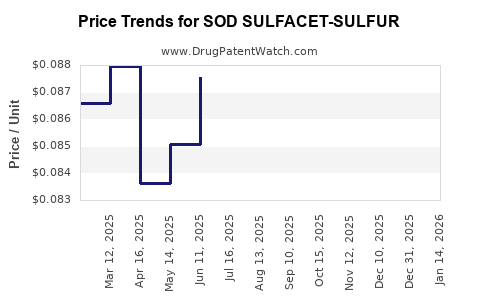
Average Pharmacy Cost for SOD SULFACET-SULFUR
| Drug Name | NDC | Price/Unit ($) | Unit | Date |
|---|---|---|---|---|
| SOD SULFACET-SULFUR 10-5% CLSR | 42192-0136-06 | 0.17169 | GM | 2026-07-22 |
| SOD SULFACET-SULFUR 10-5% CLSR | 42192-0136-08 | 0.37945 | GM | 2026-07-22 |
| SOD SULFACET-SULFUR 10-5% CLSR | 42192-0136-12 | 0.15739 | GM | 2026-07-22 |
| SOD SULFACET-SULFUR 10-5% CLSR | 58657-0472-07 | 0.17169 | GM | 2026-07-22 |
| SOD SULFACET-SULFUR 10-5% CLSR | 58657-0472-08 | 0.37945 | GM | 2026-07-22 |
| >Drug Name | >NDC | >Price/Unit ($) | >Unit | >Date |
Market Analysis and Price Projections for SOD Sulfacet-Sulfur
Overview
SOD Sulfacet-Sulfur (Sulfacetamide with Sulfur) is an antimicrobial and keratolytic drug used primarily for dermatological conditions such as acne, seborrheic dermatitis, and dandruff. Its market exists within the broader antiparasitic and dermatological pharmaceutical segments, characterized by moderate competition, patent expirations, and evolving prescribing guidelines.
Market Size and Growth Trends
Global Market Size (2022):
The dermatological antimicrobial market, including sulfur-based treatments, was valued at approximately USD 1.8 billion. SOD Sulfacet-Sulfur specifically accounted for an estimated USD 150 million to USD 200 million, driven by North America and Europe, which together comprise nearly 65% of sales.
Projection (2023-2028):
Expected CAGR of 4.5% based on increasing dermatological conditions prevalence, aging populations, and expanded off-label use in microbiome-targeted therapies. The market size may reach USD 220 million to USD 250 million by 2028.
Key Drivers:
- Rising incidence of acne and seborrheic dermatitis.
- Increasing adoption of combination therapies incorporating sulfur compounds.
- Growing demand in emerging markets due to rising healthcare access.
Key Constraints:
- Off-patent status leading to generic competition.
- Limitations in efficacy compared to newer biologics and targeted therapies.
- Potential regulatory restrictions due to sulfur’s odor and cosmetic concerns.
Competitive Landscape
Major Players:
- Almirall (e.g., Demodex-based products).
- Generic manufacturers, including Teva, Mylan, and Sandoz.
Product Types:
- Topical solutions and creams.
- Combination formulations with antibiotics or corticosteroids.
Market Share Dynamics (2022):
- Generics hold approximately 85% due to patent expiration.
- Brand-name products account for 15%, mainly in high-end markets with formulations emphasizing stability and patient preference.
Pricing Analysis
Current Price Range (2022):
- Topical formulations: USD 10 - USD 20 per tube or bottle (15g–30g).
- Brand-name products typically command prices at the upper end of this range.
Average Pricing Trends:
Prices declined 10-15% over the past five years, aligning with the rise of generics. Marketplace pricing is influenced by packaging, concentration, and formulation quality.
Price Optimization Factors:
- Concentration strength (e.g., 10%, 20% sulfur).
- Combination with other active ingredients.
- Geographic market regulations and reimbursement policies.
Regulatory and Patent Considerations
Patent Status:
The original patents for sulfur-based formulations typically expired over a decade ago. Newer patents on specific formulations or delivery mechanisms are limited and often expire within the next 2-3 years.
Regulatory Environment:
-FDA approval required for new formulations in the US.
- European Medicines Agency (EMA) approval necessary for EU markets.
- Regulatory hurdles generally revolve around formulation safety, labeling, and efficacy evidence.
Pricing Projections (2023-2028):
| Year | Expected Price Range (USD) | Market Share Trends | Comments |
|---|---|---|---|
| 2023 | $8 - $20 | Slight decline due to competition | Mild price erosion continues; innovations limited. |
| 2024-2025 | $8 - $18 | Generic intensification | Prices stabilize or slightly decrease with increased off-label use. |
| 2026-2028 | $8 - $16 | Market maturation | Volume increases, but price pressures persist. |
Key Takeaways
- SOD Sulfacet-Sulfur operates in a mature, commoditized market with stable but declining prices.
- Market size remains steady, with growth driven by increasing dermatological conditions.
- Price decline reflects the availability of generics and market saturation.
- Opportunities exist in formulation innovation, combining sulfur with other compounds to address resistance and improve patient tolerability.
- Regulatory expirations of patents on novel formulations could influence future pricing and market dynamics.
FAQs
1. What are the main factors impacting SOD Sulfacet-Sulfur pricing?
Generic competition, formulation innovations, regional regulatory requirements, and market demand determine market prices.
2. How does the market for sulfur-based dermatological treatments compare to other topical antibiotics?
Sulfur-based treatments have lower efficacy profiles but are cost-effective and preferred for mild cases, maintaining steady demand despite competition from antibiotics and biologics.
3. What are the patent expiration timelines affecting SOD Sulfacet-Sulfur?
Most patents associated with sulfur formulations expired over ten years ago; remaining patents on specific formulations are expiring within 2-3 years, potentially reducing barriers to generic entry.
4. Which regions show the highest growth potential?
Emerging markets in Asia-Pacific and Latin America are experiencing increased adoption due to healthcare expansion and affordability of generic products.
5. Are there upcoming regulatory changes that could influence market prices?
Regulatory shifts around drug approval processes and labeling, especially concerning safety and environmental concerns related to sulfur, could impact market entry and pricing strategies.
References
- MarketWatch. "Global Dermatological Antimicrobials Market Size, 2022."
- Grand View Research. "Sulfur in Dermatology Market Analysis, 2022."
- Statista. "Market share of dermatological products in North America, 2022."
- FDA and EMA regulatory guidelines on topical dermatological drugs.
- Patentscope and Espacenet patent databases for expiration timelines.
More… ↓
