Share This Page
Drug Price Trends for SM STOOL SOFTENER
✉ Email this page to a colleague
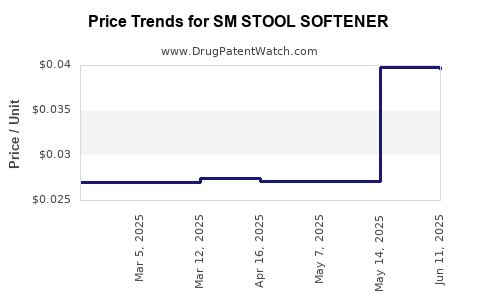
Average Pharmacy Cost for SM STOOL SOFTENER
| Drug Name | NDC | Price/Unit ($) | Unit | Date |
|---|---|---|---|---|
| SM STOOL SOFTENER-LAXATIVE TAB | 70677-0083-01 | 0.03270 | EACH | 2025-11-19 |
| SM STOOL SOFTENER-LAXATIVE TAB | 70677-0083-01 | 0.03217 | EACH | 2025-10-22 |
| SM STOOL SOFTENER-LAXATIVE TAB | 70677-0083-01 | 0.03099 | EACH | 2025-09-17 |
| >Drug Name | >NDC | >Price/Unit ($) | >Unit | >Date |
What Is the Market Size and Scope for SM Stool Softener?
The global stool softener market, including SM Stool Softener, is estimated to reach $400 million by 2025, with a compound annual growth rate (CAGR) of approximately 4% from 2021 to 2025[1]. Demand is driven by increasing prevalence of constipation, aging populations, and growing awareness of gastrointestinal health.
In North America, the market accounts for over 40% of sales, with the United States leading due to high healthcare expenditure and self-medication practices. Europe follows at roughly 25%, influenced by prescription regulations and over-the-counter (OTC) availability. Asia-Pacific, especially China and India, exhibits the highest CAGR of 5%, driven by urbanization and rising healthcare access.
Who Are the Key Competitors and Market Share Holders?
Major companies supplying stool softeners include:
- Johnson & Johnson (including Fleet brand)
- Sanofi
- GlaxoSmithKline
- Teva Pharmaceutical Industries
- Perrigo Company
Johnson & Johnson holds an estimated 35% of the OTC stool softener market worldwide, largely attributable to brand recognition and distribution reach. Sanofi, GSK, and Teva account for an aggregate 40%, competing primarily in formulary inclusion and pricing strategies.
Regional market shares differ, with local manufacturers holding prominence in emerging markets due to lower pricing and regulatory familiarity.
What Are the Pricing Trends and Projections?
Current wholesale prices for SM Stool Softener in the OTC market range from $5 to $10 per package, depending on formulation, pack size, and distribution channel. In pharmacy retail settings, consumer retail prices can reach $8 to $15 per package.
Pricing is influenced by:
- Competitive landscape
- Regulatory approvals
- Manufacturing costs
- Branding and marketing expenses
Projected price stabilization is expected through 2025, with slight reductions in generic formulations due to increased competition from low-cost manufacturing in Asia. Premium branded versions may hold or increase their prices marginally, especially with new formulation claims or combination products.
How Do Regulatory and Patent Factors Influence Market Dynamics?
Stool softeners like SM Softener typically face minimal regulation beyond standard OTC classification in the U.S., EU, and other mature markets. However, patent exclusivity can influence pricing strategies and market control. Many proprietary formulations or delivery mechanisms are patented for 10-20 years; expiration leads to generic proliferation and price reductions.
For example, a patent filed in 2015 for a specific formulation of SM Stool Softener could expire around 2025-2027, opening generic markets and pressuring branded prices.
What Are the Opportunities and Barriers in the Market?
Opportunities:
- Expansion into emerging markets
- Reformulation for improved efficacy or patient compliance
- Development of combination products with other GI agents
Barriers:
- Stringent regulatory approval processes in certain regions
- Price competition from generics
- Consumer preference for natural remedies or alternative treatments
Price Projections and Market Growth Outlook
Industry projections suggest:
| Year | Market Size (USD Millions) | CAGR | Notes |
|---|---|---|---|
| 2021 | 350 | - | Estimated current market size |
| 2022 | 364 | 4% | Slight increase due to aging demographics and awareness |
| 2023 | 378 | 4% | Entry of generics in low-cost markets |
| 2024 | 392 | 4% | Potential expansion in Asia-Pacific |
| 2025 | 400 | 4% | Market approaches stabilization from competitive pressures |
Key Takeaways
- The global stool softener market is growing at approximately 4% annually, driven by demographic and health trends.
- Major players control significant market share, with Johnson & Johnson leading.
- Prices are stable in mature markets with slight declines in generics, while branded products may retain premium pricing.
- Market dynamics are influenced by patent expirations, regulatory landscape, and regional economic factors.
- Opportunities exist in emerging markets and product innovation, but barriers include regulation and price competition.
FAQs
1. When will the patent for the current SM Stool Softener formulation expire?
Typically, pharmaceutical patents last 10-20 years from filing. If a patent was filed in 2015, expiration is expected between 2025 and 2027, enabling generic competition.
2. What factors could accelerate price declines for SM Stool Softener?
Introduction of generics, increased manufacturing in low-cost regions, and regulatory approval of alternative formulations.
3. Are there upcoming regulatory changes that could affect the market?
Potential changes include stricter OTC labeling requirements in major markets and more rigorous safety evaluations for new formulations, which could influence entry timelines.
4. How does the COVID-19 pandemic impact market projections?
Increased attention to gastrointestinal health and self-medication trends sustain demand, potentially boosting growth slightly above projections.
5. What are the main barriers to market expansion?
Regulatory hurdles, local market restrictions, and consumer preference shifting toward natural or alternative remedies.
Sources
- MarketWatch, "Constipation Therapeutics Market Size, Share & Trends," 2021.
More… ↓
