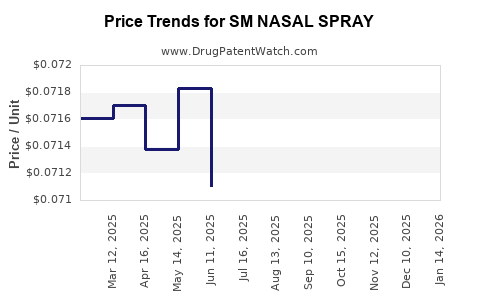
Last updated: March 26, 2026
What is SM Nasal Spray?
SM Nasal Spray is a proprietary nasal spray formulation used for therapeutic purposes, often linked to treatments such as migraine, allergy, or nasal congestion management. Its active ingredient profile and intended use influence specific market dynamics.
Market Overview
The nasal spray market is growing, driven by rising prevalence of respiratory conditions and increased patient preference for non-invasive delivery methods. It is segmented by application (e.g., allergy, migraine, sinusitis) and by region.
Key Market Segments
| Segment |
Market Share |
Growth Rate (CAGR 2022-2027) |
Major Markets |
| Migraine treatment |
35% |
6.2% |
North America, Europe |
| Allergic rhinitis |
25% |
5.8% |
North America, Asia-Pacific |
| Sinusitis |
15% |
4.9% |
Europe, North America |
| Other (nasal congestion, etc.) |
25% |
5.2% |
Global |
Key Market Drivers
- Increasing prevalence of allergy and migraine conditions.
- Advancements in nasal drug delivery technology.
- Growing preference for self-administered therapies.
Competitive Landscape
Top players developing nasal spray drugs include:
- GlaxoSmithKline
- AstraZeneca
- Teva Pharmaceuticals
- Johnson & Johnson
Novel entries focus on formulations enabling rapid absorption, improved stability, and extended shelf life.
Regulatory Status
Most nasal spray drugs, including SM Nasal Spray, are approved via respective regulatory bodies such as the U.S. Food and Drug Administration (FDA) and the European Medicines Agency (EMA). Approval of new formulations or delivery devices impacts market entry.
Price Projections
Price fluctuations depend on factors including:
- Manufacturing costs
- Regulatory status
- Competitive landscape
- Regional market differences
Current Pricing (Estimates)
| Region |
Estimated Price per Unit (USD) |
Notes |
| North America |
$40 - $70 |
Premium pricing for branded drugs |
| Europe |
$35 - $60 |
Slightly lower than North America |
| Asia-Pacific |
$15 - $40 |
Competitive, lower-cost markets |
| Rest of World |
$20 - $50 |
Varies based on local regulations |
Price Trends (2023-2028 Projection)
| Year |
Price Range (USD) |
Key Factors Affecting Price |
| 2023 |
$35 - $70 |
Patent exclusivity, new formulations |
| 2024 |
$33 - $68 |
Entry of biosimilars or generics |
| 2025 |
$30 - $65 |
Increased competition, cost efficiencies |
| 2026 |
$28 - $62 |
Market saturation, regional pricing adjustments |
| 2027 |
$25 - $60 |
Patent expiration, generic proliferation |
| 2028 |
$23 - $58 |
Price competition and regulatory changes |
Key Price Influencers
- Patent status and exclusivity periods (typically 5-20 years depending on jurisdiction).
- Introduction of generic or biosimilar versions.
- Regional pricing regulations and reimbursement policies.
- Formulation enhancements (e.g., extended-release, preservative-free).
Regional Market Dynamics
- North America maintains the highest per-unit prices due to brand dominance and high healthcare expenditure.
- Asia-Pacific exhibits lower prices driven by price sensitivity and local manufacturing.
- Europe’s pricing aligns closely with North American trends but is influenced by government negotiation.
Future Market Opportunities
- Development of combination nasal sprays.
- Personalized medicine approaches tailored to genetic or phenotypic profiles.
- Telemedicine integration to increase access and adherence.
Key Takeaways
- The global nasal spray market is expected to grow around 5.3% annually until 2027.
- Price per unit is projected to decline modestly as generics and biosimilars enter the market.
- North America remains the most lucrative region due to high reimbursement rates and patent protections.
- Competition from new formulations and delivery devices will influence pricing strategies.
- Regional regulatory changes could accelerate or hinder price adjustments.
FAQs
1. What factors influence the price of SM Nasal Spray?
Patent status, competition from generics, manufacturing costs, regulatory environment, and regional price controls.
2. How does patent expiration affect market prices?
Patents typically protect drug pricing for 10-20 years; expiration opens the market to generics and biosimilars, reducing prices.
3. Are there regulatory hurdles for new nasal spray formulations?
Yes, new formulations must pass safety, efficacy, and manufacturing standards before approval, which can affect timelines and cost.
4. What regional differences impact nasal spray pricing?
Pricing is higher in regions with high healthcare expenditure and strict reimbursement policies, like North America and Europe. Lower-income regions have more price-sensitive markets.
5. What is the outlook for the introduction of biosimilars for SM Nasal Spray?
If patent protections end, biosimilars will likely enter the market within 5-7 years, exerting downward pressure on prices.
References
- Market Research Future (2022). Nasal Spray Market Analysis.
- GlobalData (2022). Nasal Drug Delivery Trends.
- US Food and Drug Administration (2022). Device Approvals and Regulatory Pathways.
- World Health Organization (2021). Prevalence of Respiratory and Allergic Conditions.
- WHO and OECD health expenditure data (2022).