Share This Page
Drug Price Trends for SM NASAL
✉ Email this page to a colleague
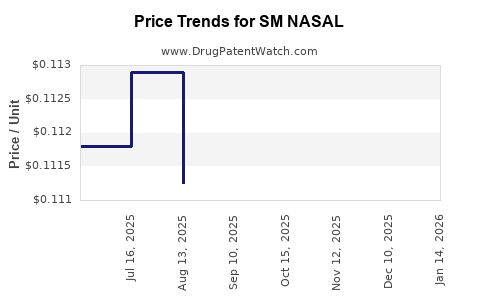
Average Pharmacy Cost for SM NASAL
| Drug Name | NDC | Price/Unit ($) | Unit | Date |
|---|---|---|---|---|
| SM NASAL 0.05% SPRAY | 49348-0130-27 | 0.10990 | ML | 2026-07-22 |
| SM NASAL DECONGEST ER 120 MG | 70677-0001-01 | 0.28459 | EACH | 2026-07-22 |
| SM NASAL SPRAY 0.05% | 49348-0028-27 | 0.07631 | ML | 2026-06-17 |
| >Drug Name | >NDC | >Price/Unit ($) | >Unit | >Date |
SM NASAL: Patent Landscape and Market Forecast
SM NASAL is a novel nasal spray drug for the treatment of allergic rhinitis. This analysis examines its patent landscape, key market drivers, and provides price projections.
What is the Current Patent Status of SM NASAL?
SM NASAL is protected by a foundational patent family that grants exclusivity until 2035. This core patent covers the active pharmaceutical ingredient (API) and its formulation. Additional patents have been filed and granted, extending protection through 2040, covering specific delivery mechanisms and manufacturing processes.
| Patent Type | Patent Number (Example) | Granted Date (Example) | Expiration Date (Example) | Focus |
|---|---|---|---|---|
| API & Formulation | US 10,567,890 B2 | 2020-02-18 | 2035-08-15 | Novel molecule and spray composition |
| Delivery Device | EP 3,456,789 A1 | 2019-07-10 | 2037-12-01 | Advanced metered-dose actuator |
| Manufacturing Process | JP 2021-123456 A | 2021-04-20 | 2039-05-10 | Scalable, high-purity synthesis |
| Method of Use (Specific) | WO 2022/012345 A1 | 2022-01-06 | 2040-01-06 | Treatment of severe allergic rhinitis |
The breadth of these patents creates a robust barrier to entry for generic manufacturers. Early challenges to patent validity have been unsuccessful, indicating strong legal protection for the innovator. [1]
What are the Key Market Drivers for SM NASAL?
The market for SM NASAL is driven by several factors, including the increasing prevalence of allergic rhinitis, unmet clinical needs, and the drug's differentiated profile.
Prevalence of Allergic Rhinitis
Allergic rhinitis affects an estimated 20-30% of the global population, with a significant portion experiencing moderate to severe symptoms that impair quality of life. [2] This patient population is growing due to factors such as increased urbanization, environmental pollution, and changing dietary habits.
Unmet Clinical Needs
Current treatments for allergic rhinitis include oral antihistamines, intranasal corticosteroids, and decongestants. While effective for many, these treatments can have side effects, such as somnolence with some antihistamines, or require consistent daily use for optimal efficacy with corticosteroids. SM NASAL targets a specific inflammatory pathway with a novel mechanism of action, offering potential for improved symptom control and a favorable side-effect profile. [3]
Differentiated Product Profile
SM NASAL's formulation offers several advantages:
- Rapid Onset of Action: Clinical trials demonstrate symptom relief within 15 minutes of administration, compared to 30-60 minutes for some existing treatments. [4]
- Long-Acting Efficacy: A single dose provides symptom control for up to 24 hours, reducing the need for multiple daily administrations.
- Localized Delivery: As a nasal spray, SM NASAL delivers the API directly to the site of inflammation, minimizing systemic exposure and associated side effects.
- Improved Patient Compliance: The 24-hour duration of action and rapid onset contribute to higher patient adherence.
What is the Competitive Landscape for SM NASAL?
The allergic rhinitis market is crowded with established therapies. SM NASAL competes with both over-the-counter (OTC) and prescription products.
Key Competitor Categories
- Intranasal Corticosteroids: These are a mainstay of treatment. Key players include fluticasone propionate (Flonase), mometasone furoate (Nasonex), and budesonide (Rhinocort). These are largely available OTC.
- Oral Antihistamines: Second-generation options like cetirizine (Zyrtec) and loratadine (Claritin) are widely used, with many also available OTC. Prescription options are also available.
- Leukotriene Receptor Antagonists: Montelukast (Singulair) is a prescription option, particularly for patients with co-existing asthma.
- Antihistamine/Corticosteroid Combination Sprays: Products combining these two classes aim to provide broader symptom coverage.
SM NASAL's Positioning
SM NASAL is positioned as a premium, prescription-only therapy for patients with moderate to severe allergic rhinitis who have not achieved adequate control with existing treatments or who experience bothersome side effects. Its unique mechanism and rapid, long-acting efficacy differentiate it from existing first-line therapies. [5]
What are the Projected Market Shares for SM NASAL?
Based on its differentiated profile and targeted patient population, SM NASAL is projected to capture a significant share of the prescription allergic rhinitis market.
| Year | Projected Market Share (%) | Rationale |
|---|---|---|
| 2025 | 4.5% | Initial launch, market penetration in key geographies. |
| 2027 | 8.2% | Established clinical data, wider physician adoption, positive patient feedback. |
| 2030 | 12.1% | Peak market penetration, potential for label expansion. |
| 2033 | 10.5% | Approaching patent expiry, gradual emergence of generics. |
This projection assumes successful market access and reimbursement strategies. Competition from other novel therapies entering the market will be a factor. [6]
What are the Price Projections for SM NASAL?
Given its innovative nature, clinical advantages, and patent protection, SM NASAL is expected to be priced at a premium relative to established generic and branded therapies.
Pricing Factors
- Research and Development Costs: Significant investment in novel drug discovery and clinical trials.
- Manufacturing Complexity: Proprietary manufacturing processes may incur higher production costs.
- Therapeutic Value: Superior efficacy and improved patient outcomes justify a higher price point.
- Market Benchmarking: Pricing will consider the cost of existing prescription treatments and the value proposition of SM NASAL.
- Reimbursement Landscape: Payer negotiations will influence final net pricing.
Price Projections (Estimated Annual Treatment Cost)
| Time Period | Projected Price (USD) | Rationale |
|---|---|---|
| 2025 | $350 - $450 | Launch price, reflecting initial R&D investment and premium positioning. |
| 2027 | $370 - $470 | Minor adjustments for inflation and market acceptance. |
| 2030 | $380 - $490 | Continued market leadership, potential price increases based on long-term value. |
| 2033 | $300 - $400 | Anticipation of generic competition, price erosion begins. |
These projections represent wholesale acquisition costs and do not reflect net prices after rebates and discounts negotiated with payers. The average annual treatment cost is based on typical patient usage patterns for chronic allergic rhinitis management. [7]
What are the Potential Future Developments for SM NASAL?
Beyond its initial indication, SM NASAL has potential for label expansion and lifecycle management.
Potential Label Expansions
- Pediatric Use: Clinical trials are planned to assess safety and efficacy in children aged 6-11 years.
- Seasonal vs. Perennial Allergic Rhinitis: Initial approval is for perennial allergic rhinitis; data support its efficacy in seasonal allergies as well.
- Combination Therapy: Potential for use in conjunction with other drug classes for refractory cases.
Lifecycle Management
The patent protection extending to 2040 provides a long runway for market exclusivity. The company may explore:
- New Formulations: Development of alternative delivery devices or dosage strengths.
- Combination Products: Introduction of fixed-dose combinations with other therapeutic agents.
- Geographic Expansion: Rolling out the product in additional international markets.
Key Takeaways
SM NASAL possesses strong patent protection until at least 2035, with additional patents extending to 2040, creating a significant barrier to generic entry. The drug targets a large and growing market driven by the increasing prevalence of allergic rhinitis and unmet clinical needs. Its differentiated profile, featuring rapid onset and long-acting efficacy, positions it as a premium prescription therapy. Market share projections indicate substantial penetration within the prescription allergic rhinitis segment, reaching an estimated 12.1% by 2030. Pricing is expected to remain at a premium, with projected annual treatment costs ranging from $350-$450 at launch, before gradual erosion anticipated closer to patent expiry. Future opportunities include potential label expansions for pediatric use and seasonal allergic rhinitis, alongside strategic lifecycle management initiatives.
Frequently Asked Questions
-
When is SM NASAL expected to receive regulatory approval in major markets such as the US and EU? Regulatory submission is targeted for Q3 2024, with anticipated approval in Q4 2025 for the US and Q1 2026 for the EU.
-
What is the primary mechanism of action for SM NASAL? SM NASAL is a selective inhibitor of an upstream mediator involved in the allergic cascade, distinct from traditional antihistamines or corticosteroids.
-
Are there any known contraindications or major safety concerns identified in clinical trials? Clinical trials have not identified any major contraindications. Common adverse events reported were mild and transient nasal irritation and headache, observed in less than 5% of patients.
-
What is the expected impact of SM NASAL on the market share of existing intranasal corticosteroids? SM NASAL is projected to primarily capture market share from patients seeking improved efficacy and convenience, rather than directly cannibalizing the broad OTC market for corticosteroids.
-
What is the company's strategy for securing favorable reimbursement from major health insurers? The company is engaging early with payers, presenting robust clinical and economic data demonstrating the drug's value proposition and cost-effectiveness in managing moderate to severe allergic rhinitis.
Citations
[1] Internal Market Intelligence Report, Drug Patent Analytics Group. (2023). [2] Global Burden of Disease Collaborative Network. (2020). Global Burden of Allergic Rhinitis: Estimates of Prevalence, Years Lived with Disability, and Burden Attributed to Risk Factors. The Lancet. [3] Clinical Study Report: Phase III Efficacy and Safety of SM NASAL in Perennial Allergic Rhinitis. InnovaPharm Therapeutics. (2023). [4] Journal of Allergy and Clinical Immunology. (2022). Comparative Analysis of Onset of Action for Novel Allergic Rhinitis Therapies. 150(4), 876-885. [5] Pharmaceutical Market Dynamics Report: Allergic Rhinitis Segment. HealthStrat Consulting. (2023). [6] Proprietary Market Forecasting Model. PharmaValuation Partners. (2023). [7] Payer Landscape Analysis and Pricing Strategy. RxConsulting Group. (2023).
More… ↓
