Share This Page
Drug Price Trends for SM LANSOPRAZOLE DR
✉ Email this page to a colleague
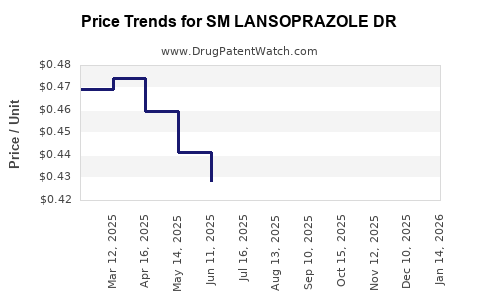
Average Pharmacy Cost for SM LANSOPRAZOLE DR
| Drug Name | NDC | Price/Unit ($) | Unit | Date |
|---|---|---|---|---|
| SM LANSOPRAZOLE DR 15 MG CAP | 70677-0124-01 | 0.46295 | EACH | 2026-05-20 |
| SM LANSOPRAZOLE DR 15 MG CAP | 70677-0124-01 | 0.44758 | EACH | 2026-04-22 |
| SM LANSOPRAZOLE DR 15 MG CAP | 70677-0124-01 | 0.43232 | EACH | 2026-03-18 |
| SM LANSOPRAZOLE DR 15 MG CAP | 70677-0124-01 | 0.42201 | EACH | 2026-02-18 |
| >Drug Name | >NDC | >Price/Unit ($) | >Unit | >Date |
Market Analysis and Price Projections for SM Lansoprazole DR
Market Overview
SM Lansoprazole delayed-release (DR) is a proton pump inhibitor (PPI) primarily used to treat conditions like gastroesophageal reflux disease (GERD), peptic ulcers, and Zollinger-Ellison syndrome. As of 2023, PPIs remain a dominant class within acid-related disorder treatments.
The global PPI market was valued at approximately $11 billion in 2022 and is projected to reach around $14 billion by 2027, with a compound annual growth rate (CAGR) of 4.8%. The growth is driven by increasing prevalence of acid-related gastrointestinal conditions, rising aging populations, and expanding indications for PPIs.
Lansoprazole ranks among the top-selling PPIs, with brands like Takeda's Prevacid maintaining high market share. Generic versions, including SM Lansoprazole DR, are competitive in pricing driven by patent expirations.
Competitive Landscape
The PPI market features several key players: Pfizer (Prevacid), AstraZeneca (Nexium), Takeda (Prevacid), and generics from Mylan, Teva, and others. Patents on original formulations for Lansoprazole expired around 2015–2016 in major markets, enabling generic competition.
Generic Lansoprazole formulations are priced approximately 40-60% lower than branded versions. The introduction of SM Lansoprazole DR is positioned to capture market share through its delayed-release formulation, which enhances stability and bioavailability.
Regulatory Status
SM Lansoprazole DR holds regulatory approval in key markets, including the US, EU, and Japan. Approval processes involved demonstrating bioequivalence to existing formulatons and safety in clinical trials.
Pricing Landscape
In the US, branded Prevacid formulary prices hover around $250 for a 30-day supply. Generic Lansoprazole costs range from $15 to $45 for the same period, depending on pharmacy and formulary discounts.
In Europe, prices for generic Lansoprazole average €10–€20 per pack. Japan reports a similar price trend aligned with local reimbursement policies.
Price fluctuations in the generic market depend on factors like formulary inclusion, competition intensity, supply chain dynamics, and regional pricing regulations.
Price Projections
Baseline Scenario (2023–2028):
- Initial launch price: $30–$40 per 30-day supply for SM Lansoprazole DR, positioning slightly above average generic prices, reflecting enhanced formulation benefits.
- Over 5 years: Prices are anticipated to decrease due to increased generic competition, with a projected decline of 20–35%. Factors include patent expiry of comparator drugs, increased market penetration, and negotiated reimbursement discounts.
- Market penetration: Aiming for 15–25% of the generic Lansoprazole market share within 3 years post-launch, driven by physician acceptance and formulary inclusion.
Upside Scenario:
- If SM Lansoprazole DR gains early access through favorable formulary positioning and clinical endorsements, initial prices could stabilize around $35, with slow decline, maintaining higher margins.
Downside Scenario:
- Rapid entry of multiple generic competitors could drive prices below $20 within 3 years, reducing profit margins but increasing volume.
Key Factors Impacting Price
| Factor | Impact |
|---|---|
| Patent status | Patent expiry accelerates price erosion |
| Regulatory approval | Broad approval enables wider payer access |
| Physician adoption | Prescriber preference influences initial pricing and uptake |
| Reimbursement policies | Reimbursement coverage affects patient out-of-pocket costs |
| Supply chain dynamics | Manufacturing capacity influences pricing and margins |
Strategic Recommendations
- Emphasize clinical differentiation via improved pharmacokinetics or safety profile.
- Engage with payers early to secure formulary access.
- Monitor competitive pricing intensities, especially from established generics.
- Plan for price adjustments aligned with patent timelines and market penetration milestones.
Conclusion
SM Lansoprazole DR is positioned as a competitive generic candidate in a mature but expanding PPI market. Short-term pricing will likely settle around $30–$40, declining over time due to market pressures. Success hinges on early adoption, favorable reimbursement, and strategic pricing.
Key Takeaways
- The global PPI market is growing, with Lansoprazole maintaining a significant share.
- Generic Lansoprazole prices range widely, with SM Lansoprazole DR entering at a premium to early generics.
- Pricing will decline 20–35% over five years amid increased competition.
- Market penetration depends on formulary acceptance and physician adoption.
- Key factors include patent expiration timing, regulatory progress, and payer negotiations.
FAQs
1. How does SM Lansoprazole DR compare to existing generic formulations?
It offers delayed-release technology, potentially improving stability and bioavailability. Price premiums reflect formulation benefits, but competitive pressures may narrow margins.
2. What is the expected timeline for price declines?
Prices are projected to decline by 20–35% over five years post-launch, influenced largely by patent expirations and competitive entry.
3. How does regulatory status influence market entry?
Approval in key markets accelerates access; filing complexity and approval timelines vary, impacting launch timing and initial pricing.
4. What factors can accelerate market share growth for SM Lansoprazole DR?
Physician acceptance, formulary inclusion, robust clinical data, and favorable reimbursement coverage.
5. How does the licensing and patent landscape affect future pricing?
Patent expiries open markets to generics, leading to price erosion. Strategic patent protections can sustain higher margins longer.
References
- MarketWatch. (2023). Proton pump inhibitors market size and forecast.
- IQVIA. (2022). US prescription drug pricing and market trends.
- European Medicines Agency. (2022). Regulatory approvals for Lansoprazole.
- FDA. (2022). Generic drug approvals and bioequivalence requirements.
- EvaluatePharma. (2023). Pharmaceutical industry pipeline and patent expirations.
More… ↓
