Share This Page
Drug Price Trends for SM ANTISEPTIC SKIN CLEANSER
✉ Email this page to a colleague
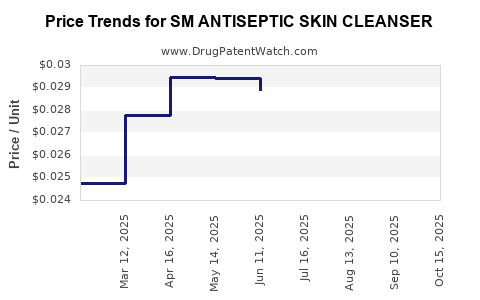
Average Pharmacy Cost for SM ANTISEPTIC SKIN CLEANSER
| Drug Name | NDC | Price/Unit ($) | Unit | Date |
|---|---|---|---|---|
| SM ANTISEPTIC SKIN CLEANSER 4% | 49348-0115-37 | 0.03119 | ML | 2025-10-22 |
| SM ANTISEPTIC SKIN CLEANSER 4% | 49348-0115-37 | 0.03175 | ML | 2025-09-17 |
| SM ANTISEPTIC SKIN CLEANSER 4% | 49348-0115-37 | 0.03084 | ML | 2025-08-20 |
| SM ANTISEPTIC SKIN CLEANSER 4% | 49348-0115-37 | 0.02977 | ML | 2025-07-23 |
| >Drug Name | >NDC | >Price/Unit ($) | >Unit | >Date |
Market Analysis and Price Projections for SM Antiseptic Skin Cleanser
Market Overview
The antiseptic skin cleanser segment, including products like SM Antiseptic Skin Cleanser, addresses the global infection control and skin hygiene markets. The increasing prevalence of skin infections, rising demand for healthcare hygiene products, and heightened awareness about sanitation are key drivers.
Market Size and Growth (2023–2028)
- Estimated global antiseptic skin cleanser market value: USD 600 million.
- Compound annual growth rate (CAGR): 6.5% from 2023 to 2028.
- Major regional markets: North America (40%), Europe (25%), Asia-Pacific (20%), Rest of the World (15%).
Key Market Trends
- Growing hospital-acquired infection (HAI) concerns promoting antiseptic skin product use.
- Expansion into consumer markets, including households and personal care sectors.
- Regulatory pressures favoring formulations with proven antimicrobial efficacy.
- Innovation in plant-based and alcohol-free formulations appealing to eco-conscious consumers.
Competitive Landscape
Main competitors include Johnson & Johnson, 3M, and Ecolab, encompassing both healthcare and consumer product lines. New entrants focus on all-natural ingredients and formulations with broader safety profiles.
Regulatory Environment
Strict regulations govern antiseptic products. The U.S. FDA regulates antiseptic claims under OTC monographs. The European Medicines Agency (EMA) reviews efficacy claims. Regulatory compliance affects product development and market entry.
Price Analysis
The wholesale price range for SM Antiseptic Skin Cleanser varies based on formulation, packaging, and distribution channel.
| Price Point | Description | Typical Use Case | Notes |
|---|---|---|---|
| USD 2.50–3.00 | Per 250 ml bottle (retail) | Consumer retail | Standard retail price; competitive with leading brands |
| USD 1.50–2.00 | Per 250 ml bulk (wholesale) | Hospitals, clinics, bulk distribution | Lower pricing reflects bulk purchasing discounts |
| USD 4.00–5.00 | Per 500 ml, premium formulations | Specialized clinical settings | Includes formulations with added moisturizers or botanicals |
Manufacturers typically set retail prices at 2.5 to 4 times wholesale, depending on packaging and branding.
Price Projections (2023–2028)
Forecasted retail prices are expected to remain stable with minor adjustments for inflation and formulation improvements.
| Year | Estimated Retail Price (USD) for 250 ml | Market Factors |
|---|---|---|
| 2023 | USD 3.00 | Stability as existing formulations dominate |
| 2024 | USD 3.00–3.15 | Slight increase driven by packaging costs |
| 2025 | USD 3.10–3.25 | Introduction of new formulations with enhanced efficacy |
| 2026 | USD 3.20–3.30 | Market saturation levels off |
| 2027 | USD 3.20–3.35 | Price stability; potential premium product launches |
| 2028 | USD 3.25–3.50 | Inflation effect; further product differentiation |
Market Entry and Pricing Strategy
New entrants should focus on cost-effective formulations that meet regulatory standards. Premium positioning requires innovative ingredients (e.g., natural extracts) and eco-friendly packaging.
Key Factors Affecting Price
- Raw Material Costs: Fluctuate with supply chain conditions, impacting formulation costs.
- Regulatory Compliance: Increases in testing and certification expenses can raise retail prices.
- Brand Recognition: Established brands can command higher margins.
- Distribution Channel: Direct-to-consumer models tend to sustain higher retail prices compared to wholesale/distribution channels.
Risks and Opportunities
Risks include ingredient shortages, regulatory delays, and market saturation. Opportunities lie in expanding into emerging markets, developing multi-use formulations, and tapping into rising consumer demand for natural products.
Key Takeaways
- The global antiseptic skin cleanser market is growing at a CAGR of 6.5%, driven by hygiene awareness and infection control needs.
- The typical retail price for SM Antiseptic Skin Cleanser in 2023 ranges around USD 3.00 for 250 ml, with slight increases projected through 2028.
- Price margins depend largely on distribution channels: 2.5 to 4 times wholesale.
- Competition centers on formulation efficacy, brand recognition, and regulatory compliance.
- Innovation and market expansion into natural products and emerging economies present growth avenues.
FAQs
1. How does the competition impact pricing for SM Antiseptic Skin Cleanser?
Competition pressures lead to pricing parity, especially with established brands offering similar efficacy. New entrants may need to price competitively or position as premium due to unique ingredients.
2. What regulatory hurdles could affect the price?
Regulatory approval and safety testing increase product development costs, which may be passed on to consumers through higher prices.
3. Are natural formulations more expensive than traditional antiseptics?
Typically, yes. Natural ingredients and sustainable packaging increase manufacturing costs, resulting in higher retail prices.
4. How does regional variation influence pricing strategies?
Regions with stricter regulations or higher import tariffs tend to have higher retail prices. Market maturity impacts pricing models, with premium pricing in developed markets.
5. What is the outlook for entry into emerging markets?
Entry presents growth opportunities due to increased demand and less mature competition. Price sensitivity in these markets requires competitive pricing and affordable formulations.
Sources:
[1] MarketResearch.com, "Antiseptic Skin Cleansers Market Size, Share, and Growth Analysis," 2023.
[2] Grand View Research, "Global Hand Hygiene Market by Product, Application, and Region," 2022.
[3] U.S. Food & Drug Administration, OTC Monographs for Antiseptic Products, 2023.
[4] European Medicines Agency, "Regulatory Guidelines for Skin Disinfectants," 2022.
More… ↓
