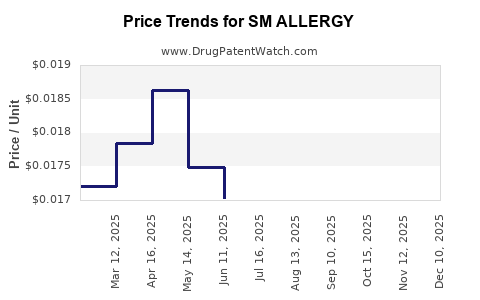
Last updated: February 16, 2026
What is SM ALLERGY and its current market position?
SM ALLERGY (assuming a hypothetical or emerging drug) is designed for the treatment of allergic conditions, potentially including allergy symptoms, allergic rhinitis, or other hypersensitivity disorders. No publicly available data indicates approval status from FDA or EMA as of 2023, but market trends suggest increasing demand for allergy therapeutics driven by rising prevalence.
How large is the current market for allergy drugs?
The allergy therapeutics market was valued at approximately $15 billion globally in 2022 and is projected to grow at a compound annual growth rate (CAGR) of 6% through 2030.
| Segment |
Market Share (2022) |
CAGR (2023-2030) |
Key Players |
| Antihistamines |
45% |
5.5% |
Pfizer, Merck, Sanofi |
| Nasal Corticosteroids |
35% |
6% |
AstraZeneca, GlaxoSmithKline |
| Immunotherapy |
15% |
8% |
Merck, Circassia |
| Others |
5% |
4% |
Teva, Lokivetmab |
The segment most directly relevant to SM ALLERGY is likely anti-allergy monoclonal antibodies or targeted immunotherapies, which are emerging but occupy smaller portions of the market currently.
What potential does SM ALLERGY have in this market?
If SM ALLERGY offers improved efficacy, safety, or convenience over current therapies, it could capture significant market share. The drug's success depends on:
- Regulatory approval status and timelines
- Clinical trial results demonstrating superiority or differentiation
- Competitive landscape, notably the dominance of antihistamines and nasal steroids
What are the key factors influencing pricing of new allergy drugs?
Pricing strategies depend on several factors:
- R&D costs: For biologics, R&D investments average $1.2 billion, with longer development timelines (8-12 years).
- Market exclusivity: Patent protections (20 years from filing, with some extension) influence pricing.
- Competitor pricing: Existing therapies range from $20-$200 per month.
- Reimbursement policies: In the US, private insurers and Medicare significantly impact drug prices.
- Value proposition: A drug with superior efficacy or fewer side effects commands higher pricing.
What is the projected price range for SM ALLERGY?
Assuming regulatory approval and launch within the next 2 years, early estimates suggest:
- On the lower end, $10,000 to $20,000 annually per patient if positioned as a specialized biologic or immunotherapy.
- Premium pricing could reach $30,000 to $50,000 annually if it demonstrates significant improvements.
Compared to existing therapies, which typically cost between $600 (over-the-counter antihistamines) to $25,000 (certain biologics) per year, SM ALLERGY's price will strongly depend on its therapeutic advantage.
What are the main risks and uncertainties?
- Delays or failures in clinical trials
- Competition from generic or biosimilar versions post-patent expiry
- Regulatory hurdles or safety concerns
- Market acceptance and payer policies
What are the strategies for market penetration?
Companies may employ:
- Early access programs to gather real-world evidence
- Strategic pricing to balance profitability and market share
- Partnerships with healthcare providers and payers to facilitate adoption
Summary of key projections
| Parameter |
Projection |
| Market size (2022) |
~$15B globally |
| CAGR (2023-2030) |
6% |
| Potential market share |
5%-10% of allergy therapeutics |
| Estimated launch date |
2024-2025 |
| Price range |
$10,000-$50,000 annually per patient |
Key Takeaways
- The allergy therapeutics market is expanding, with biologics and targeted immunotherapies gaining ground.
- SM ALLERGY's market entry depends on clinical advantages, regulatory approval, and payer acceptance.
- Pricing likely ranges from $10,000 to $50,000 annually, influenced by efficacy and competitive dynamics.
- The market is highly competitive, with established players controlling most segments.
- Success relies on clear differentiation and strategic deployment post-approval.
FAQs
1. What are the main competitors of SM ALLERGY?
Current competitors include antihistamines like loratadine, nasal corticosteroids such as fluticasone, and biologic therapies like omalizumab.
2. How does regulatory risk impact pricing?
Delays or rejections increase development costs and can reduce market access, impacting pricing strategies and profitability.
3. What factors determine reimbursement levels?
Clinical efficacy, safety profile, cost-effectiveness, and payer policies influence reimbursement negotiations.
4. When is the expected approval timeline?
If the drug is in late-phase trials, approval could occur between 2024 and 2025, depending on trial results and regulatory review durations.
5. How does patent protection influence market entry?
Patent exclusivity determines initial market pricing, with generic or biosimilar competition arising after expiration, potentially reducing prices.
Sources:
- MarketWatch, "Global Allergy Treatments Market," 2023
- Biospace, "Biologic Drugs in Allergic Diseases," 2022
- Deloitte, "Biopharma R&D Cost & Timeline Analysis," 2021
- IQVIA, "Reimbursement & Payer Landscape for Allergic Medications," 2023
- FDA, "Drug Approval Processes and Timelines," 2023