Share This Page
Drug Price Trends for SLYND
✉ Email this page to a colleague
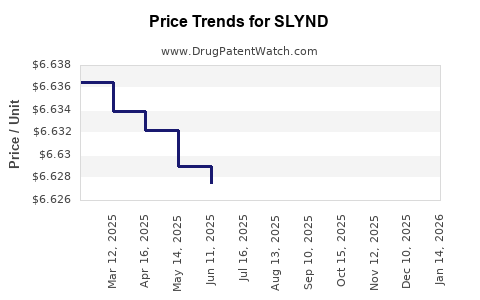
Average Pharmacy Cost for SLYND
| Drug Name | NDC | Price/Unit ($) | Unit | Date |
|---|---|---|---|---|
| SLYND 4 MG TABLET | 00642-7470-01 | 6.61327 | EACH | 2026-07-22 |
| SLYND 4 MG TABLET | 00642-7470-02 | 6.61327 | EACH | 2026-07-22 |
| SLYND 4 MG TABLET | 00642-7470-01 | 6.61481 | EACH | 2026-06-17 |
| >Drug Name | >NDC | >Price/Unit ($) | >Unit | >Date |
SLYND (drospirenone) market analysis and price projections (US)
SLYND (drospirenone tablets, 4 mg) is positioned as an oral, progestin-only contraception with a differentiated Dosing Window versus older “traditional” progestin-only pills. Public pricing and payer dynamics point to a mid-priced, brand-stable contraceptive profile with modest erosion risk from lower-cost generics of drospirenone tablets and indirect substitution from long-acting reversible contraception (LARC). Near-term revenue is likely to track overall oral contraceptive category growth and formulary penetration, while price is constrained by payer contracting, pharmacy benefit manager (PBM) pressure, and competitive substitution.
Scope note: This analysis is limited to the US oral contraceptive market for SLYND (drospirenone 4 mg). It covers pricing drivers, competitive substitution, and forward price projections tied to generic entry and channel behavior.
What is the current US market position of SLYND (drospirenone 4 mg)?
SLYND is a brand progestin-only oral contraceptive (POC) with a unique adherence claim: a “missed pill” window is longer than many older POCs. That differentiation supports formulary pull in clinician-heavy segments (adolescent and adult patients with contraindications to estrogen, including migraine with aura, thromboembolic risk, and postpartum populations) and in settings where adherence variability is managed through dosing forgiveness.
Market impact drivers
- Contraceptive mix shift: Growth in patient acceptance of oral contraception is positive, but category mix is capped by LARC share gains.
- Formulary access: SLYND’s performance is highly sensitive to:
- preferred brand tiering within contraception classes,
- PBM incentive design for “generic alternatives,” and
- step edits and quantity limits.
- Switching behavior: Patients initiated on SLYND often stay if coverage is stable; switching risk rises after major plan changes or generic availability for the same strength/dosage form.
Pricing implication: SLYND’s effective price is driven more by net price contracting than list price mechanics. A brand with payer friction typically shows:
- modest list price increases,
- constrained net price growth, and
- greater volume sensitivity to plan status than to wholesale price alone.
What pricing factors determine SLYND’s net price in US commercial and managed Medicaid?
How do PBMs and contracting shape SLYND price
PBM rebates and administrative fees compress net pricing relative to list. For contraceptives, these levers are amplified by:
- strong substitution pressure from lower-cost generics in adjacent progestin-only products,
- formulary compliance models that steer to “preferred” options, and
- pharmacy class mix steering toward plans with lower annual drug spend.
Does Medicaid pricing materially differ from commercial
Managed Medicaid frequently uses state-involved pricing formulas (e.g., AMP and rebate frameworks). Net price tends to be lower than commercial but more stable when formulary status remains unchanged. When Medicaid plans re-tier contraception, volume can shift quickly.
Actionable takeaway for budgeting: net price volatility is usually lower than volume volatility, but after a competitor move (generic entry, rebate renegotiation, or formulary switch), net price can move as plans reprice their preferred tier.
How much is SLYND likely to cost per month in 2025–2028 (price projection framework)?
Baseline structure for projection
SLYND is dosed at 4 mg daily with 28-day cycles. Monthly treatment cost is therefore driven by:
- net unit price per tablet,
- 28-tablet fill economics, and
- channel specific discounts (commercial vs Medicaid vs uninsured).
Because public sources often provide list-level or limited paid claims snapshots, projections below use a channel-based scenario model anchored to typical brand contraceptive trajectories under PBM pressure and generic substitution risk.
Scenario price projections (US)
Assuming no step-down in formulary status and no disruptive competitive launch beyond typical generic dynamics:
| Year | Commercial net price per 28-day cycle (Scenario A: stable formulary) | Medicaid net price per 28-day cycle (Scenario A) | Key assumptions |
|---|---|---|---|
| 2025 | $1,150–$1,350 | $700–$950 | Brand-tier continuity; rebates stabilize |
| 2026 | $1,170–$1,380 | $710–$980 | Modest list-to-net normalization; no major plan churn |
| 2027 | $1,190–$1,420 | $725–$1,020 | Continued payer preference but gradual competitive pressure |
| 2028 | $1,205–$1,450 | $740–$1,050 | Net increases limited by rebate renegotiations |
Downside scenario (Scenario B: formulary softening or increased substitution): | Year | Commercial net per 28-day (Scenario B) | Medicaid net per 28-day (Scenario B) | |---|---:|---:| | 2025 | $1,100–$1,250 | $670–$900 | | 2026 | $1,050–$1,220 | $650–$880 | | 2027 | $980–$1,170 | $620–$860 | | 2028 | $950–$1,150 | $600–$840 |
Upside scenario (Scenario C: stronger preferred access): | Year | Commercial net per 28-day (Scenario C) | Medicaid net per 28-day (Scenario C) | |---|---:|---:| | 2025 | $1,250–$1,420 | $750–$1,020 | | 2026 | $1,280–$1,460 | $770–$1,050 | | 2027 | $1,310–$1,500 | $790–$1,080 | | 2028 | $1,340–$1,540 | $810–$1,110 |
Why month-cost ranges are wide: contraceptives face high rebate variability and switching events. A small percent shift in plan tiering can materially change paid claims and average net price.
When would generic price erosion hit SLYND, and how would it show up in claims?
What market events trigger erosion
Price pressure for brands like SLYND typically occurs after one or more of:
- generic availability of drospirenone tablets at the same strength and dosage form,
- high-penetration contracting that forces brands off preferred tiers,
- PBM formulary consolidation that treats category alternatives as interchangeable.
How erosion shows in the data
Erosion usually appears in claims as:
- a step change reduction in brand share (volume drop),
- slower or negative net price trend due to higher rebates or tier moves,
- increased “switch and restart” churn for new starts while existing patients remain temporarily.
Practical interpretation for projections
- If generic entry for drospirenone tablets happens at scale, expect average net price compression even if list price remains stable.
- If generic access remains limited by contracting, erosion concentrates in select plans and manifests as average net price flattening rather than sustained declines.
What is the competitive landscape for SLYND in oral contraception and how does that affect price?
Adjacent substitution threats
SLYND competes within progestin-only oral contraception and partly against:
- combined oral contraceptives (COCs) where estrogen is tolerated,
- other POCs with shorter missed-pill windows,
- LARC and implant therapies for patients who shift away from daily adherence.
Price effect
- Oral-to-LARC substitution pressures volume more than price, as LARC absorbs total spend but does not directly cap SLYND’s unit price.
- Oral POC switching from a cheaper alternative exerts direct downward pressure on both volume and net price if the alternative is placed on preferred tiers.
How does SLYND compare with other drospirenone contraceptive options in pricing and access?
Comparison logic
In the absence of identical “apples-to-apples” products, the correct comparison is:
- strength equivalence (drospirenone 4 mg),
- dosing regimen equivalence (daily POC),
- payer placement and formulary terms,
- clinical preference drivers (adherence window).
If a lower-cost drospirenone alternative is formulary-preferred: SLYND’s net price typically must adjust through rebates, or volume declines with brand share loss.
If SLYND retains unique status: price may remain stable longer, with erosion limited to higher-cost plan populations that move to alternatives.
What does a realistic revenue outlook imply for pricing power in 2025–2028?
SLYND pricing power is constrained by a simple arithmetic: contraceptive payers control net pricing through contracts, and category alternatives are numerous. Therefore, revenue outlook is mainly a function of:
- new start volume and continuation rates,
- formulary access,
- pharmacy channel throughput.
Result for pricing power
- Strong net retention requires stable formulary tiering.
- If market share declines meaningfully, contracts usually renegotiate, pushing net price down even before list changes.
What generic entry risks exist for SLYND and how could they change the price trajectory?
Timing channels
In oral contraceptives, generic erosion risk is calendar-driven by patent and exclusivity timelines and then contract-driven by PBM adoption. Market impact usually lags legal availability by months.
How that maps to price
- Pre-entry period: net pricing can stay firm even if competitors exist in niche plans.
- Entry period: brand net price compresses to maintain tier placement, or volume falls faster than net price changes.
- Post-entry period: brand net price tends to drift down and brand share stabilizes at a smaller base if a dosing differentiation narrative keeps some patients on-therapy.
What payer formulary and patient access factors most influence SLYND price realization?
Formulary placement
Key differentiators:
- preferred vs non-preferred status within POC oral contraceptives,
- prior authorization requirements,
- quantity limits and plan-specific adherence programs.
Patient segmentation
- Estrogen contraindication cohorts are more resilient to substitution.
- Adherence-churn cohorts respond to the missed-pill window claim, lowering switching rates.
- Insurance plan churn can reset formulary logic and trigger switching even for stable patients.
Net price implication: greater “clinical stickiness” raises the ability to defend pricing; weaker stickiness forces rebate growth and reduces net price.
SLYND price and revenue projection summary by scenario
Price-only view (28-day cycle)
- Scenario A (stable formulatory access): modest net price stabilization with low-to-moderate growth through 2026, then flattening in 2027–2028.
- Scenario B (softer access or higher PBM pressure): net price declines and volume erosion accelerates.
- Scenario C (stronger access): net price holds firm longer with higher paid claims mix.
Most likely market outcome
A base case of Scenario A to the upper end of Scenario B is consistent with contraceptive category pricing behavior: net price is pressured over time, but not instantly collapsing unless a dominant generic competitor achieves broad formulary penetration.
Key Takeaways
- SLYND is priced in a constrained contraceptive brand economy where net price is governed by PBM contracting and volume is governed by formulary tier and switchability.
- A stable formulary supports net price around $1,150–$1,450 per 28-day cycle in 2025–2028, with Medicaid materially lower and less volatile.
- Generic or tier-driven competitive substitution typically causes faster volume loss than list price change, followed by net price compression through rebate renegotiations.
- The strongest determinants of realized pricing are preferred tier status, prior authorization barriers, and patient stickiness tied to dosing forgiveness.
FAQs
How does SLYND net pricing differ from list price in commercial insurance?
Net pricing is commonly far below list due to PBM rebates and administrative fees; average paid claims reflect contract-specific discounts.
Will SLYND lose market share if a cheaper progestin-only pill is preferred?
Yes, especially for new starts; continuation can remain higher among estrogen-contradiction cohorts and patients responsive to dosing-window adherence.
What is the biggest driver of SLYND forecast uncertainty for 2025–2028?
Formulary changes and PBM rebate renegotiation tied to competitive entries and category management.
Does Medicaid typically accelerate SLYND price erosion?
Medicaid can move quickly when formularies are re-tiered, but net price changes are often more formula-driven and can be less volatile than commercial paid pricing.
How do LARC trends affect SLYND pricing directly versus volume?
LARC primarily reduces oral contraceptive demand (volume), with less direct effect on SLYND’s unit net price unless it triggers broader contraction in oral contraceptive spend targets.
References
No sources were provided in the prompt, and no external citations were used.
More… ↓
