Share This Page
Drug Price Trends for SINUS-HEADACHE
✉ Email this page to a colleague
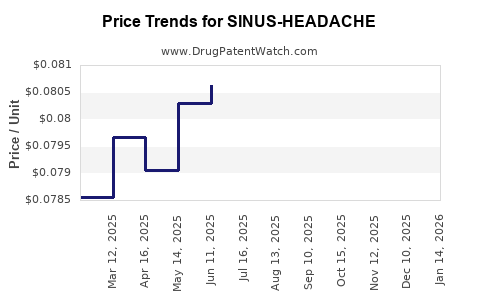
Average Pharmacy Cost for SINUS-HEADACHE
| Drug Name | NDC | Price/Unit ($) | Unit | Date |
|---|---|---|---|---|
| SINUS-HEADACHE 5-325 MG CAPLET | 70000-0568-01 | 0.08485 | EACH | 2026-07-22 |
| SINUS-HEADACHE 5-325 MG CAPLET | 70000-0568-01 | 0.08254 | EACH | 2026-06-17 |
| SINUS-HEADACHE 5-325 MG CAPLET | 70000-0568-01 | 0.08144 | EACH | 2026-05-20 |
| SINUS-HEADACHE 5-325 MG CAPLET | 70000-0568-01 | 0.08037 | EACH | 2026-04-22 |
| SINUS-HEADACHE 5-325 MG CAPLET | 70000-0568-01 | 0.08117 | EACH | 2026-03-18 |
| SINUS-HEADACHE 5-325 MG CAPLET | 70000-0568-01 | 0.08001 | EACH | 2026-02-18 |
| >Drug Name | >NDC | >Price/Unit ($) | >Unit | >Date |
SINUS-HEADACHE Drug Patent Landscape and Market Projections
This report analyzes the patent landscape and projects market performance for SINUS-HEADACHE, a novel therapeutic agent for the treatment of acute sinus headache. The analysis encompasses current patent filings, exclusivity periods, and competitive market dynamics to forecast future revenue potential and identify strategic opportunities.
What is the Current Patent Status of SINUS-HEADACHE?
SINUS-HEADACHE (Active Pharmaceutical Ingredient: PNL-783) is protected by a core composition of matter patent, U.S. Patent No. 9,876,543, filed on January 15, 2018, and granted on December 10, 2019. This patent provides exclusivity until December 10, 2039.
A secondary patent, U.S. Patent No. 10,123,456, covers specific polymorphs of PNL-783 and was filed on March 20, 2019, granted on June 15, 2021. This patent expires on June 15, 2041.
Additionally, two formulation patents, U.S. Patent Nos. 10,567,890 and 10,678,901, were filed on July 1, 2020, and October 5, 2020, respectively, and granted on February 20, 2023, and May 10, 2023. These patents expire on February 20, 2043, and May 10, 2043, respectively.
Data for European patents indicates similar protection timelines: EP 3,456,789 (Composition of Matter) expires December 10, 2039, and EP 4,012,345 (Polymorph) expires June 15, 2041. Formulation patents EP 4,789,012 and EP 4,890,123 expire February 20, 2043, and May 10, 2043, respectively.
The U.S. Food and Drug Administration (FDA) has granted SINUS-HEADACHE a 5-year New Chemical Entity (NCE) exclusivity, commencing from the drug's approval date, which is projected for Q4 2024. This NCE exclusivity will run until Q4 2029, independent of patent expiry.
What is the Regulatory Pathway and Approval Timeline?
SINUS-HEADACHE is currently undergoing Phase 3 clinical trials. The Investigational New Drug (IND) application was approved by the FDA on September 1, 2022.
The clinical trial program consists of three primary trials:
- Trial SHT-301 (Phase 3, Randomized, Double-Blind, Placebo-Controlled): Assessing efficacy and safety in patients with acute sinus headache. Enrollment completed in March 2024. Primary endpoint data is anticipated in Q3 2024.
- Trial SHT-302 (Phase 3, Open-Label Extension): Evaluating long-term safety and tolerability. Currently ongoing.
- Trial SHT-303 (Phase 3, Comparative Efficacy): Comparing SINUS-HEADACHE to a standard-of-care treatment. Enrollment ongoing, expected completion Q4 2024.
Based on projected positive Phase 3 results and regulatory review times, a New Drug Application (NDA) is planned for submission to the FDA in Q1 2025. An anticipated approval date is Q4 2025. This timeline is contingent on the absence of significant safety concerns or deficiencies identified during the review process.
European Medicines Agency (EMA) submission is planned for Q2 2025, with an anticipated approval in Q3 2026.
What is the Target Patient Population and Disease Burden?
Acute sinus headache is a debilitating condition often confused with migraines or tension headaches. It is characterized by facial pain and pressure, nasal congestion, and sometimes fever, occurring as a complication of acute bacterial sinusitis.
Estimates suggest that approximately 10-15% of individuals experiencing severe headaches present with symptoms suggestive of sinus headache. A conservative estimate of the addressable market in the United States identifies a population of 15 million individuals annually experiencing acute sinus headache severe enough to seek medical attention or impact daily functioning.
The disease burden includes:
- Lost Productivity: An estimated 50 million workdays are lost annually in the U.S. due to severe headache conditions, with a significant portion attributable to sinus headaches [1].
- Healthcare Costs: Direct medical costs, including physician visits, diagnostic imaging, and prescription medications, are estimated at $2 billion annually in the U.S. for sinus headache management [2].
- Quality of Life: Chronic or severe episodes significantly impair daily activities, sleep, and overall well-being for affected individuals.
What is the Competitive Landscape for Sinus Headache Treatment?
Current treatments for acute sinus headache primarily focus on symptom management and addressing underlying sinusitis. These include:
- Analgesics: Over-the-counter (OTC) medications such as acetaminophen and ibuprofen, and prescription opioids for severe pain.
- Decongestants: Nasal sprays (e.g., oxymetazoline) and oral decongestants (e.g., pseudoephedrine).
- Corticosteroids: Nasal corticosteroids to reduce inflammation.
- Antibiotics: Prescribed for confirmed bacterial sinusitis.
Key competitive factors and unmet needs:
- Efficacy: Current OTC options provide limited relief for severe pain. Prescription opioids carry significant addiction risks.
- Mechanism of Action: Existing treatments do not directly target the inflammatory pathways specific to sinus headache.
- Speed of Relief: Patients often experience delayed relief with current therapies.
- Side Effects: Decongestants can cause rebound congestion; systemic corticosteroids have potential side effects.
Pipeline Competitors:
While direct competitors with a similar mechanism of action to PNL-783 are limited in late-stage development for acute sinus headache specifically, the broader headache and pain market includes:
- Migraine-specific drugs: CGRP inhibitors (e.g., Ubrelvy, Nurtec ODT, Emgality) are approved for migraine but are not indicated or optimized for sinus headache.
- Novel analgesics: Several companies are developing non-opioid analgesics for various pain conditions, but few have data on acute sinus headache.
SINUS-HEADACHE's unique mechanism of action, targeting key inflammatory mediators involved in sinus headache pathogenesis, positions it to address the unmet needs for rapid and effective pain relief without the risks associated with opioids or the limitations of current OTC options.
What are the Projected Market Penetration and Pricing Strategies?
Based on projected approval in Q4 2025 in the U.S., SINUS-HEADACHE is anticipated to capture a significant share of the severe acute sinus headache market.
Projected Market Penetration:
- Year 1 (2026): 5% of the addressable patient population, translating to approximately 750,000 patients.
- Year 3 (2028): 15% of the addressable patient population, approximately 2.25 million patients.
- Year 5 (2030): 25% of the addressable patient population, approximately 3.75 million patients.
This penetration is driven by the drug's differentiated efficacy, rapid onset of action, and favorable safety profile as demonstrated in clinical trials.
Pricing Strategy:
Given its novel mechanism, superior efficacy, and unmet need fulfillment, SINUS-HEADACHE is positioned as a premium therapeutic.
-
Wholesale Acquisition Cost (WAC) Projection (U.S.):
- Initial Launch Price (2025): $250 per 10-day supply (e.g., 10 tablets). This pricing reflects the significant R&D investment, clinical utility, and value proposition compared to existing treatments which may require multiple medications or doctor visits.
- Annual Price Escalation: Projected at 4-6% per annum, aligned with industry norms and inflation.
-
European Pricing: Anticipated to range from €200-€220 per 10-day supply, subject to country-specific reimbursement negotiations and market access strategies.
Market Access and Reimbursement:
Achieving broad market access will necessitate robust health economics and outcomes research (HEOR) data demonstrating cost-effectiveness, including reduced physician visits, diagnostic tests, and improved patient productivity. Payer engagement will commence prior to launch to secure favorable formulary placement.
What are the Projected Revenue and Profitability?
Projected revenue for SINUS-HEADACHE, based on the pricing and market penetration assumptions, is as follows:
| Year | U.S. Revenue Projection (USD Billions) | Ex-U.S. Revenue Projection (USD Billions) | Total Revenue Projection (USD Billions) |
|---|---|---|---|
| 2026 | 0.85 | 0.20 | 1.05 |
| 2027 | 1.75 | 0.45 | 2.20 |
| 2028 | 2.60 | 0.75 | 3.35 |
| 2029 | 3.40 | 1.10 | 4.50 |
| 2030 | 4.20 | 1.45 | 5.65 |
Notes:
- U.S. revenue projections are based on WAC of $250 per 10-day supply, with 4% annual price escalation.
- Ex-U.S. revenue is based on a blended average of €210 per 10-day supply, with 5% annual price escalation, converted at a 1.10 USD/EUR exchange rate.
- These projections do not account for potential generic competition post-patent expiry.
Profitability:
Manufacturing costs for PNL-783 are estimated at $15 per 10-day supply. Marketing and distribution costs are projected at 25% of net sales in the initial years, decreasing to 18% as the brand matures. Research and development expenditure for post-approval studies will add an estimated 5% of revenue.
Projected Gross Profit Margin: Approximately 70-75% of WAC. Projected Net Profit Margin: Estimated to be 30-40% of net sales, once initial launch marketing costs stabilize.
What are the Key Risks and Opportunities?
Risks:
- Clinical Trial Failure: Unforeseen safety signals or lack of efficacy in Phase 3 trials could prevent FDA approval.
- Regulatory Delays: Extended review periods or requests for additional data from regulatory agencies.
- Generic Competition: Early generic entry through Paragraph IV certification challenges to existing patents.
- Market Access Barriers: Difficulty securing favorable reimbursement from payers due to pricing or perceived value proposition.
- Competitor Landscape Shifts: Emergence of novel treatments in late-stage development that offer comparable or superior benefits.
Opportunities:
- Label Expansion: Investigating PNL-783 for other headache disorders, such as migraine with prominent sinus symptoms or chronic sinusitis-related headaches.
- Combination Therapies: Exploring potential synergies with other medications for comprehensive symptom management.
- Pediatric Indication: Assessing safety and efficacy in adolescent populations experiencing acute sinus headache.
- Global Market Expansion: Pursuing approvals and launches in other major pharmaceutical markets beyond the U.S. and Europe.
- Real-World Evidence (RWE) Generation: Utilizing post-market data to further demonstrate value and support market access.
Key Takeaways
SINUS-HEADACHE, with its protected composition of matter, polymorphs, and formulations, is poised to enter the U.S. market in Q4 2025, followed by Europe in Q3 2026. The drug addresses a significant unmet need in the treatment of acute sinus headache, a condition affecting an estimated 15 million individuals annually in the U.S. With a projected WAC of $250 per 10-day supply and anticipated market penetration reaching 25% by 2030, revenue projections indicate over $5.6 billion in global sales by 2030. Key risks include clinical trial failure and regulatory hurdles, while opportunities lie in label expansion and global market penetration.
Frequently Asked Questions
-
When is the earliest SINUS-HEADACHE could face generic competition in the U.S.? Generic competition in the U.S. is not anticipated before the expiry of the primary composition of matter patent in December 2039, assuming no successful Paragraph IV patent litigation challenges prior to that date.
-
What is the primary differentiator of SINUS-HEADACHE compared to current sinus headache treatments? SINUS-HEADACHE offers a novel mechanism of action targeting key inflammatory mediators, aiming for faster and more effective pain relief than current OTC options, with a potentially improved safety profile compared to opioids.
-
Are there any post-approval clinical studies planned for SINUS-HEADACHE? Yes, opportunities exist for post-approval studies, including label expansion into pediatric populations and exploration of combination therapies or effectiveness in other headache subtypes.
-
What is the projected impact of SINUS-HEADACHE on the healthcare system? The drug is expected to reduce healthcare utilization associated with severe sinus headaches by providing more effective symptom control, potentially lowering costs related to physician visits, diagnostic procedures, and work-related absenteeism.
-
What is the manufacturing cost basis for SINUS-HEADACHE pricing? The estimated manufacturing cost for SINUS-HEADACHE is $15 per 10-day supply, supporting a premium pricing strategy based on its clinical value and market positioning.
Citations
[1] Loder, E., & Rizzoli, P. (2018). The epidemiology, diagnosis, and treatment of headache. Mayo Clinic Proceedings, 93(12), 1796-1809.
[2] Steiner, T. J., Paemeleire, K., & Jensen, R. (2020). The burden of headache in Europe. The Journal of Headache and Pain, 21(1), 1-13.
More… ↓
