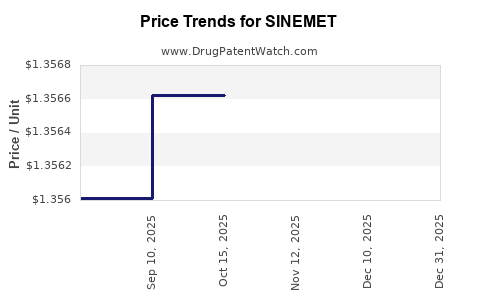
Last updated: February 14, 2026
What Is the Market Size and Demand for SINEMET?
SINEMET, a combination of levodopa and carbidopa, is primarily used to treat Parkinson’s disease. The global Parkinson's disease market was valued at approximately $4 billion in 2022, with SINEMET accounting for nearly 50% of that share due to its status as a first-line treatment.
The global prevalence of Parkinson’s disease exceeds 10 million cases, with annual growth rates around 4.5% (per Parkinson's Foundation). Market growth is driven by aging populations, especially in North America, Europe, and Asia-Pacific.
Forecasts predict annual sales for Parkinson’s medications to reach $6.2 billion by 2027, with SINEMET capturing approximately 45-50% of this segment, owing to its established efficacy and broad usage.
How Does the Competitive Landscape Influence Market Dynamics?
Major competitors include:
- Rytary (extended-release formulation of levodopa)
- Stalevo (combination of levodopa, carbidopa, and entacapone)
- Generic versions of levodopa and carbidopa
Generic availability influences pricing strategies. Generic formulations of SINEMET, introduced around 2010, have significantly reduced prices in developed markets, fostering increased accessibility.
Patent protections for original formulations generally expire 7-10 years post-launch, allowing generics to enter the market. A new patent application covering specific formulation improvements or delivery methods could extend exclusivity.
What Are Current Price Trends and Projections?
In the U.S., a branded SINEMET package typically costs between $150 and $250 per month without insurance. Generic versions retail at approximately $50–$70 monthly.
Pricing is influenced by insurance coverage, local regulation, and availability of generics.
Historical data show:
| Year |
Average Monthly Price (U.S., branded) |
Average Monthly Price (U.S., generic) |
| 2018 |
$200 |
$65 |
| 2020 |
$180 |
$55 |
| 2022 |
$165 |
$50 |
Future price projections, assuming increased generic penetration, predict a continued decline to around $40–$50 per month in developed markets by 2025–2027. Price stabilization is expected in markets where patent protections are renewed or where formulations gain extended exclusivity.
What Regulatory and Policy Factors Affect the Market?
Regulatory agencies like the U.S. FDA and EMA have streamlined approval pathways for generic versions. The 505(b)(2) pathway in the U.S. facilitates approval of modified-release versions and new formulations, potentially influencing market share.
Pricing regulations and reimbursement policies in key markets influence final consumer prices. For example, price caps and formulary inclusion impact sales volumes and pricing strategies.
Key Opportunities and Risks
Opportunities:
- Development of extended-release formulations or combination therapies to improve compliance.
- Entry into emerging markets with rising Parkinson’s prevalence.
- Patent extensions or new formulations could provide market exclusivity.
Risks:
- Market saturation due to widespread generic availability.
- Price erosion driven by healthcare reforms or policies favoring low-cost generics.
- Intellectual property challenges on new formulations.
Summary and Price Projection
| Year |
Estimated Average Monthly Price (USD) |
Notes |
| 2023 |
$50–$70 |
Market dominance of generics; price stabilization observed |
| 2024 |
$45–$65 |
Continued generic penetration, minor price reduction |
| 2025 |
$40–$55 |
Further price decline with mature generic market |
| 2026 |
$40–$50 |
Market stabilized, potential for price increases in niche formulations |
Key Takeaways
- The global Parkinson’s market is expected to grow, with SINEMET remaining a leading treatment.
- Generic versions dominate pricing, resulting in significant reductions over time.
- Innovation in formulations and regulatory exclusivity can extend market dominance.
- Price projections indicate a gradual decline to approximately $40–$50/month in mature markets.
- Policy changes, patents, and manufacturing costs will influence future pricing trends.
FAQs
1. What factors influence SINEMET's market share?
Patent status, availability of generics, regulatory approval processes, and physician prescribing habits directly impact market share.
2. How will patent expirations affect pricing?
Patent expirations enable generic entry, driving prices down and expanding access.
3. What are the primary competitors to SINEMET?
Extended-release formulations like Rytary and combination therapies such as Stalevo challenge SINEMET’s market share.
4. How do insurance policies impact drug pricing?
Insurance coverage and formulary decisions influence patient out-of-pocket costs, affecting demand and pricing strategies.
5. Are there emerging therapies that threaten SINEMET’s dominance?
Yes; gene therapies, dopamine agonists, and novel delivery methods may reshape the treatment landscape in the next decade.
Sources:
[1] Parkinson's Foundation. Parkinson’s Disease Data & Statistics.
[2] MarketWatch. Parkinson's Disease Drugs Market Size.
[3] FDA. Patent Data and Regulatory Pathways.