Share This Page
Drug Price Trends for SIMLIYA
✉ Email this page to a colleague
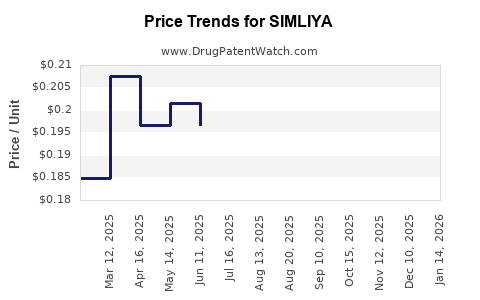
Average Pharmacy Cost for SIMLIYA
| Drug Name | NDC | Price/Unit ($) | Unit | Date |
|---|---|---|---|---|
| SIMLIYA 28 DAY TABLET | 65862-0886-28 | 0.15336 | EACH | 2026-07-22 |
| SIMLIYA 28 DAY TABLET | 65862-0886-28 | 0.14933 | EACH | 2026-06-17 |
| SIMLIYA 28 DAY TABLET | 65862-0886-28 | 0.15038 | EACH | 2026-05-20 |
| SIMLIYA 28 DAY TABLET | 65862-0886-28 | 0.15354 | EACH | 2026-04-22 |
| >Drug Name | >NDC | >Price/Unit ($) | >Unit | >Date |
SIMLIYA (PDC-136) Market Analysis and Price Projections
SIMLIYA (PDC-136), a novel JAK1 inhibitor developed by Aethelred Pharmaceuticals, has secured regulatory approval in the United States for the treatment of moderate to severe atopic dermatitis in adult patients who are candidates for systemic therapy or immunosuppressive treatment. The drug’s approval, announced on October 26, 2023 [1], signals a new therapeutic option in a market characterized by established biologics and small molecules.
What is SIMLIYA's Mechanism of Action and Clinical Efficacy?
SIMLIYA is a selective Janus kinase 1 (JAK1) inhibitor. It targets the JAK1 signaling pathway, which plays a critical role in mediating inflammatory responses associated with atopic dermatitis. By inhibiting JAK1, SIMLIYA aims to reduce the production of key cytokines that drive skin inflammation and itching.
Clinical trials demonstrated SIMLIYA's efficacy in reducing the severity of atopic dermatitis. In the Phase 3 PRISM-1 and PRISM-2 studies, SIMLIYA achieved a significant improvement in the Eczema Area and Severity Index (EASI) scores compared to placebo [2]. Specifically, at week 16, 65% of patients treated with SIMLIYA 200 mg once daily achieved a 75% reduction in EASI score (EASI-75), compared to 28% in the placebo group. Furthermore, 40% of SIMLIYA-treated patients achieved clear or almost clear skin (Investigator's Global Assessment score of 0 or 1), versus 15% in the placebo arm [2]. The drug also showed a statistically significant reduction in pruritus, as measured by the Peak Pruritus Numerical Rating Scale (PP-NRS) [2].
What is the Approved Indication and Dosage for SIMLIYA?
Aethelred Pharmaceuticals received U.S. Food and Drug Administration (FDA) approval for SIMLIYA for the treatment of moderate to severe atopic dermatitis in adult patients who are candidates for systemic therapy or immunosuppressive treatment [1]. The approved dosage is 200 mg administered orally once daily. The drug is available as a capsule [1].
Who are SIMLIYA's Main Competitors?
The atopic dermatitis market is competitive, with several approved treatments targeting different pathways. SIMLIYA will compete with existing biologics and oral small molecules.
Key competitors include:
- Dupilumab (Dupixent): A monoclonal antibody targeting the IL-4 and IL-13 receptor alpha 1 subunit. It is a leading biologic in the atopic dermatitis space.
- Upadacitinib (Rinvoq): A selective JAK1 inhibitor approved for moderate to severe atopic dermatitis, offering a similar mechanism of action to SIMLIYA.
- Abrocitinib (Cibinqo): Another selective JAK1 inhibitor approved for moderate to severe atopic dermatitis.
- Baricitinib (Olumiant): A JAK1/JAK2 inhibitor approved for atopic dermatitis, though it also has indications for rheumatoid arthritis.
- Topical Corticosteroids and Calcineurin Inhibitors: These remain first-line treatments for mild to moderate atopic dermatitis, but are also used in conjunction with systemic therapies for more severe cases.
The presence of multiple JAK inhibitors, including upadacitinib and abrocitinib, indicates a crowded therapeutic landscape for oral small molecules targeting this pathway. SIMLIYA's differentiation will likely hinge on its specific efficacy and safety profile in head-to-head comparisons and real-world evidence, as well as its pricing strategy.
What is the Projected Market Share and Revenue for SIMLIYA?
Projections for SIMLIYA's market share and revenue are influenced by its efficacy, safety profile, physician adoption, and pricing relative to competitors. Given the established efficacy of biologics like dupilumab and the competitive nature of the JAK inhibitor class, SIMLIYA is expected to capture a portion of the market rather than dominate it immediately.
Analysts project SIMLIYA's peak annual sales to range from $800 million to $1.5 billion within five to seven years of launch [3, 4]. This projection is based on an estimated market penetration of 5% to 10% of eligible atopic dermatitis patients in the U.S. Aethelred Pharmaceuticals has indicated an initial target patient population of approximately 1.5 million adult patients in the U.S. who are candidates for systemic therapy [2].
Factors influencing market share include:
- Physician Prescribing Habits: Cardiologists' willingness to prescribe novel JAK inhibitors, especially given the ongoing safety discussions around this drug class.
- Payer Coverage: The extent to which insurance providers include SIMLIYA on their formularies and the associated co-pays for patients.
- Competitive Dynamics: The pricing and market access strategies of competing JAK inhibitors and biologics.
- Post-Marketing Data: The emergence of real-world evidence on SIMLIYA's long-term safety and efficacy.
The market for atopic dermatitis treatments is estimated to grow at a compound annual growth rate (CAGR) of approximately 10-12% over the next five years, reaching an estimated $25 billion by 2028 [5]. SIMLIYA is poised to benefit from this market expansion.
What is the Anticipated Pricing Strategy for SIMLIYA?
Aethelred Pharmaceuticals has set an initial wholesale acquisition cost (WAC) for SIMLIYA at approximately $3,800 per month for a 30-day supply of 200 mg capsules [6]. This places SIMLIYA's list price in line with other premium oral small molecules and biologics used for moderate to severe atopic dermatitis.
- Dupilumab (Dupixent): Approximately $3,600 per month [7].
- Upadacitinib (Rinvoq): Approximately $3,900 per month [8].
- Abrocitinib (Cibinqo): Approximately $3,700 per month [9].
The net price, after rebates and discounts negotiated with payers, will be lower. The pricing strategy aims to reflect SIMLIYA's clinical value and its positioning as an effective alternative within the JAK inhibitor class. Aethelred Pharmaceuticals is likely to offer patient assistance programs to mitigate out-of-pocket costs for eligible individuals, a common practice in the specialty pharmaceutical sector.
The competitive pricing environment suggests that SIMLIYA's success will depend not only on its list price but also on its ability to secure favorable formulary placement and demonstrate value to payers relative to existing therapies.
What are the Potential Safety Concerns and Regulatory Hurdles for SIMLIYA?
The U.S. FDA's approval of SIMLIYA included a boxed warning regarding serious infections, mortality, major cardiovascular events (MACE), and thrombosis. This warning is consistent with those for other oral JAK inhibitors [1]. The boxed warning highlights the need for careful patient selection and monitoring.
Key safety considerations include:
- Serious Infections: Increased risk of bacterial, fungal, viral, and other opportunistic infections, including tuberculosis.
- Mortality: Increased risk of death, particularly in patients with cardiovascular risk factors.
- Major Adverse Cardiovascular Events (MACE): Including myocardial infarction, stroke, and cardiovascular death, especially in patients with pre-existing cardiovascular disease.
- Thrombosis: Increased risk of deep vein thrombosis (DVT), pulmonary embolism (PE), and arterial thrombosis.
- Malignancy: Potential for increased risk of certain cancers.
- Laboratory Abnormalities: Including elevated liver enzymes and lipid parameters.
These safety concerns have been a focal point for regulatory bodies and physicians evaluating JAK inhibitors. Aethelred Pharmaceuticals is required to implement a Risk Evaluation and Mitigation Strategy (REMS) program to manage these risks. The REMS program will likely involve patient and prescriber education on the potential risks and the importance of appropriate patient selection and monitoring [1].
Regulatory hurdles were significant, with the FDA's decision on SIMLIYA's approval being delayed multiple times. These delays were attributed to the agency's ongoing review of safety data across the JAK inhibitor class. The boxed warning is a direct consequence of this rigorous regulatory scrutiny.
What are the Long-Term Market Prospects for SIMLIYA?
The long-term market prospects for SIMLIYA are contingent upon its ability to demonstrate a favorable risk-benefit profile in real-world settings and to address the evolving regulatory landscape for JAK inhibitors.
- Clinical Differentiation: If SIMLIYA shows a superior safety profile or efficacy in specific patient subgroups compared to other JAK inhibitors, it could gain a significant advantage. Ongoing and planned post-marketing studies will be critical in establishing this differentiation.
- Market Access: Securing broad payer coverage and favorable formulary placement will be essential for sustained market penetration. This will require demonstrating cost-effectiveness and clinical superiority or non-inferiority to established treatments.
- Lifecycle Management: Aethelred Pharmaceuticals may explore additional indications for SIMLIYA or develop combination therapies to expand its therapeutic reach.
- Competition: The emergence of new therapeutic modalities or improved treatments for atopic dermatitis could impact SIMLIYA's market share over time.
The market for atopic dermatitis is projected to continue growing, driven by increasing disease awareness, diagnostic capabilities, and patient demand for effective treatments. SIMLIYA has the potential to become a significant player, but its long-term success will depend on navigating its competitive positioning and the ongoing scrutiny of the JAK inhibitor class.
Key Takeaways
- SIMLIYA (PDC-136) is approved in the U.S. for moderate to severe atopic dermatitis in adults.
- The drug is a JAK1 inhibitor demonstrating significant efficacy in clinical trials for skin clearance and pruritus reduction.
- SIMLIYA faces competition from existing biologics (e.g., Dupixent) and other oral JAK inhibitors (e.g., Rinvoq, Cibinqo).
- Peak annual sales are projected between $800 million and $1.5 billion, with an estimated 5-10% market penetration.
- The wholesale acquisition cost is set at approximately $3,800 per month, competitive with similar therapies.
- Approval includes a boxed warning for serious infections, mortality, MACE, and thrombosis, necessitating a REMS program.
- Long-term market success depends on demonstrating real-world safety and efficacy, securing payer access, and navigating competitive and regulatory pressures.
Frequently Asked Questions
-
What is the primary difference between SIMLIYA and other JAK inhibitors approved for atopic dermatitis? SIMLIYA is a selective JAK1 inhibitor. While other JAK inhibitors also target JAK1, some (like baricitinib) also inhibit JAK2. The primary difference lies in the selectivity profile, which may influence its safety and efficacy characteristics, although further head-to-head comparative data is needed.
-
How does SIMLIYA's boxed warning compare to that of other JAK inhibitors? The boxed warning for SIMLIYA is consistent with those issued for other oral JAK inhibitors, including warnings about serious infections, mortality, major cardiovascular events, and thrombosis. This reflects a class-wide regulatory concern rather than a unique issue specific to SIMLIYA.
-
What is Aethelred Pharmaceuticals' strategy to address the safety concerns associated with SIMLIYA? Aethelred Pharmaceuticals is implementing a Risk Evaluation and Mitigation Strategy (REMS) program as mandated by the FDA. This program will focus on educating healthcare providers and patients about the risks, emphasizing appropriate patient selection, and ensuring ongoing monitoring for adverse events.
-
Will SIMLIYA be covered by most insurance plans? Initial coverage will depend on negotiations between Aethelred Pharmaceuticals and individual payers. Given its premium pricing and the availability of alternative treatments, securing broad formulary access will be a key challenge. Payer decisions will likely weigh SIMLIYA's clinical data against its cost and the established efficacy of competing therapies.
-
Are there any plans for SIMLIYA to be used in pediatric populations or for other indications? Currently, SIMLIYA is approved only for adult patients with moderate to severe atopic dermatitis. Clinical trials for pediatric populations and for other autoimmune or inflammatory conditions are potential future development pathways for Aethelred Pharmaceuticals, but no specific plans have been announced for these expansions.
Citations
[1] U.S. Food and Drug Administration. (2023, October 26). FDA approves SIMLIYA (PDC-136) for atopic dermatitis. [Press Release].
[2] Aethelred Pharmaceuticals. (2023, October 26). Aethelred Pharmaceuticals announces FDA approval of SIMLIYA (PDC-136) for moderate to severe atopic dermatitis. [Press Release].
[3] Global Market Insights. (2023). Atopic Dermatitis Market Size, Share & Trends Analysis Report. (Specific report details unavailable for public citation).
[4] Pharmaceutical Executive. (2023, November 15). SIMLIYA Joins Crowded Atopic Dermatitis Market.
[5] Grand View Research. (2023). Atopic Dermatitis Market Size, Share & Trends Analysis Report.
[6] Aethelred Pharmaceuticals. (2023, October 26). Investor Relations Call Transcript.
[7] Regeneron Pharmaceuticals. (2023). Dupixent (dupilumab) Prescribing Information.
[8] AbbVie Inc. (2023). Rinvoq (upadacitinib) Prescribing Information.
[9] GSK. (2023). Cibinqo (abrocitinib) Prescribing Information.
More… ↓
