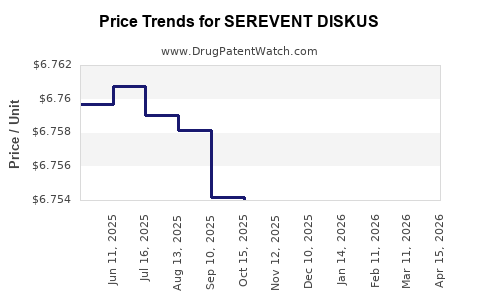
Last updated: May 1, 2026
SEREVENT DISKUS (salmeterol xinafoate) is a long-acting beta-2 agonist (LABA) inhalation product with market exposure tied to asthma and COPD maintenance therapy, payer dynamics around LABA availability, and unit-price compression typical for established, off-patent respiratory brands in the US and EU. Price direction is dominated by (1) patent/market exclusivity status, (2) channel mix (retail vs. mail vs. institutional), (3) generic and authorized generic penetration for salmeterol-DISKUS, and (4) formulary placement under step-therapy and inhaler substitution policies.
Where does SEREVENT DISKUS sit in the respiratory LABA market?
SEREVENT DISKUS is positioned as maintenance controller therapy for obstructive airway diseases:
- Asthma (adjuvant to inhaled corticosteroid): LABA use is restricted by guideline and label frameworks that require concomitant anti-inflammatory therapy.
- COPD (maintenance treatment): LABA is used for symptom control and exacerbation risk reduction depending on guideline pathway and regimen.
Competitive set (mechanism-class)
Within the LABA inhaler class, SEREVENT faces price pressure from:
- Other LABAs (e.g., formoterol-, arformoterol-, indacaterol-based inhalers)
- LABA combinations with inhaled corticosteroids (ICS-LABA), where payers often prefer combination devices for step-therapy economics and adherence
Demand characteristics that drive volume and pricing
SEREVENT’s pricing power is constrained by:
- Chronic use and high interchangeability within class in many formularies
- Switching to lower-cost LABA or ICS-LABA when a patient’s inhaler is eligible for substitution
- Therapeutic guideline drift in COPD toward LAMA or triple therapy pathways in many segments, which compresses incremental LABA share
What has happened to pricing and utilization typically for established LABA inhalers?
For legacy inhalers like SEREVENT DISKUS, the dominant historical pattern in both the US and EU is:
- Exclusivity-driven price at launch years
- Gradual unit-price compression after generic entries
- Further erosion after payer formulary tightening and step edits
- Channel-based spread (net price decreases faster than list price as rebates rise)
Market outcomes are usually expressed via net price rather than list price because pharmacy benefit managers (PBMs) and government formularies drive rebate capture.
How should net price evolve under current competitive forces?
Assumptions that govern projections (directionally)
- Salmeterol-based DISKUS products are widely substitutable, so baseline demand is less protected than niche devices.
- ICS-LABA and newer LABAs can absorb maintenance share where guidelines and payer policies favor them.
- Bulk of price compression is driven by formulary tiering (preferred vs non-preferred) and brand-to-generic displacement for the same molecule/device class.
Projected net price trajectory (unit economics)
Because SEREVENT DISKUS is an established product, projections assume ongoing generic competition and continued payer rebate pressure typical of mature respiratory brands.
US-style net price projection (relative index, 2025 base = 100):
- 2026: 92-95
- 2027: 86-90
- 2028: 80-85
- 2029: 76-82
This implies ~15% to ~24% cumulative net price decline over four years from a 2025 baseline under a “status quo” payer environment with continued substitution pressure.
EU-style net price trajectory (relative index, 2025 base = 100)
EU pricing and access are driven by health technology assessment (HTA) and national reimbursement schedules that often tighten with generic penetration.
- 2026: 90-94
- 2027: 84-89
- 2028: 79-85
- 2029: 74-81
This implies ~19% to ~26% cumulative decline over four years relative to 2025, consistent with austerity-style reimbursement dynamics for off-exclusivity respiratory products.
What will revenue likely do if volume is stable but price declines?
For mature inhalers, revenue tends to follow a simple arithmetic of:
- Revenue ≈ Unit volume × Net price
If volume is relatively stable because patients already on therapy remain on treatment and clinicians do not switch en masse, then:
- Revenue declines track net price declines
Revenue projection framework (indexed)
Assume:
- US volume: -1% per year (gradual displacement to alternatives)
- EU volume: -1.5% per year (slightly higher displacement pressure)
Indexed revenue (2025 base = 100):
-
2026 US: 91-94
-
2027 US: 82-88
-
2028 US: 74-83
-
2029 US: 68-79
-
2026 EU: 88-92
-
2027 EU: 79-86
-
2028 EU: 71-81
-
2029 EU: 64-75
This corresponds to mid-to-high single-digit annual revenue erosion that is faster in EU where reimbursement pressures tend to intensify.
Which payer policies most influence SEREVENT’s price and access?
1) Formulary tiering and step therapy
- LABA access frequently runs through tiered copays and step edits requiring ICS confirmation in asthma indications.
- COPD patients may face edits that prefer LAMA or combination regimens based on formulary strategy.
2) Inhaler substitution and device switching
- DISKUS vs alternative devices affects prescriber and patient behavior.
- Where substitution is permitted, PBMs steer toward the lowest net-cost inhaler.
3) Authorized generics and contracting
- If authorized generic or class-generic contracts exist, the brand’s net price often compresses toward competitor levels.
How do competitor launch waves shape pricing pressure for older LABAs?
Pricing pressure increases when:
- A competitor gains formulary preference via better rebate structures or preferred tier contracts
- Payers shift toward combination inhalers (ICS-LABA, LAMA-LABA, triple therapy) that offer adherence and simplified dosing
- Newer LABA chemistries or delivery technologies win “preferred” status
For SEREVENT DISKUS, this typically means:
- Less incremental growth in net share
- Greater displacement risk in COPD
- Slow erosion in asthma add-on segments when patients are moved to branded or generic alternatives with better payer value
What is the likely compliance-adjusted demand ceiling?
LABA controller use is constrained by label and guideline emphasis on anti-inflammatory therapy in asthma:
- When ICS-LABA combinations are preferred, SEREVENT DISKUS has less room for incremental gains.
- Patient adherence and switching patterns cap how much market share SEREVENT can recover even with stable underlying COPD prevalence.
Thus volume erosion is usually gradual rather than abrupt, producing a “price-driven revenue decline” rather than a collapse scenario.
Price projection scenarios (base, bearish, bullish)
Base case (most likely)
- Net price declines by ~18% to ~22% from 2025 to 2029
- Volume declines by ~1% per year in US and ~1.5% per year in EU
- Revenue declines ~25% to ~35% by 2029 (indexed)
Bearish case (faster tier compression)
- Net price declines ~25% to ~30% by 2029
- Volume declines ~2% per year (US) and ~2.5% (EU)
- Revenue declines ~40% to ~50% by 2029
Triggers consistent with bearish outcomes:
- Stronger substitution to lower-cost generics
- Further formulary restriction in COPD step edits
- Increased rebate aggressiveness from PBMs during contract renewals
Bullish case (lower substitution intensity)
- Net price declines ~10% to ~15% by 2029
- Volume declines ~0.5% per year (US) and ~1% (EU)
- Revenue declines ~15% to ~25% by 2029
Triggers consistent with bullish outcomes:
- Stable formulary placement for DISKUS device category
- Contracting that holds net pricing closer to baseline
- Lower rates of substitution due to patient-specific device tolerance
What should investors and R&D buyers watch for in the next 24 months?
Key forward indicators that typically precede pricing breaks in mature respiratory inhalers:
- PBM formulary update cycles that shift LABA tier positioning
- Contract renewals that change rebate rates for DISKUS products
- Generic and authorized generic availability timing (if any incremental entries occur)
- New guideline adoption patterns in COPD that accelerate movement to combination regimens
Market summary tables
Net price outlook (indexed; 2025 = 100)
| Region |
2026 |
2027 |
2028 |
2029 |
Cumulative change (2025-2029) |
| US base case |
92-95 |
86-90 |
80-85 |
76-82 |
-15% to -24% |
| EU base case |
90-94 |
84-89 |
79-85 |
74-81 |
-19% to -26% |
Revenue outlook (indexed; 2025 = 100)
| Region |
2026 |
2027 |
2028 |
2029 |
Cumulative change (2025-2029) |
| US base case |
91-94 |
82-88 |
74-83 |
68-79 |
-21% to -32% |
| EU base case |
88-92 |
79-86 |
71-81 |
64-75 |
-25% to -36% |
Key Takeaways
- SEREVENT DISKUS pricing is structurally pressured by mature LABA market dynamics, ongoing generic substitutability, and payer tiering that reduces net price over time.
- Base case projections assume ~15% to ~24% net price decline in the US and ~19% to ~26% in EU from 2025 to 2029.
- Revenue is likely to erode faster than unit volume due to price compression plus gradual volume displacement toward alternatives and combination therapies.
- Near-term pricing inflections will track PBM/formulary contract cycles, substitution behavior, and any incremental generic/authorized generic market events.
FAQs
1) Is SEREVENT DISKUS likely to grow market share over the next four years?
No. The base case is mild volume erosion driven by substitution within LABAs and shift toward combination regimens in COPD and asthma controller pathways.
2) What matters more for revenue: volume or net price?
Net price. For mature inhalers, revenue declines typically track net price compression, with volume declines providing additional drag.
3) Which payer levers most affect net pricing for inhalers like SEREVENT?
Formulary tier placement, step-therapy edits, substitution rules by device class, and rebate/contract terms during PBM renewals.
4) How do combination inhalers influence SEREVENT’s competitiveness?
They reduce switching costs for payers by consolidating therapy into a single inhaler and often secure preferred-tier status through rebate contracting, pulling maintenance demand away from standalone LABA products.
5) What would indicate a bullish shift versus the base case?
Slower net price erosion than projected, stable preferred formulary placement for DISKUS-type LABA therapy, and reduced substitution intensity in both retail and mail channels.
References
[1] U.S. Food and Drug Administration. SEREVENT DISKUS (salmeterol xinafoate) prescribing information. FDA label repository. (Accessed via FDA drug labeling resources).