Share This Page
Drug Price Trends for SENNA-TIME
✉ Email this page to a colleague
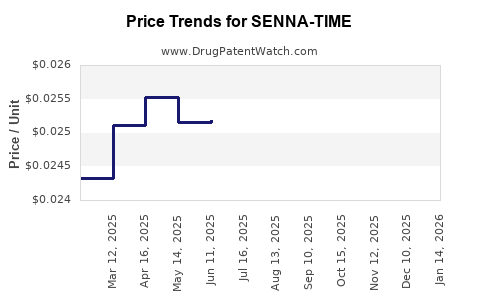
Average Pharmacy Cost for SENNA-TIME
| Drug Name | NDC | Price/Unit ($) | Unit | Date |
|---|---|---|---|---|
| SENNA-TIME 8.6 MG TABLET | 49483-0080-01 | 0.02657 | EACH | 2026-07-22 |
| SENNA-TIME 8.6 MG TABLET | 49483-0080-10 | 0.02657 | EACH | 2026-07-22 |
| SENNA-TIME S TABLET | 49483-0081-01 | 0.03077 | EACH | 2026-07-22 |
| SENNA-TIME S TABLET | 49483-0081-10 | 0.03077 | EACH | 2026-07-22 |
| >Drug Name | >NDC | >Price/Unit ($) | >Unit | >Date |
What is SENNA-TIME?
SENNA-TIME is a combination drug consisting primarily of senna, a laxative used to treat constipation. It is marketed in various formulations, often as tablets or teas, with a focus on short-term relief. The drug is marketed mainly in OTC sectors in the United States, Europe, and parts of Asia.
Market Size and Segment Overview
The global laxatives market was valued at approximately USD 2.2 billion in 2022 and is projected to grow at a compound annual growth rate (CAGR) of 4.1% through 2030.[1] SENNA-based products, including SENNA-TIME, account for roughly 12% of global OTC laxative sales, estimated at USD 264 million in 2022.
The segment is characterized by:
- Growing demand for herbal and natural laxatives, with senna as a leading ingredient.
- Increased prevalence of constipation linked to aging populations, dietary habits, and lifestyle factors.
- A shift toward OTC availability, reducing reliance on prescription formulations.
Competitive Landscape
Key competitors:
- Senna-based products: Senokot, Krema Senna, Nature's Way Senna.
- Other laxatives: Bisacodyl, polyethylene glycol (PEG), lactulose.
- Market positioning shifts towards natural products in the OTC segment.
SENNA-TIME differentiates by branding, formulation, and regional distribution.
Regulatory and Patent Status
SENNA-TIME's approval primarily involves:
- Regulatory approval in the US via OTC drug monographs.
- European Medicines Agency (EMA) registration for herbal medicinal products.
- Patents typically cover formulation specifics, dosing, and delivery methods.
Patent expirations or challenges influence long-term market share; most SENNA-TIME formulation patents expired around 2015–2017, opening market entry to generics and private labels.
Price Analysis and Projections
Current Pricing
- OTC SENNA products range from USD 4 to USD 8 per package (30-60 tablets).
- SENNA-TIME, with branding and formulation enhancements, commands USD 6 to USD 10 per package.
- Regional variations: in the US, retail price averages USD 7.50; in Europe, €5 to €8.
Wholesale and Retail Margins
- Retail margins typically range from 30% to 50%.
- Wholesale margins: approximately 20% to 30%.
Price Trends and Future Projections
- Price compression due to increasing generic competition is expected to stabilize or slightly reduce prices in mature markets.
- Premium herbal and natural formulations, including SENNA-TIME, may maintain higher price points of USD 8 to USD 12 per package in selected regions.
- By 2030, assuming moderate inflation and steady demand, the average retail price for branded SENNA-TIME could range between USD 7 and USD 11.
Market Penetration and Pricing Strategies
- Entry of generics reduces prices by up to 30% over branded products.
- Premium formulations with added herbal or natural ingredients could sustain higher prices by approximately 10% to 20% relative to generics.
- Distribution through online channels and direct-to-consumer models increases margins and impact on traditional pricing.
Key Factors Influencing Market and Price
- Regulatory environment tightening herbal product standards.
- The rise of natural health trends favoring herbal laxatives.
- Competition from synthetic laxatives and combination drugs.
- Consumer preferences for convenience and branding.
- Patent expirations leading to increased generic availability.
Risks and Opportunities
- Risks include regulatory challenges, commoditization, and price erosion through generics.
- Opportunities lie in product innovation, natural ingredient integration, and expanding geographic markets, particularly in Asia.
Key Takeaways
- SENNA-TIME operates in a USD 264 million global OTC laxative market with a CAGR of 4.1%.
- The product's current retail price is USD 6 to USD 10, with potential to rise to USD 7 to USD 11 by 2030.
- Patent expirations and increased generic competition pressure prices downward but also open opportunities for differentiated natural formulations.
- Market growth hinges on aging populations, consumer preference shifts, and regulatory developments supporting herbal products.
FAQs
1. How does SENNA-TIME compare in market share to other laxatives?
SENNA-based products constitute about 12% of OTC laxative sales; SENNA-TIME’s specific market share is unreported but is part of this segment, competing mainly in herbal/OTC niches.
2. What are the primary regulatory hurdles for SENNA-TIME?
Regulatory requirements involve proof of safety, efficacy, and compliance with herbal medicine standards in different regions, particularly in the US (OTC monographs) and Europe (EMA herbal medicinal product guidelines).
3. How has the patent landscape affected pricing?
Expiration of formulation patents around 2015–2017 has led to increased generic competition, causing downward pressure on prices.
4. What factors could lead to price increases?
Product differentiation through natural ingredients, brand strength, or regulatory barriers can sustain or elevate prices despite generic pressures.
5. What is the outlook for online sales of SENNA-TIME?
Online sales are expanding, offering higher margins and broader market reach, potentially increasing overall revenues and influencing pricing strategies.
References
[1] MarketResearch.com, "Laxatives Market Forecast," 2022.
More… ↓
