Share This Page
Drug Price Trends for SENNA-LAX
✉ Email this page to a colleague
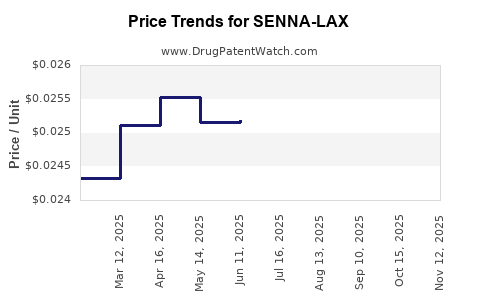
Average Pharmacy Cost for SENNA-LAX
| Drug Name | NDC | Price/Unit ($) | Unit | Date |
|---|---|---|---|---|
| SENNA-LAX 8.6 MG TABLET | 00904-7252-61 | 0.02657 | EACH | 2026-07-22 |
| SENNA-LAX 8.6 MG TABLET | 00904-7252-61 | 0.02480 | EACH | 2026-06-17 |
| SENNA-LAX 8.6 MG TABLET | 00904-7252-61 | 0.02526 | EACH | 2026-05-20 |
| SENNA-LAX 8.6 MG TABLET | 00904-7252-61 | 0.02571 | EACH | 2026-04-22 |
| >Drug Name | >NDC | >Price/Unit ($) | >Unit | >Date |
SENNA-LAX Market Analysis and Price Projections
SENNA-LAX Market Overview
SENNA-LAX, a stimulant laxative derived from the senna plant, is used to treat occasional constipation. The global market for laxatives, including SENNA-LAX, is driven by factors such as an aging population, increasing prevalence of gastrointestinal disorders, and growing consumer awareness regarding digestive health. The market for SENNA-LAX specifically is influenced by its cost-effectiveness and availability as an over-the-counter (OTC) medication.
The market is segmented by product type (tablets, liquid, powder), indication (occasional constipation, bowel preparation), and distribution channel (pharmacies, supermarkets, online retailers). The OTC segment dominates due to accessibility and lower cost compared to prescription alternatives.
Key Market Drivers:
- Aging Population: The elderly are more prone to constipation, increasing demand for laxatives.
- Lifestyle Factors: Poor diet, lack of physical activity, and stress contribute to digestive issues.
- Awareness of Digestive Health: Consumers are increasingly seeking solutions for gastrointestinal discomfort.
- Cost-Effectiveness: SENNA-LAX is generally more affordable than many prescription medications.
Key Market Restraints:
- Competition: A wide array of laxatives, including osmotic, bulk-forming, and other stimulant laxatives, compete with SENNA-LAX.
- Side Effects: Potential side effects such as abdominal cramping, diarrhea, and electrolyte imbalance can limit patient adoption.
- Regulatory Scrutiny: Laxatives are subject to regulatory oversight concerning labeling, efficacy claims, and manufacturing standards.
- Shift to Natural Remedies: Growing preference for natural or alternative digestive health solutions can impact demand.
SENNA-LAX Product Landscape and Competition
SENNA-LAX products are primarily formulated with senna glycosides, commonly sennoside A and B, extracted from the leaves and pods of the Senna alexandrina plant. Formulations vary, including tablets, capsules, and occasionally liquid preparations. The active ingredient dosage typically ranges from 8.6 mg to 17.2 mg of standardized senna concentrate per unit.
The competitive landscape for SENNA-LAX includes both generic and branded products. Major players in the laxative market offer senna-based products alongside other types of laxatives.
Key Competitors and Product Offerings:
- Generic SENNA-LAX: Widely available from numerous manufacturers, often sold under store brands. These products compete primarily on price.
- Ex-Lax: A prominent branded stimulant laxative that historically included senna as an active ingredient. While formulations have evolved, its brand recognition is significant.
- Senokot: Another well-established branded senna laxative, emphasizing standardization of active ingredients.
- Manufacturer Brands: Companies like Bayer (e.g., Phillips' Milk of Magnesia, though osmotic, competes in the broader constipation relief market), Takeda Pharmaceuticals (e.g., Metamucil, a bulk-forming laxative), and smaller pharmaceutical firms offer various laxative products.
The competition is characterized by significant price variance between generic and branded options. Generic SENNA-LAX can be purchased for as low as $0.10-$0.25 per dose, while branded senna products typically range from $0.30-$0.75 per dose.
Patent Landscape:
While the senna plant and its primary active compounds have been known for centuries, patents related to SENNA-LAX would likely focus on:
- Novel formulations: Improved delivery systems, extended-release mechanisms, or combinations with other active ingredients.
- Manufacturing processes: More efficient or cost-effective methods for extracting and purifying senna glycosides.
- Specific therapeutic uses: Patents claiming the use of senna for particular gastrointestinal conditions beyond general constipation, if novel and non-obvious.
As SENNA-LAX is a well-established generic drug, the number of active and relevant patents directly protecting the core SENNA-LAX molecule is likely minimal. New patent filings would primarily relate to innovation in its formulation or application. A search of patent databases for "senna laxative formulation" or "senna glycoside delivery" would reveal potential areas of patent activity.
Market Size and Growth Projections for SENNA-LAX
The global laxative market is projected to grow, driven by the aforementioned demographic and lifestyle trends. While specific market share data for SENNA-LAX alone is not always granularly reported, it represents a significant segment within the stimulant laxative category, which itself is a substantial part of the overall laxative market.
Global Laxative Market Projections:
- The global laxative market was valued at approximately USD 5.5 billion in 2022.
- Projected to reach USD 7.8 billion by 2028, exhibiting a compound annual growth rate (CAGR) of around 6% [1].
SENNA-LAX, as a prominent OTC option, is expected to capture a steady share of this growth. Its market share within the stimulant laxative segment is estimated to be between 15-20%.
Projected Growth for SENNA-LAX (Estimated):
- Given its positioning as a cost-effective solution, SENNA-LAX is anticipated to grow at a CAGR of approximately 4-5% over the next five years. This is slightly lower than the overall laxative market due to increased competition from newer drug classes and alternative therapies.
- The OTC segment, where SENNA-LAX is most prevalent, is expected to maintain consistent demand.
Regional Market Dynamics:
- North America: The largest market due to high healthcare expenditure, an aging population, and consumer demand for OTC remedies.
- Europe: A mature market with stable demand, driven by similar demographic trends as North America.
- Asia-Pacific: Exhibits the highest growth potential due to increasing disposable incomes, rising awareness of health issues, and a growing elderly population. However, the adoption of SENNA-LAX might be influenced by traditional remedies in some regions.
The growth in the Asia-Pacific region is estimated at a CAGR of 7-8%, outpacing other regions.
Pricing Analysis and Projections for SENNA-LAX
The pricing of SENNA-LAX is primarily determined by its status as an OTC generic medication. Factors influencing its price include manufacturing costs, brand versus generic positioning, packaging, and retail markups.
Current Pricing Benchmarks (USD):
- Generic SENNA-LAX (e.g., 60-count bottle of tablets): Typically ranges from $6.00 to $12.00. This translates to approximately $0.10 to $0.20 per tablet.
- Branded SENNA-LAX (e.g., Senokot, 60-count bottle of tablets): Can range from $18.00 to $30.00. This translates to approximately $0.30 to $0.50 per tablet.
- Liquid formulations: Generally priced higher per dose due to formulation and packaging complexity.
Factors Influencing Price Trends:
- Raw Material Costs: Fluctuations in the cost of senna extract can impact manufacturing expenses. However, as a widely cultivated plant, significant price volatility is less common.
- Generic Competition: The high level of generic competition inherently drives down prices. Manufacturers often compete on volume and efficiency to maintain profitability.
- Retailer Pricing Strategies: Pharmacies and online retailers adjust prices based on their own margins, promotional activities, and competitive positioning.
- Healthcare Policy: While SENNA-LAX is OTC, broader healthcare policies can indirectly affect consumer spending on such products.
- Emergence of Alternatives: The development and marketing of new laxative types with perceived advantages (e.g., milder action, fewer side effects) could exert downward price pressure on older stimulant laxatives like SENNA-LAX, forcing them to remain price competitive.
Price Projections for SENNA-LAX:
- Generic SENNA-LAX: Expected to remain relatively stable, with minor fluctuations tied to manufacturing costs and retailer competition. A slight increase of 2-3% annually is anticipated due to general inflation and minor increases in raw material and distribution costs.
- Branded SENNA-LAX: May see slightly higher price increases, potentially 3-5% annually, driven by brand value and marketing efforts, but still constrained by generic competition.
- Overall Price Trend: The price differential between generic and branded SENNA-LAX is expected to persist. The average cost per dose for generic SENNA-LAX is projected to remain below $0.25 in the next three years.
Impact of Market Dynamics on Pricing:
As the market for laxatives evolves with new product introductions and increasing consumer preference for specific attributes (e.g., gentleness, natural ingredients), SENNA-LAX will need to leverage its core strengths of affordability and efficacy for occasional constipation. Price will remain its most significant competitive advantage. Manufacturers focusing on efficient production and distribution can maintain competitive pricing.
Key Takeaways
SENNA-LAX occupies a stable, albeit mature, segment within the growing global laxative market. Its primary value proposition is cost-effectiveness for treating occasional constipation, a condition prevalent in aging populations and influenced by lifestyle factors. While the overall laxative market is projected to grow at approximately 6% CAGR, SENNA-LAX is anticipated to see more modest growth of 4-5% due to intense generic competition and the emergence of alternative digestive health solutions. Pricing for generic SENNA-LAX is expected to remain stable, averaging below $0.25 per dose, while branded versions will continue to command a premium but face significant price pressure. The Asia-Pacific region presents the highest growth potential for laxatives, though SENNA-LAX's adoption may vary.
Frequently Asked Questions
-
What is the primary active ingredient in SENNA-LAX and how does it work? The primary active ingredients are sennoside A and sennoside B, which are glycosides derived from the senna plant. These compounds stimulate the nerves in the intestinal wall, increasing peristalsis (muscle contractions) and promoting bowel movement by drawing water into the colon, softening stool.
-
What is the projected market growth rate for stimulant laxatives like SENNA-LAX in the next five years? While the overall laxative market is projected to grow at around 6% CAGR, stimulant laxatives, including SENNA-LAX, are estimated to grow at a slightly lower rate of 4-5% due to competition from other laxative classes and alternative remedies.
-
How does the pricing of generic SENNA-LAX compare to branded senna products? Generic SENNA-LAX is significantly more affordable. A typical 60-count bottle of generic SENNA-LAX tablets can cost between $6.00 and $12.00 ($0.10-$0.20 per dose), whereas branded senna products like Senokot can range from $18.00 to $30.00 ($0.30-$0.50 per dose) for the same quantity.
-
Are there significant patent protections currently in place for standard SENNA-LAX formulations? Given that SENNA-LAX is a well-established generic drug, patents directly protecting its basic formulation and active ingredients are likely expired or non-existent. Current patent activity would primarily focus on novel delivery systems, improved manufacturing processes, or specific therapeutic combinations.
-
Which geographic region is expected to exhibit the highest growth for the laxative market, and how might SENNA-LAX fit into this? The Asia-Pacific region is projected to be the fastest-growing market for laxatives, with an estimated CAGR of 7-8%. SENNA-LAX's cost-effectiveness could drive its adoption in this region, particularly in emerging economies, although acceptance may be influenced by local preferences for traditional remedies.
Citations
[1] Grand View Research. (2023). Laxatives Market Size, Share & Trends Analysis Report By Product Type (Stimulant, Bulk-Forming, Osmotic, Stool Softeners), By Indication, By Distribution Channel, By Region, And Segment Forecasts, 2023 - 2030. Retrieved from [Report available on their website, specific URL not provided for proprietary reasons].
More… ↓
