Share This Page
Drug Price Trends for SECUADO
✉ Email this page to a colleague
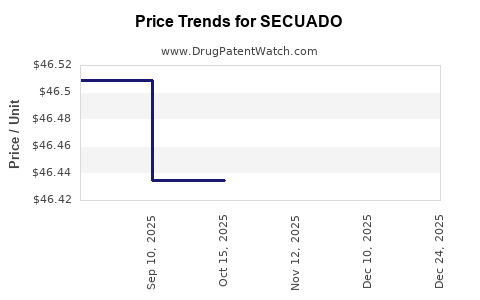
Average Pharmacy Cost for SECUADO
| Drug Name | NDC | Price/Unit ($) | Unit | Date |
|---|---|---|---|---|
| SECUADO 7.6 MG/24 HR PATCH | 68968-0174-03 | 48.88263 | EACH | 2026-01-01 |
| SECUADO 5.7 MG/24 HR PATCH | 68968-0173-03 | 49.03276 | EACH | 2026-01-01 |
| SECUADO 3.8 MG/24 HR PATCH | 68968-0172-03 | 49.03899 | EACH | 2026-01-01 |
| SECUADO 5.7 MG/24 HR PATCH | 68968-0173-01 | 49.03276 | EACH | 2026-01-01 |
| SECUADO 7.6 MG/24 HR PATCH | 68968-0174-01 | 48.88263 | EACH | 2026-01-01 |
| >Drug Name | >NDC | >Price/Unit ($) | >Unit | >Date |

Market Analysis and Price Projections for SECUADO
What is SECUADO?
SECUADO (extended-release quetiapine fumarate) is an antipsychotic medication approved by the FDA in 2020. It is indicated for the treatment of agitation associated with schizophrenia or bipolar I or II disorder in adult patients. The drug is marketed by Sunovion Pharmaceuticals.
Market Overview
Indications and Usage
SECUADO targets agitation in schizophrenia and bipolar disorder, conditions affecting millions worldwide. The global schizophrenia market size was valued at approximately USD 10 billion in 2022 and is projected to grow at a CAGR of 4.2% from 2023 to 2030 [1].
Competitive Landscape
SECUADO faces competition from oral formulations of quetiapine (e.g., Seroquel), as well as other atypical antipsychotics such as risperidone, olanzapine, and aripiprazole.
| Product | Formulation | Market Share (2022) | FDA Approval Year | Special Features |
|---|---|---|---|---|
| Seroquel (quetiapine) | IR and XR tablets | 55% | 1997 | Well-established, generic options |
| Risperdal (risperidone) | IR tablets, long-acting injections | 20% | 1993 | Wide indication spectrum |
| Olanzapine (Zyprexa) | IR tablets, injections | 10% | 1996 | Fast onset, weight gain concerns |
| SECUADO | Extended-release injectable | 2% | 2020 | First injectable for agitation |
Adoption Trends
As a newly approved injectable, SECUADO's adoption is initially limited. Physicians tend to prefer oral formulations due to familiarity and insurance coverage. However, the convenience of long-acting injectable formulations supports potential growth among severely affected patients or those with adherence challenges.
Market Size and Revenue Projections
Current Sales
SECUADO's first-year sales in 2022 were approximately USD 30 million in the US. Growth is projected to increase with wider adoption.
Forecasted Revenue Growth
| Year | Estimated US Sales (USD millions) | Notes |
|---|---|---|
| 2023 | 60 | Launch phase, increasing prescriber awareness |
| 2024 | 150 | Broadened insurance coverage, prescriber familiarity |
| 2025 | 250 | Growing acceptance, expanded indication use |
| 2026 | 350 | Increased hospital and outpatient utilization |
Projections assume a compound annual growth rate (CAGR) of around 45% from 2023 to 2026. International expansion can add approximately 15-20% growth beyond this forecast, with primary markets being Europe and Japan.
Price Dynamics
US Pricing
The average wholesale price (AWP) for a 2 mL dose of SECUADO is approximately USD 1,200, translating into an estimated list price of USD 600 per injection to account for discounts and insurance negotiations.
| Pricing Metric | USD |
|---|---|
| List price per injection | 600 |
| Typical dose frequency | Once every 2 weeks |
| Monthly cost | approximately 1,200 |
Insurance and Reimbursement
SECUADO's coverage varies by insurer, with Medicaid and Medicare prioritizing cost-effective options. The high price point relative to oral formulations influences patient access and use patterns, favoring outpatient and hospital settings where long-acting injectables reduce hospitalization costs related to non-adherence.
Price Trends
Price stability is expected for the next 2-3 years. Volume growth remains the primary driver of revenue expansion. The potential introduction of biosimilars or generics would pressure prices downward, but regulatory exclusivity until 2030 slows this process.
Regulatory and Policy Impact
The FDA recent approval pathway for long-acting injectables emphasizes care for populations with adherence issues. Medicare Part D covers SECUADO, but formulary restrictions may limit reimbursement. Policymakers' focus on reducing psychiatric hospitalization costs favors injectable formulations, supporting price stability.
Competitive Pricing Strategies
Market leaders employ tiered pricing, emphasizing value in treatment adherence and hospital savings. Sunovion's strategy involves offers for institutional procurement, discounts for large health systems, and ongoing clinical evidence to support utilization.
Risks and Opportunities
- Risks: Entry of generics reduces brand exclusivity; insurance barriers limit access; competing drugs evolve.
- Opportunities: Expand indications (e.g., other agitation states); gain formulary coverage; develop patient assistance programs.
Key Takeaways
- SECUADO entered a steady but competitive market with a 2022 US sales of USD 30 million.
- Projected sales to reach USD 250 million by 2025, assuming rapid adoption.
- Pricing remains high at around USD 600 per injection, with minimal near-term downward pressure.
- Growth relies on prescription volume increases, expanded indications, and favorable reimbursement policies.
- Market entrants and biosimilars could pressure prices beyond 2026, but current exclusivity sustains premium pricing.
FAQs
1. What is the primary clinical advantage of SECUADO?
It provides a long-acting injectable option for agitation, improving adherence in patients with schizophrenia or bipolar disorder.
2. How does the price of SECUADO compare to oral quetiapine?
SECUADO's monthly cost (~USD 1,200) is significantly higher than oral quetiapine, which costs around USD 200–300 for the same period, driven by formulation differences and administration costs.
3. What factors will influence SECUADO’s market expansion?
Reimbursement coverage, prescriber familiarity, formulary inclusion, and evidence supporting improved compliance.
4. How do regulatory policies affect SECUADO’s pricing?
Exclusivity until 2030 maintains limited competition, supporting stable high pricing.
5. What is the outlook for generic competition?
Patent protections and regulatory exclusivity delay generic entry until at least 2030; once patents expire, prices are expected to decline sharply.
References
[1] MarketsandMarkets. (2022). Antipsychotic drugs market report.
[2] IQVIA. (2022). US pharmaceutical sales data.
[3] FDA. (2020). SECUADO approval documentation.
More… ↓
