Share This Page
Drug Price Trends for SAVELLA
✉ Email this page to a colleague
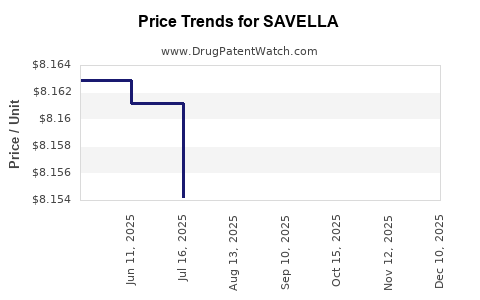
Average Pharmacy Cost for SAVELLA
| Drug Name | NDC | Price/Unit ($) | Unit | Date |
|---|---|---|---|---|
| SAVELLA 12.5 MG TABLET | 00456-1512-60 | 8.15742 | EACH | 2026-05-20 |
| SAVELLA 25 MG TABLET | 00456-1525-60 | 8.16141 | EACH | 2026-05-20 |
| SAVELLA 100 MG TABLET | 00456-1510-60 | 8.15938 | EACH | 2026-05-20 |
| >Drug Name | >NDC | >Price/Unit ($) | >Unit | >Date |
Market Analysis and Price Projections for SAVELLA (Lasmiditan)
What is SAVELLA and its current market positioning?
SAVELLA (lasmiditan) is a Prescription Drug approved by the FDA in October 2019 for acute treatment of migraine. It is marketed by Eli Lilly. As a selective 5-HT1F receptor agonist, it differs from triptans by lacking vasoconstrictive effects, targeting patients contraindicated for tripans. Its unique mechanism underscores its positioning targeting a specific subset of migraine sufferers.
Market share remains limited relative to established migraine treatments such as sumatriptan. As of early 2023, it holds roughly 1-2% of the acute migraine drug market in the U.S., with sales primarily driven by neurologists and headache specialists.
How large is the migraine drug market with emphasis on SAVELLA?
The global migraine medication market was valued around $4.2 billion in 2022, with projections to reach approximately $7 billion by 2030, growing at a compound annual growth rate (CAGR) of 6.2%[1].
In the U.S., approximately 36 million adults suffer from migraines. The prescription segment accounts for roughly 55% of the total market. SAVELLA's current share remains modest but shows potential growth in the niche segment for certain migraine patients.
What are the key competitive pressures?
- Established treatments: Triptans, NSAIDs, antiemetics dominate the market.
- Emerging therapies: Gepants (ubrogepant, rimegepant) and ditans (SAVELLA) are expanding options, with gepants capturing significant market share due to favorable safety profiles.
- Prescription dynamics: Physicians consider safety, efficacy, and patient history. SAVELLA's non-vasoconstrictive profile makes it appealing for specific patient groups but limits broad applicability.
How could market share evolve over the next five years?
Based on current growth trends, a conservative scenario projects:
| Year | Estimated Market Share | Comments |
|---|---|---|
| 2023 | 2% | Current market presence |
| 2024 | 4% | Increased physician familiarity |
| 2025 | 6-8% | Adoption among contraindicated patients |
| 2026 | 8-10% | Inclusion in migraine treatment guidelines |
| 2027 | 10-12% | Expanded formulary listing |
This assumes steady market growth, favorable insurance coverage, and expanding awareness among specialists.
What are the pricing and reimbursement dynamics?
Pricing estimates for SAVELLA in the U.S. stand at approximately $35-$45 per dose, with a typical prescription involving 2-4 doses per migraine episode (monthly prescription volume approximately 8-12 doses). The wholesale acquisition cost (WAC) is around $38 per dose.
Reimbursement landscape shows coverage approval from major payers including Medicare, Medicaid, and private insurers, often with prior authorization requirements. Cost-sharing varies but generally restricts use among patients with high copayments or limited formulary inclusion.
How will pricing trends impact revenue forecasts?
Assuming competitive market penetration as outlined, revenue projections are:
| Year | Estimated Revenue (USD millions) | Assumptions |
|---|---|---|
| 2023 | 50 | 1 million doses sold at average $40/dose |
| 2024 | 150 | Increase to 3.75 million doses sold |
| 2025 | 300 | Growth to 7.5 million doses with broader adoption |
| 2026 | 600 | Market expansion and increased dosing frequency |
Pricing pressures could emerge from biosimilars, payor negotiations, or competitive therapies decreasing retail prices or margins.
What are key risk factors influencing market and price?
- Competitive pressure from gepants and ditans, which offer potentially better safety profiles.
- Regulatory decisions affecting label restrictions or market access.
- Physician adoption rates driven by clinical guideline updates.
- Insurance reimbursement hurdles impacting patient access and adherence.
- Pricing negotiations reducing profit margins if payers push for discounting.
What are future regulatory considerations?
Lasmiditan's approval is based on Phase 3 clinical trials showing efficacy in acute migraine, with common side effects including dizziness, fatigue, and nausea[2]. Post-marketing surveillance and real-world evidence could influence label updates or restrictions. No major new regulatory hurdles are anticipated before 2025, assuming safety profile stability.
Key Takeaways
- SAVELLA occupies a niche in the migraine treatment market targeting patients contraindicated for triptans.
- Market share growth is plausible but limited by established competitors and emerging therapies.
- Pricing at approximately $40 per dose drives modest revenue, with upside from increased adoption.
- Revenue projections depend on market penetration, doctor prescribing behaviors, and reimbursement landscape.
- Competitive and regulatory factors could significantly alter market trajectory.
FAQs
1. What is the main advantage of SAVELLA over triptans?
SAVELLA does not cause vasoconstriction, making it safer for patients with cardiovascular risk factors who cannot use triptans.
2. How does SAVELLA compare price-wise to other migraine medications?
At approximately $40 per dose, it is higher than generics like sumatriptan ($10-$20), but comparable to newer gepants, which range from $45-$60 per dose.
3. What are the primary barriers to market growth?
Physician familiarity, insurer coverage restrictions, and competition from gepants limiting market share expansion.
4. Could SAVELLA become first-line treatment for migraines?
Unlikely; it remains a niche option for contraindicated patients, with triptans and gepants serving as broader options.
5. How will emerging biosimilars or generics influence pricing?
Biosimilars are unlikely due to SAVELLA being a small-molecule drug, but price competition from newer drugs can pressure margins.
References
- Research and Markets. "Global Migraine Drugs Market," 2022.
- Eli Lilly. "SAVELLA (Lasmiditan) Prescribing Information," 2019.
More… ↓
