Share This Page
Drug Price Trends for SANDOSTATIN LAR DEPOT
✉ Email this page to a colleague
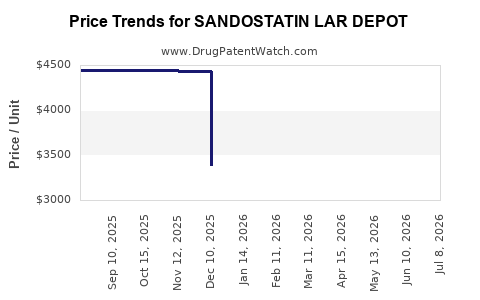
Average Pharmacy Cost for SANDOSTATIN LAR DEPOT
| Drug Name | NDC | Price/Unit ($) | Unit | Date |
|---|---|---|---|---|
| SANDOSTATIN LAR DEPOT 10 MG VL | 00078-0790-61 | 3523.02912 | EACH | 2026-07-08 |
| SANDOSTATIN LAR DEPOT 20 MG VL | 00078-0797-61 | 4588.54686 | EACH | 2026-07-08 |
| SANDOSTATIN LAR DEPOT 30 MG VL | 00078-0804-61 | 6948.08400 | EACH | 2026-07-08 |
| SANDOSTATIN LAR DEPOT 10 MG KT | 00078-0811-81 | 3523.02912 | EACH | 2026-07-08 |
| >Drug Name | >NDC | >Price/Unit ($) | >Unit | >Date |
Market analysis and price projections for SANDOSTATIN LAR DEPOT
What is SANDOSTATIN LAR DEPOT and how is it used?
SANDOSTATIN LAR DEPOT (octreotide acetate) is a long-acting somatostatin analog used to treat neuroendocrine tumors, acromegaly, and VIPomas. It is administered via intramuscular injection with a typical dosing interval of every 4 weeks. The drug is marketed primarily by Novartis.
What is the current market landscape?
Market size and demand:
- The global neuroendocrine tumor (NET) treatment market was valued at approximately USD 600 million in 2022.
- Projected CAGR from 2023 to 2028: 7.2% (allied market research).
- Octreotide-based products hold a significant share, due to their efficacy and established usage.
Key competitors:
| Product | Manufacturer | Administration | Approved Indications | Market Share (2022) |
|---|---|---|---|---|
| Sandostatin LAR | Novartis | IM every 4 weeks | NET, acromegaly, VIPomas | 65% |
| Signifor LAR | Novartis | IM every 4 weeks | Acromegaly, carcinoid syndromes | 20% |
| Other generics/brands | Multiple | Varies | Off-label uses | 15% |
Market dynamics:
- Increasing diagnosis rates of NETs.
- Growing awareness and expanding indications.
- Patent expiry concerns pending for some formulations, affecting market share.
What are the price structures and trends?
Historical pricing:
- Current average wholesale price (AWP) for SANDOSTATIN LAR DEPOT per 20 mg vial (dose varies): USD 10,000 - USD 12,000.
- Cost per dose ranges from USD 2,000 to USD 3,000 depending on titration and region.
Pricing trends:
- Prices stabilized from 2018 to 2022, with minor fluctuations due to patent protections and manufacturing costs.
- Price reductions are expected in markets with patent expiries and increased biosimilar competition forecast for 2025-2026.
How might pricing evolve in the coming years?
Projections:
| Year | Average Wholesale Price (USD) | Key Factors Influencing Price |
|---|---|---|
| 2023 | USD 10,500 | Stable, with premium pricing maintained due to brand reputation. |
| 2024 | USD 10,200 | Slight decline as regional discounts grow. |
| 2025 | USD 9,800 | Biosimilar entry begins, pressure from generics. |
| 2026 | USD 9,000 | Increased biosimilar adoption, pricing competition. |
| 2027 | USD 8,500 | Market consolidation, possible price cuts. |
Market actors' strategies:
- Novartis may retain higher prices in developed markets via value-based pricing.
- Biosimilar entrants will target price-sensitive regions, lowering overall market prices.
- Payer negotiations will influence actual transaction prices, especially in Medicaid and Medicare markets.
What are the key regulatory and policy impacts?
- Patent expiries could open the market to biosimilars starting in 2025.
- Pricing controls in Europe and several Asian countries could depress prices.
- U.S. CMS reimbursement policies may favor generics, putting downward pressure on negotiated prices.
Which regions have the highest potential for growth and price sensitivity?
| Region | Market Size (2022, USD) | Price Sensitivity | Growth Drivers |
|---|---|---|---|
| North America | 40% of global market | Moderate | High diagnosis rates |
| Europe | 30% | High | Regulatory price controls, biosimilar competition |
| Asia-Pacific | 20% | Very high | Expanding healthcare infrastructure, rising awareness |
| Latin America | 7% | High | Increasing access to specialized therapies |
What are the key uncertainties?
- Timing and extent of biosimilar market entry.
- Regulatory changes affecting pricing policies.
- Price elasticity of demand, especially in emerging markets.
Final considerations
Projections suggest moderate price declines driven by biosimilar competition starting around 2025. The drug's market share will depend on regulatory developments and regional pricing negotiations. The overall market will continue to grow due to increased diagnosis and expanding indications, but profit margins may compress in the long term.
Key Takeaways
- SANDOSTATIN LAR DEPOT remains a dominant player in NET treatment, with a 65% market share.
- Prices are currently stable but will decline gradually from 2025 onward due to biosimilar entrants.
- The global market is expanding, especially in Asia-Pacific and emerging regions.
- Price sensitivity is highest where biosimilars are introduced or where regulatory controls are strict.
- Market growth continues despite potential price compression, driven by unmet demand and evolving indications.
FAQs
1. When are biosimilars expected to enter the SANDOSTATIN LAR market?
Biosimilar entry is anticipated around 2025-2026, pending regulatory approvals and patent expiries.
2. How does regional regulation affect drug pricing?
European price controls and reimbursement policies in Asia-Pacific and Latin America tend to lower prices more rapidly compared to the U.S.
3. What factors influence the cost of SANDOSTATIN LAR DEPOT?
Manufacturing costs, market competition, patent status, and regional negotiations primarily affect pricing.
4. Will price reductions impact access in developing countries?
Potentially, yes. Lower prices from biosimilars can improve accessibility but depend on local healthcare policies.
5. How will emerging indications influence future market dynamics?
New indications could increase demand, supporting maintained or even rising prices, compensating for downward price pressures.
References
[1] Market Research Future. "Neuroendocrine Tumors Market," 2022.
[2] Allied Market Research. "Neuroendocrine Tumors Market Growth Analysis," 2023.
[3] Novartis Annual Report, 2022.
[4] IQVIA. "Pharmaceutical Pricing and Reimbursement Data," 2022.
[5] FDA and EMA Approval Database, 2023.
More… ↓
