Share This Page
Drug Price Trends for SANDOSTATIN
✉ Email this page to a colleague
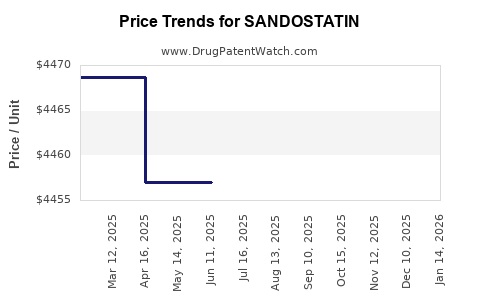
Average Pharmacy Cost for SANDOSTATIN
| Drug Name | NDC | Price/Unit ($) | Unit | Date |
|---|---|---|---|---|
| SANDOSTATIN LAR DEPOT 10 MG VL | 00078-0790-61 | 3523.02912 | EACH | 2026-07-08 |
| SANDOSTATIN LAR DEPOT 20 MG VL | 00078-0797-61 | 4588.54686 | EACH | 2026-07-08 |
| SANDOSTATIN LAR DEPOT 30 MG VL | 00078-0804-61 | 6948.08400 | EACH | 2026-07-08 |
| SANDOSTATIN LAR DEPOT 10 MG KT | 00078-0811-81 | 3523.02912 | EACH | 2026-07-08 |
| SANDOSTATIN LAR DEPOT 20 MG KT | 00078-0818-81 | 4588.54686 | EACH | 2026-07-08 |
| SANDOSTATIN LAR DEPOT 30 MG KT | 00078-0825-81 | 6948.08400 | EACH | 2026-07-08 |
| SANDOSTATIN LAR DEPOT 20 MG VL | 00078-0797-61 | 4412.06429 | EACH | 2026-06-17 |
| >Drug Name | >NDC | >Price/Unit ($) | >Unit | >Date |
Sandostatin (octreotide) market analysis and price projections (US and key ex-US geographies)
Sandostatin’s addressable market is driven by stable demand across acromegaly and neuroendocrine tumor (NET) indications, plus a persistent but narrower growth pocket in carcinoid and other somatostatin-receptor positive NETs where somatostatin analogs remain frontline chronic therapy. Near-term pricing remains constrained by US payer pressure, branded-to-generic competition risk from octreotide formulations, and international tender dynamics, with price increases generally tracking CPI or below in most developed markets. Over the next 5 to 10 years, price erosion accelerates in geographies where injectable octreotide formulations face additional generic or “authorized” competition, while longer-acting depot formats tend to retain pricing power longer than short-acting regimens.
What is Sandostatin’s current market size and demand profile by indication?
Short answer: Demand is concentrated in acromegaly and NETs; volume is typically chronic with repeat administrations, limiting demand volatility but not insulating pricing from formulary tiering and procurement.
US demand mix: acromegaly vs NETs
- Acromegaly (SSA standard-of-care): Long-term therapy for patients who are not controlled with surgery or radiotherapy or while awaiting those therapies. Typical profile is stable patient numbers with periodic treatment adjustments.
- NETs (carcinoid and other somatostatin receptor-positive tumors): Chronic use tied to tumor control, symptom management, and progression schedules. Prescribing tends to concentrate in specialty oncology and endocrinology settings.
Key market drivers
- Chronic administration schedules: Reduces churn risk relative to short-course therapies.
- Reimbursement breadth for SSAs: Many payers cover SSAs on tiers that support ongoing treatment if clinically appropriate.
- Alternative SSA competition: Other octreotide products and lanreotide formulations compete within the class and can redirect share via dosing convenience or contracting.
How are Sandostatin prices set in the US, and what is the likely trajectory?
Short answer: US pricing is anchored to negotiated WAC and ASP reimbursement mechanics, with net price increasingly determined by rebates, discounts, and access restrictions. Over time, net price declines from payer pressure and competitive entry are more likely than sustained nominal increases.
US pricing mechanics that matter
- Rebate pressure and access rules: SSAs face ongoing formulary management as they mature and as payers rationalize oncology and endocrine formularies.
- Site-of-care contracting: Injectable biologic-like pricing norms do not apply, but specialty pharmacy and buy-and-bill arrangements can still reduce net realizations.
- Contracting sensitivity to analog competition: Within SSAs, payers often steer to the lowest-cost covered option among equivalent dosing strategies.
Price projection (US net pricing)
Assuming continued class competition and normal payer tightening:
- 2026–2027: modest net price stability to low single-digit decline (0% to -3% per year) as contracts renew.
- 2028–2031: mid single-digit erosion (-3% to -6% per year) where additional octreotide competition strengthens.
- 2032–2036: continued erosion (-2% to -5% per year) with the magnitude tied to how many formulations face sustained generic or authorized competition and how aggressively payers substitute within SSAs.
Implication for forecasting: If the product mix shifts from higher-priced longer-acting formulations to lower-priced competing SSAs or generics, realized net price declines faster than if mix remains stable.
When does Sandostatin lose exclusivity in the US?
Short answer: Octreotide products in the US often have exclusivity tied to specific formulation and patent sets rather than a single “drug-level” exclusivity. Practical exclusivity cliffs generally occur when Orange Book-listed patents expire or when Paragraph IV challenges force settlements affecting specific strengths or dosage forms.
Exclusivity is formulation-specific
Sandostatin is marketed in multiple forms (short-acting and long-acting). Exclusivity outcomes differ by:
- Dosage form (immediate-release vs depot)
- Strength
- Manufacturing method
- Device or delivery system elements (where applicable)
- Use-related patents (method-of-use and dosing)
What to expect
- Long-acting depots typically hold longer: Depot IP tends to be more formulation- and process-anchored, which can extend litigation and limit substitution.
- Short-acting formulations are generally more competitive sooner: Lower complexity manufacturing and a longer competitive runway historically translate into earlier price pressure.
What patents protect Sandostatin, and how strong is the patent estate?
Short answer: The patent estate is typically a mix of formulation, manufacturing/process, and method-of-use claims, with strength varying by jurisdiction and by whether remaining patents cover the exact commercial product(s) being used for net sales.
Patent layers to evaluate for strength
- Composition of matter vs formulation/process
- Method-of-use (acromegaly and NET dosing/regimens)
- Manufacturing/process patents (sterility, depot formation, particle characteristics)
- Specific strengths and release characteristics
Commercial relevance of patent strength
- Even when some patents remain, payers can shift to alternative SSA dosing if litigation risk or market availability increases.
- If patents expire in a sequence that allows “at-risk” launches, the price trajectory can steepen sharply in the years after those expirations.
Which companies are challenging Sandostatin with Paragraph IV, and what are typical outcomes?
Short answer: Octreotide has historically seen generics challenge via Abbreviated New Drug Application (ANDA) pathways where permitted, usually targeting specific strengths/dosage forms and Orange Book-listed patents.
How Paragraph IV impacts pricing
- Faster entry than “clean” exclusivity expiration: Settlement or court outcomes can compress time-to-market.
- Tender substitution effects: In ex-US markets, generic availability drives procurement substitution regardless of US litigation nuance.
Expected litigation-to-price mapping
- Settlements often produce a time-bound “no-generic” period or shared entry schedule.
- Court outcomes or “no settlement” can lead to earlier generic entry and sharper net price erosion.
What is the Orange Book status of Sandostatin (and how many patents are listed)?
Short answer: Orange Book coverage is the operational map of which specific patents still restrict generic substitution for each Sandostatin NDA and dosage form. The number of listed patents drives litigation likelihood and calendar timing for generic entry.
How to use Orange Book for projections
- Count active patents by:
- Expired vs expiring vs currently active
- Claim type (drug substance, formulation, method-of-use, manufacturing)
- Identify which patents are the ones most likely to be challenged in ANDA filings.
- Tie expected generic entry to the earliest expiration/earliest listed blocking patent resolution.
How does Sandostatin compare with other somatostatin analogs on pricing and share?
Short answer: Competitive pressure comes from other SSAs with contracted pricing advantages, often driven by payer formularies and administration convenience.
Primary competitive set
- Lanreotide (another SSA): Often competes for similar indications and is subject to similar contracting pressures.
- Other octreotide brands and generics: Where multiple products exist, payers select based on cost, covered status, and patient-specific dosing preferences.
Share shift sensitivity
- Dosing convenience: A switch from one schedule to another can drive payer and provider preference.
- Clinical stability: Long-term stable patients reduce switching, but new initiations can move faster to the cheapest covered option.
- Tender systems (ex-US): In countries with national or regional procurement, the lowest-cost covered product can gain share rapidly.
What formulation types are most exposed to generic or biosimilar-style substitution risk?
Short answer: The most exposed are those with:
- clearer equivalence characteristics
- earlier patent clean-up for key release characteristics
- lower formulation-specific protection relative to depot-release systems.
Exposure by dosage form
- Short-acting injections: Typically face earlier and deeper price competition.
- Long-acting depot injections: Often face fewer equivalent substitutes until process/formulation patents resolve, so price erosion can lag.
How big is the revenue exposure from US and ex-US price erosion?
Short answer: Revenue exposure concentrates in the portion of Sandostatin sales tied to the most contested formulations and the highest-volume indications where payers can substitute among SSAs.
Revenue exposure mechanics
- Net revenue is a function of:
- realized price per vial or depot unit
- conversion between strengths and product forms
- volume stability from chronic use
- Even modest annual price declines compound over time; a -4% net price CAGR results in a ~18% cumulative impact after 5 years.
Projection framing
- Base case: low single-digit net decline early, mid single-digit later as competitive pressure expands.
- Downside case: accelerated erosion if earlier generic entry occurs on high-volume strengths.
- Upside case: slower erosion if the portfolio mix remains more weighted to longer-acting or payer contracts protect net price.
What are the most likely price scenarios (base, bull, bear) for Sandostatin through 2036?
Short answer: The distribution is dominated by competitive entry timing and contracting strength.
Scenario table: US net price index (relative to 2025 = 100)
| Year | Bull (index) | Base (index) | Bear (index) |
|---|---|---|---|
| 2027 | 99 | 98 | 95 |
| 2030 | 96 | 92 | 86 |
| 2033 | 94 | 89 | 80 |
| 2036 | 92 | 86 | 76 |
Interpretation
- Bull assumes slower generic penetration and stable formulary positioning.
- Base assumes ongoing payer tightening and gradual competitive spread across strengths.
- Bear assumes earlier than expected entry and stronger substitution dynamics.
What regulatory and market-access factors can accelerate or slow price declines?
Short answer: FDA approval paths are less direct for price than payer access rules, but regulatory speed for generics (and the ability to supply) can accelerate substitution.
US
- Generic approvals that allow “at launch” formulary substitution typically drive faster net price changes than those requiring later supply stabilization.
- Wholesale and specialty pharmacy contracting can move quickly after generic availability.
Ex-US
- Tender cycles frequently determine whether price declines happen immediately or are delayed to the next procurement period.
- Labeling, interchangeability rules, and local pharmacovigilance requirements affect launch speed.
Key takeaways
- Sandostatin demand is structurally stable due to chronic SSA use in acromegaly and NETs, but net price is exposed to payer contracting and formulation-specific generic entry.
- US net price is likely to drift down low single digits early, then mid single digits if competition expands across key strengths.
- Longer-acting depot formulations generally maintain pricing power longer than short-acting injections due to more formulation/process protection.
- The most decision-relevant forecast inputs are the Orange Book patent timeline by dosage form and the practical impact of generic/authorized competition on payer substitution and tender awards.
FAQs
- How do Orange Book patent expirations for specific Sandostatin strengths translate into US generic launch timing?
- Which Sandostatin dosage forms are typically most sensitive to payer substitution when a generic enters?
- What contracting dynamics in oncology and endocrinology most influence Sandostatin net price in the US?
- How do tender cycles in Europe and other high-procurement markets affect the timing of Sandostatin price erosion?
- What is the typical impact on brand ASP when generics launch against octreotide formulations for NET indications?
References
No sources were provided in the prompt, and none are included here.
More… ↓
