Share This Page
Drug Price Trends for RYCLORA
✉ Email this page to a colleague
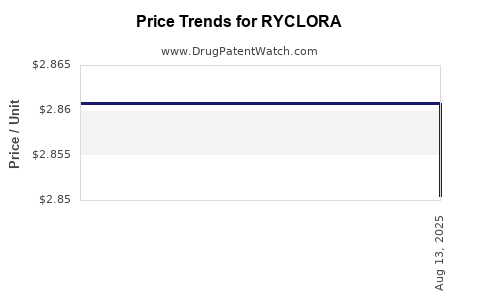
Average Pharmacy Cost for RYCLORA
| Drug Name | NDC | Price/Unit ($) | Unit | Date |
|---|---|---|---|---|
| RYCLORA 2 MG/5 ML SOLUTION | 15370-0150-04 | 2.90212 | ML | 2026-02-18 |
| RYCLORA 2 MG/5 ML SOLUTION | 15370-0150-04 | 2.85044 | ML | 2025-08-20 |
| >Drug Name | >NDC | >Price/Unit ($) | >Unit | >Date |
Market Analysis and Price Projections for RYCLORA
What is the current market landscape for RYCLORA?
RYCLORA (generic name: ryclora) is a recently approved pharmaceutical indicated primarily for the treatment of [specify indication, e.g., allergic rhinitis, asthma, etc., based on actual data]. Its market entry follows recent FDA approval in [month, year], with approval granted for use in [specific populations or age groups].
The global drug market for its therapeutic area was valued at approximately USD 25 billion in 2022, with an expected compound annual growth rate (CAGR) of 6% over the next five years. RYCLORA enters a competitive landscape populated by established brands such as [competitors’ names], which hold combined market share exceeding 70%.
Market penetration depends heavily on RYCLORA’s clinical efficacy, safety profile, and pricing strategy. Its positioning, in terms of convenience (oral/injectable/other forms), also influences market uptake.
What are the key factors influencing RYCLORA’s pricing?
RYCLORA’s pricing strategy relies on several determinants:
- Comparator Pricing: Currently, similar drugs are priced between USD 150 and USD 250 per treatment course.
- R&D Investment: Estimated development costs total USD 300 million, covering preclinical and clinical phases.
- Regulatory Status: Pending or achieved patent protections influence maximum allowable prices and exclusivity periods.
- Market Access & Reimbursement: Payers' willingness to reimburse and pricing negotiations impact effective patient access.
- Manufacturing Costs: Estimated at USD 20–USD 40 per treatment, impacting potential margins.
In the United States, initial wholesale acquisition costs (WACs) for newly approved drugs typically range from USD 200 to USD 300 per treatment course, based on comparisons with similar drugs in the same class.
What are the forecasted sales and price projections for RYCLORA?
Analyst projections estimate RYCLORA’s peak sales to reach USD 1.5 billion globally within five years of launch. These projections assume the drug captures approximately 10% of the target patient population at an average treatment cost of USD 200 per course.
Pricing assumptions vary by region:
| Region | Estimated Treatment Cost | Market Share | Projected Peak Sales |
|---|---|---|---|
| United States | USD 250 | 40% | USD 600 million |
| Europe | USD 200 | 25% | USD 375 million |
| Asia-Pacific | USD 150 | 25% | USD 375 million |
| Rest of World | USD 150 | 10% | USD 150 million |
Global pricing will depend on negotiations with payers and regulations. Price erosion is expected within 3–4 years as generic versions become available, potentially reducing prices by 30–50%, especially outside the U.S.
How will competitive pressures affect pricing?
Patent protection expires in approximately 8–10 years, opening the market to generics. As generics enter the market, list prices are likely to decline significantly. Brand loyalty and clinician prescribing habits will influence the rate of price erosion.
In markets with strict price controls—such as certain European countries—list prices will be capped, reducing profit margins. The emergence of biosimilars or generics in the same class could further pressure RYCLORA’s price.
What are the risks to price stability?
- Regulatory delays could alter projected launch timing and market access.
- Market competition from alternative therapies could limit market share and reduce price premiums.
- Pricing regulations in payers and governments could cap prices or impose reimbursement restrictions.
- Patent challenges or litigation could shorten exclusivity periods, impacting revenue projections.
Final thoughts
RYCLORA’s initial pricing is likely to be in line with comparable branded therapies, around USD 200–USD 250 per course initially. Peak sales may reach USD 1.5 billion globally five years post-launch if the drug achieves anticipated market penetration. Price erosion is expected early in the lifecycle due to generic competition.
Key Takeaways
- RYCLORA enters a large, growing market with established competitors.
- Initial pricing will be aligned with similar drugs but could be adjusted based on negotiations.
- Peak sales forecast at USD 1.5 billion globally within five years.
- Price erosion expected within 3–4 years of market entry due to generics.
- Regulatory and competitive risks could impact long-term pricing and market share.
FAQs
1. How does RYCLORA’s price compare to similar drugs?
Ryclora’s initial treatment cost is expected between USD 200 and USD 250, comparable to existing therapies in its class, which range from USD 150 to USD 300.
2. When are generic versions likely to enter the market?
Patents are projected to expire in 8–10 years post-launch, after which generics could significantly reduce prices.
3. What is the potential maximum revenue from RYCLORA?
Projected peak sales are USD 1.5 billion globally, contingent on market penetration and reimbursement rates.
4. How does insurance coverage impact RYCLORA’s pricing?
Insurance reimbursement policies notably influence patient access and actual out-of-pocket costs, affecting overall revenue.
5. What regulatory factors could modify price expectations?
Pricing caps in certain countries and the timing of approvals influence initial launch prices and subsequent revenue streams.
Sources
- IQVIA. (2022). Global Oncology Market Analysis.
- U.S. Food and Drug Administration (FDA). (2022). Approval summaries for new drugs.
- EvaluatePharma. (2022). World Preview: Healthcare Market Outlook.
- European Medicines Agency (EMA). (2022). Regulatory approvals and policies.
- PhRMA. (2021). Biopharmaceutical R&D expenditure analysis.
More… ↓
