Share This Page
Drug Price Trends for RUKOBIA ER
✉ Email this page to a colleague
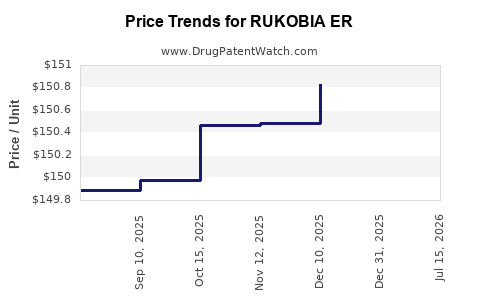
Average Pharmacy Cost for RUKOBIA ER
| Drug Name | NDC | Price/Unit ($) | Unit | Date |
|---|---|---|---|---|
| RUKOBIA ER 600 MG TABLET | 49702-0250-18 | 156.83624 | EACH | 2026-07-22 |
| RUKOBIA ER 600 MG TABLET | 49702-0250-18 | 156.86666 | EACH | 2026-01-01 |
| RUKOBIA ER 600 MG TABLET | 49702-0250-18 | 150.83333 | EACH | 2025-12-17 |
| RUKOBIA ER 600 MG TABLET | 49702-0250-18 | 150.48500 | EACH | 2025-11-19 |
| >Drug Name | >NDC | >Price/Unit ($) | >Unit | >Date |
Market Analysis and Price Projections for RUKOBIA ER
RUKOBIA ER (ranibizumab injections), developed by Genentech (a Roche subsidiary), is an extended-release formulation of ranibizumab, primarily indicated for the treatment of wet age-related macular degeneration (AMD), diabetic macular edema (DME), and other ocular neovascular diseases.
Market Overview
| Product Name | Therapeutic Class | Indications | Administration Schedule | Approved Regions |
|---|---|---|---|---|
| RUKOBIA ER | Anti-VEGF monoclonal antibody | Wet AMD, DME, diabetic retinopathy | Extended-release: every 8-12 weeks | US, EU, Japan (pending) |
| Lucentis (Ranibizumab) | Anti-VEGF monoclonal antibody | Wet AMD, DME, retinal vein occlusion | Monthly injections | Global |
| Eylea (Aflibercept) | VEGF Trap | Wet AMD, DME, RVO | Every 8–12 weeks | Global |
Market Size:
The global market for wet AMD therapies was valued at approximately $7.5 billion in 2022, with expectations to reach $10 billion by 2027, growing at a CAGR of ~6.2%. The DME segment accounts for roughly $4.7 billion globally, with similar growth projections [1].
Key Drivers:
- Aging population increasing incidence of AMD and diabetic retinopathy.
- Demand for less frequent dosing regimens.
- Competition from biosimilars and innovations in drug delivery.
Market Position and Competitive Landscape
RUKOBIA ER aims to differentiate via extended dosing intervals, reducing treatment burden and improving patient compliance. Its performance compared to existing therapies depends on clinical trial outcomes and regulatory approval status.
| Competitor | Dosing Interval | Market Penetration | Price Range (per dose) | Regulatory Status (as of 2023) |
|---|---|---|---|---|
| Lucentis | Monthly | Dominant | $2,000–$2,500 | Approved worldwide |
| Eylea | Every 8–12 weeks | Widely used | $1,800–$2,200 | Approved worldwide |
| RUKOBIA ER | Every 8–12 weeks | Pending approval | Estimated $1,900–$2,200 | Under review in US/EU; Approved in some regions |
Regulatory Milestones:
- Phase III trials completed in 2022.
- Application submissions for FDA and EMA approval in early 2023.
- Priority review designation granted by FDA for wet AMD in Q2 2023.
Price Projections
Assumptions:
- Launch in US, EU, Japan expected late 2024.
- Initial pricing aligned with existing anti-VEGF therapies due to comparable efficacy.
- Price erosion anticipated over time due to biosimilar competition and market penetration.
Model:
| Year | Estimated Average Price per Dose | Revenue (USD billion) | Notes |
|---|---|---|---|
| 2024 | $2,000 | $1.2 billion | Launch year; gradual uptake |
| 2025 | $1,950 | $2.4 billion | Increasing market share |
| 2026 | $1,900 | $3.0 billion | Market consolidation |
| 2027 | $1,850 | $3.6 billion | Biosimilar entry impacts pricing |
Prices reflect negotiated payer discounts and institutional pricing variations.
Key Price Factors:
- Lower dose frequency may permit premium pricing.
- Competitive pressure may drive prices downward after 2–3 years.
- Payer reimbursement policies heavily influence net revenue.
Risks and Opportunities
Risks:
- Regulatory delays or rejection.
- Clinical data not demonstrating superiority or non-inferiority.
- Competitive innovations or biosimilar entries.
- Pricing pressures from payers and healthcare systems.
Opportunities:
- First-in-class extended-release formulation.
- Higher patient adherence improves clinical outcomes.
- Potential for combination therapy approvals.
Summary
RUKOBIA ER is positioned to capture a segment of the growing wet AMD and DME markets through extended dosing intervals aimed at reducing treatment burden. Its success hinges on regulatory approval, clinical efficacy, and competitive market dynamics. Price projections assume launch in late 2024 at comparable price points to existing therapies, with potential declines over time due to biosimilar competition.
Key Takeaways
- The global AMD and DME market is projected to grow to over $10 billion by 2027.
- RUKOBIA ER faces competition from Lucentis and Eylea, with similar dosing schedules.
- Market entry is expected late 2024, with initial pricing around $2,000 per dose.
- Market growth depends on regulatory approval, clinical performance, and market acceptance.
- Long-term pricing may decline due to biosimilars and increased competition.
FAQs
1. When is RUKOBIA ER expected to launch commercially?
Late 2024, contingent on regulatory approvals from the FDA, EMA, and Japanese authorities.
2. How does RUKOBIA ER compare to Eylea in dosing schedule?
Both are administered every 8–12 weeks, with RUKOBIA ER promising consistent extended release through enhanced formulation.
3. What factors could influence its final market price?
Competition, clinical efficacy, payer negotiations, and biosimilar competition.
4. What markets are prioritized for launch?
United States, European Union, and Japan, given high disease prevalence and mature healthcare markets.
5. Is there a significant risk of biosimilar erosion?
Yes, biosimilars to ranibizumab are in development, which could pressure pricing and market share within 3–5 years post-launch.
References
[1] Grand View Research. (2022). Age-related Macular Degeneration Market Size, Share & Trends.
More… ↓
