Share This Page
Drug Price Trends for ROZEREM
✉ Email this page to a colleague
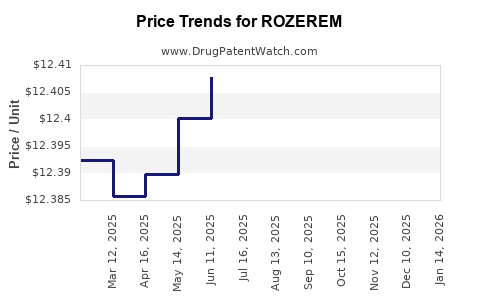
Average Pharmacy Cost for ROZEREM
| Drug Name | NDC | Price/Unit ($) | Unit | Date |
|---|---|---|---|---|
| ROZEREM 8 MG TABLET | 64764-0805-10 | 12.44836 | EACH | 2026-07-22 |
| ROZEREM 8 MG TABLET | 64764-0805-30 | 12.44836 | EACH | 2026-07-22 |
| ROZEREM 8 MG TABLET | 64764-0805-10 | 12.44236 | EACH | 2026-06-17 |
| ROZEREM 8 MG TABLET | 64764-0805-30 | 12.44236 | EACH | 2026-06-17 |
| ROZEREM 8 MG TABLET | 64764-0805-10 | 12.44199 | EACH | 2026-05-20 |
| ROZEREM 8 MG TABLET | 64764-0805-30 | 12.44199 | EACH | 2026-05-20 |
| >Drug Name | >NDC | >Price/Unit ($) | >Unit | >Date |
What is the Market Position and Usage for Rozerem (ramelteon)?
Rozerem (ramelteon) is a prescription sedative-hypnotic indicated for the treatment of insomnia characterized by difficulty with sleep onset. Approved by the FDA in 2005, it targets melatonin receptors (MT1 and MT2) without dependence risks typical of benzodiazepines or Z-drugs.
In 2022, global sales of Rozerem amounted to approximately $140 million, reflecting its niche positioning as a non-controlled alternative for sleep onset issues. U.S. sales accounted for roughly 70% of this figure. Its market presence remains limited compared to class leaders like Ambien (zolpidem).
Market penetration is constrained by limited awareness among prescribers, competition from generic Z-drugs, and newer agents offering broader sleep maintenance effects.
What Are the Competitive Dynamics and Market Segments?
Rozerem positions itself as a non-habit-forming option, targeting patients with a risk of dependence or those seeking alternatives to benzodiazepines. Its primary competitors include:
- Zolpidem (Ambien): Dominates with over $2 billion annual U.S. sales; more effective for sleep maintenance.
- Eszopiclone (Lunesta): Around $480 million in U.S. sales; approved for both sleep onset and maintenance.
- Suvorexant (Belsomra): Growing market share; insomnia associated with difficulty maintaining sleep.
Rozerem's sales trail significantly due to lower efficacy in sleep maintenance, limited marketing, and lack of control status that reduces prescribing incentives.
How Does Pricing Compare?
Ramelteon is priced higher per unit than generic Z-drugs. The average Wholesale Acquisition Cost (WAC) for a 30-count 8 mg tablet is approximately $60 to $80, translating into a monthly cost of $180 to $240.
In contrast, generic zolpidem 10 mg tablets cost roughly $10-$15 for a similar quantity, making Rozerem a premium option primarily prescribed for specific patient populations.
What Are Price Projections and Growth Opportunities?
Given its niche status and limited marketing, Rozerem's sales are expected to remain flat in the short term, with potential under the following scenarios:
-
Market Expansion: If awareness campaigns emphasize its non-habit forming properties, prescriber adoption could increase modestly.
-
Pricing Trends: Without competition from new branded products, a slight increase in price may occur due to inflation and formulary placement, but significant hikes are unlikely due to existing generic competition in the broader sleep disorder market.
-
Pipeline and Patent Status: Rozerem's primary patent protection expired in 2016, with no current patent extensions. Biosimilar or generic formulations are permitted, which could further suppress prices.
Long-term growth prospects are limited unless new formulations, indications, or delivery systems (e.g., long-acting or sublingual) emerge.
What Are the Regulatory and Patent Considerations?
Ramelteon’s patent protections ended in late 2016. The absence of exclusivity rights impacts pricing power. It primarily depends on competitive pressures and prescriber preferences.
The FDA has approved some formulations and delivery methods extending the potential market, but regulatory hurdles and patent expirations curtail exclusive commercialization.
What Are Key Takeaways?
- Rozerem is a niche sleep aid focusing on non-habit forming treatment of sleep onset insomnia.
- Global 2022 sales stand around $140 million, primarily in the U.S.
- Pricing is about $180-$240/month, significantly above generics.
- Market growth remains limited due to competition, patent expiration, and limited efficacy.
- Future sales depend on prescriber awareness, marketing efforts, and potential new formulations.
FAQs
1. Will Rozerem's sales increase with new formulations?
Potentially, if new delivery mechanisms or indications receive approval, but no current plans are publicly announced.
2. Is Rozerem covered by most insurance plans?
Typically, yes, especially in formulary tiers favoring non-controlled and non-habit-forming medications.
3. How does Rozerem compare safety-wise with Z-drugs?
Rozerem does not cause dependence, sleep behavior issues, or next-day impairment at typical doses, making it preferable for at-risk populations.
4. What is the outlook for generic competition?
Since patent expiry, generics are available, putting downward pressure on price and sales.
5. Could Rx market share shift towards Rozerem?
Unlikely unless prescribers prioritize non-habit-forming agents, which remains a small segment of insomnia treatment.
Sources
- Eisai official filings and sales data (2022).
- IQVIA prescription sales database (2022).
- FDA product approval and patent documentation.
- Market research reports from EvaluatePharma and Grand View Research.
- Industry analysis publications (2023).
More… ↓
