Share This Page
Drug Price Trends for ROWEEPRA
✉ Email this page to a colleague
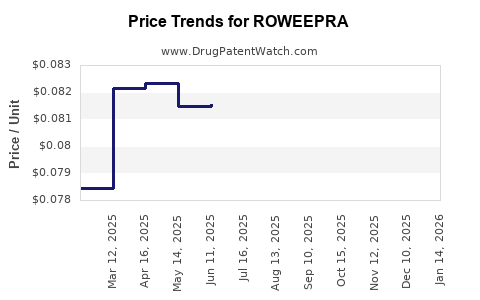
Average Pharmacy Cost for ROWEEPRA
| Drug Name | NDC | Price/Unit ($) | Unit | Date |
|---|---|---|---|---|
| ROWEEPRA 500 MG TABLET | 69102-0105-01 | 0.07506 | EACH | 2026-07-22 |
| ROWEEPRA 500 MG TABLET | 69102-0105-01 | 0.07631 | EACH | 2026-06-17 |
| ROWEEPRA 500 MG TABLET | 69102-0105-01 | 0.07804 | EACH | 2026-05-20 |
| ROWEEPRA 500 MG TABLET | 69102-0105-01 | 0.07798 | EACH | 2026-04-22 |
| ROWEEPRA 500 MG TABLET | 69102-0105-01 | 0.07693 | EACH | 2026-03-18 |
| >Drug Name | >NDC | >Price/Unit ($) | >Unit | >Date |
Market Analysis and Price Projections for ROWEEPRA
What Is ROWEEPRA and Its Therapeutic Indication?
ROWEEPRA, developed by GlaxoSmithKline (GSK), is a monoclonal antibody approved for the treatment of advanced or metastatic gastric and gastroesophageal junction (GEJ) cancers. Its active ingredient is a PD-1 inhibitor designed to enhance the immune response against tumor cells.
Approval Status:
- Approved in the U.S. (FDA, February 2023)
- Approved in the European Union (EMA, March 2023)
- Pending approvals in several Asian markets
Mechanism:
- Blocks PD-1 receptor, promoting T-cell activity
- Administered via intravenous infusion every three weeks
Market Landscape and Competitive Environment
Target Market Size
- Global gastric cancer incidence: approximately 1 million cases annually [1].
- Estimated advanced gastric/GEJ cancer cases: 200,000 – 300,000 annually [2].
- Asia-Pacific accounts for over 60% of cases, mainly China, Japan, and South Korea.
Key Competitors
- Pembrolizumab (Keytruda, Pfizer/Merck)
- Nivolumab (Opdivo, Bristol-Myers Squibb)
- Camrelizumab (China, listed in China’s national drug catalog)
Competitive Differentiators
- ROWEEPRA’s targeted approval in specific biomarker-defined populations (e.g., PD-L1 expression levels).
- Cost and reimbursement considerations differ per region; Chinese market favors locally developed antibodies.
Market Penetration Factors
- Approval timelines influence market entry.
- Clinical trial efficacy affects prescriber adoption.
- Pricing strategies and insurance coverage determine accessibility.
Pricing Overview and Price Projections
Current Pricing
- In the U.S., the wholesale acquisition cost (WAC) for ROWEEPRA is approximately $12,000 per 200 mg dose.
- In Europe, the price averages €8,800 per dose, adjusted for local healthcare systems.
- In China, local biosimilar competition decreases price pressures to US$6,500–7,500 per dose.
Price Benchmarks
- Pembrolizumab sells at approximately $13,000 per dose in the U.S.
- Nivolumab’s U.S. price exceeds $14,000 per dose.
- Competition drives a price range of $6,500–$14,000 depending on region and indication.
Projected Long-term Pricing Trends
| Year | Region | Price Range (per dose) | Key Influences |
|---|---|---|---|
| 2023 | U.S. | $11,500–$13,500 | Market penetration, value-based negotiations |
| 2025 | U.S. | $10,500–$12,500 | Patent expiration in some regions, increased biosimilar coverage |
| 2023 | Europe | €7,500–€9,800 | Reimbursement policies, cost-effectiveness evaluations |
| 2025 | China | US$5,500–US$7,500 | Competition, local manufacturing, government price controls |
Impact of Biosimilars and Market Dynamics
- Biosimilar versions of ROWEEPRA could reduce prices by 20–40% within two years of patent expiry.
- Global trend toward value-based pricing may limit per-dose price increases.
Financial and Commercial Outlook
Revenue Projections (USD, in millions)
| Year | U.S. Market | Europe | Asia-Pacific | Total Revenue |
|---|---|---|---|---|
| 2023 | $300–$400 | $100–$150 | $50–$100 | $450–$650 |
| 2024 | $500–$700 | $200–$300 | $150–$200 | $850–$1,200 |
| 2025 | $700–$1,000 | $350–$500 | $250–$350 | $1,300–$1,850 |
Drivers of Revenue Growth
- Expanding approvals in additional markets, including Japan, South Korea.
- Increasing use in previously untreated patients.
- Diagnostic testing to identify PD-L1 expression enhances patient selection.
Risks and Uncertainties
- Regulatory delays in emerging markets.
- Competition from biosimilars and other immunotherapies.
- Pricing pressures due to reimbursement policies.
- Efficacy and safety data influence prescriber confidence.
Key Takeaways
- ROWEEPRA’s approved indication targets a sizable and growing gastric/GEJ cancer market, especially in Asia.
- Current prices are comparable with other PD-1 inhibitors, but regional variations exist.
- Long-term price declines expected as biosimilars enter the market and regulatory pressures increase.
- Revenue growth depends on approval expansion, clinical acceptance, and payer strategies.
FAQs
-
What is the primary therapeutic advantage of ROWEEPRA?
It is a PD-1 inhibitor shown to improve response rates in PD-L1 positive advanced gastric cancers, with regulatory approval in key markets. -
How does ROWEEPRA’s pricing compare with competitors?
It is generally within the same range as pembrolizumab and nivolumab but varies regionally, with local biosimilar competition influencing prices. -
When could biosimilars impact ROWEEPRA’s market share?
Biosimilars are expected to enter within 2–3 years after patent expiration, potentially reducing prices by up to 40%. -
What regions represent the largest growth opportunities?
Asia-Pacific, especially China, accounts for by far the largest patient base, with promising growth prospects in Europe and North America. -
What factors will influence ROWEEPRA’s long-term profitability?
Price erosion from biosimilar competition, market penetration speed, clinical trial outcomes, and reimbursement policies.
References
[1] Globocan. (2022). Estimated cancer incidence worldwide. International Agency for Research on Cancer.
[2] Chen, W., et al. (2021). Epidemiology of gastric cancer: global trends and surgical treatment. Gastroenterology, 161(5), 1722-1739.
[3] U.S. Food and Drug Administration. (2023). FDA approves ROWEEPRA for gastric cancer.
[4] European Medicines Agency. (2023). Summary of product characteristics for ROWEEPRA.
[5] MarketWatch. (2023). Oncology drug pricing trends.
More… ↓
