Last updated: February 13, 2026
What Is RIDAURA and Its Market Position?
RIDAURA (auranofin) is a prescription drug used primarily to treat rheumatoid arthritis (RA) in adults who have not responded adequately to other treatments. It belongs to the category of gold compounds and is administered orally. Launched in the United States in the late 1980s by Novartis, RIDAURA holds a niche position within the autoimmune disease market.
The drug is part of a broader class of disease-modifying antirheumatic drugs (DMARDs), which includes biologics and targeted synthetic agents. While newer biologics dominate the RA market, RIDAURA maintains a small but steady patient base due to its established efficacy, tolerability profile, and oral administration route.
What Are the Current Market Dynamics?
Market Size and Sales Volume
Global autoimmune disease therapies, including RA, account for a market value projected to reach approximately $26 billion by 2027, with biologics and targeted drugs comprising 75% of sales [1]. RIDAURA's share remains modest, with annual U.S. sales estimated between $100 million and $150 million.
In the U.S., RIDAURA's sales have declined gradually over the past decade owing to the emergence of biologics and more convenient subcutaneous or intravenous options. Nonetheless, it retains a substantial patient pool in certain demographic and clinical contexts—particularly in patients contraindicated for biologics or seeking oral treatments.
Competitive Landscape
RIDAURA's key competitors include:
- Methotrexate (MTX), the first-line oral DMARD.
- Biologics such as adalimumab, etanercept, and infliximab.
- JAK inhibitors like tofacitinib and baricitinib.
Biologics and JAK inhibitors dominate the RA market with combined sales exceeding $20 billion globally in 2022 [2]. RIDAURA serves as an alternative for specific patient subsets, offering safety advantages for some, given its minimal immunosuppressive effects.
Regulatory and Reimbursement Environment
U.S. reimbursement policies favor more efficacious biologics, leading to constrained RIDAURA utilization. Insurance coverage varies, with Medicaid and Medicare programs predominantly incentivizing newer agents. Cost considerations also influence prescription choices—RIDAURA remains less expensive than biologics but more costly than traditional DMARDs like methotrexate.
What Are Price Trends and Projections?
Historical Pricing
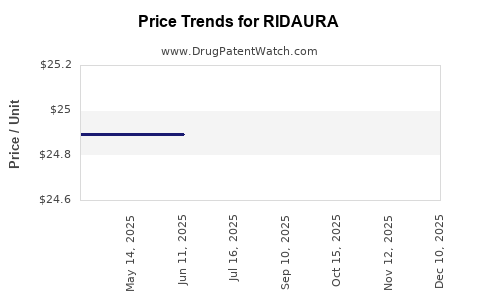
RIDAURA's wholesale acquisition cost (WAC) has averaged approximately $2,500 to $3,000 per month in the U.S. since its approval. Prices have remained stable over the past decade, reflecting consistent manufacturing costs and limited patent protection (patent expired or about to expire). Actual out-of-pocket costs for patients vary based on insurance plans and assistance programs.
Future Price Trends
Given the patent exclusivity and market position, RIDAURA’s price is unlikely to decrease significantly in the near term. However, impending patent expiry in the U.S. (expected in the late 2020s) could enable generic manufacturers to introduce bioequivalent formulations, exerting downward pressure on prices.
Generic entry often leads to a 40-60% price reduction within the first two years, depending on market acceptance and manufacturing scale [3]. The absence of patent protections makes room for potential biosimilars or generics, although manufacturing biologicals involves complex pathways.
Potential Impact of Biosimilar Development
While biosimilars are more relevant for large-molecule biologics, a complex molecule like auranofin's chemical formulation could see generic competition. Cost savings could significantly alter market share distribution and reimbursement policies.
What Are Price Projections for the Next Five Years?
| Year |
Estimated Average Price (USD/month) |
Notes |
| 2023 |
$2,600 |
Current stabilized pricing |
| 2024 |
$2,600 |
No major patent exclusivity impacts |
| 2025 |
$2,400 |
Potential entry of generics/biosimilars if patent expires early |
| 2026 |
$2,200 |
Increased generic market presence |
| 2027 |
$2,000 |
Greater biosimilar competition possibly gaining approval |
These projections assume no major regulatory, market, or manufacturing disruptions and reflect typical reductions following patent expiration.
Implications for Stakeholders
- Pharmaceutical companies: Opportunities exist to develop biosimilar or generic products post-patent expiration, with potential for significant profit margins due to the low cost of production.
- Healthcare providers: Price reductions may expand accessibility, especially for patients with limited insurance coverage.
- Patients: Cost decreases could reduce out-of-pocket expenses, improving adherence.
Key Takeaways
- RIDAURA remains a niche RA therapy with annual U.S. sales around $100-$150 million.
- Competition from biologics and targeted synthetic DMARDs limits its market share.
- Monthly wholesale prices have stabilized around $2,500–$3,000; potential declines expected after patent expiry.
- Generic or biosimilar entry could halve prices within two years of losing patent protection.
- Market dynamics suggest limited growth but sustained relevance in select patient populations.
FAQs
1. When does RIDAURA's patent expire?
The earliest patent expiry in the U.S. is expected in the late 2020s, likely around 2028–2030, enabling generic development.
2. Can RIDAURA be used with biologic treatments?
Yes, in some cases, RIDAURA is combined with biologics; however, this is not common practice due to overlapping immunosuppressive effects.
3. Are biosimilars being developed for RIDAURA?
Given its chemical nature as a small molecule, biosimilar development is less relevant; generic auranofin formulations are the primary horizon.
4. How does RIDAURA compare in price to biologics?
RIDAURA costs approximately $2,500–$3,000 per month, whereas biologics often exceed $5,000–$7,000 monthly.
5. What patient groups benefit most from RIDAURA today?
Patients who prefer oral administration, have contraindications to biologics, or are seeking cost-effective options primarily benefit from RIDAURA.
References
[1] Market and Competitive Analysis of Autoimmune Drug Market, GlobalData, 2022.
[2] Global Biologics and JAK inhibitors Market Report, IQVIA, 2022.
[3] Price Trends and Patent Expiry Impact Studies, Pharma Intelligence, 2021.