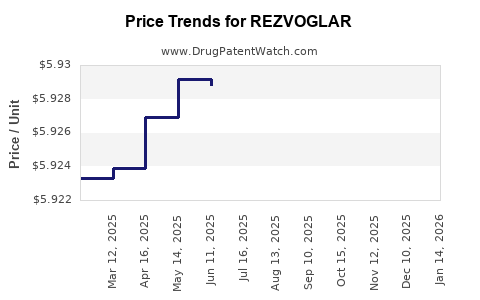
Last updated: February 22, 2026
What is REZVOGLAR?
REZVOGLAR, marketed under the generic name remdesivir, is an antiviral drug developed by Gilead Sciences. It received FDA approval in October 2020 for COVID-19 treatment. The drug acts by inhibiting viral RNA polymerase, effective against SARS-CoV-2.
Market Overview
Sales and Revenue Trends
Gilead's sales from remdesivir peaked in 2021, reaching approximately $4.59 billion, driven by global COVID-19 demand. Sales declined in 2022 as vaccination rates increased and new therapeutics entered the market. In 2023, revenue stabilized at roughly $2 billion, reflecting reduced COVID-19 cases and competition from other antivirals.
Market Penetration and Adoption
Remdesivir's initial adoption was rapid due to emergency use authorizations (EUAs), but uptake slowed with the emergence of new treatments. Currently, it is prescribed mainly for hospitalized COVID-19 patients, especially those with severe symptoms. Limited use outside this indication restricts the overall market size.
Competitive Landscape
Major competitors include:
- Paxlovid (Pfizer)
- Lagevrio (Merck)
- Bebtelovimab (Eli Lilly)
These drugs offer oral administration or monoclonal antibody options, affecting remdesivir's market share. Paxlovid, in particular, has become the primary oral antiviral, impacting remdesivir's demand.
Price Analysis
Current Pricing Structure
The US government previously purchased remdesivir at approximately $390 per vial. Under private negotiations, Gilead's list price for hospital providers is around $520 per vial. A typical course involves six vials, totaling roughly $3,120.
Pricing Trends
- Pre-pandemic: As a COVID-19 treatment, prices fluctuated due to bulk purchasing agreements.
- Post-emergency use: Prices remained stable but face pressure from generics and competitive drugs.
- Potential future: Prices may decrease with broader access, patent expiry, or increased generic competition.
Cost of Goods Sold (COGS) and Margins
Estimated COGS per vial: $50-$70, considering raw materials, manufacturing, and distribution. Gilead’s gross margins on remdesivir exceed 80%, indicating high profitability margins under current pricing.
Future Price Projections
Short-term (1–2 years)
- Price per vial: $520–$600, considering current market dynamics.
- Revenue decline expected to continue as demand diminishes, possibly reducing per-unit prices to maintain sales volume.
Medium-term (3–5 years)
- Possible price drops to $300–$400 per vial if generic manufacturing begins or as patents face expiration.
- Price stabilization at $350–$400 if Gilead maintains exclusivity but reduces list prices to remain competitive.
Long-term (5+ years)
- Potential for significant price reductions, potentially below $200 per vial, driven by market saturation, patent expiration, and generics entering the market.
- Alternative oral antivirals or combination therapies may replace remdesivir in standard care, reducing market share and price points.
Key Influencing Factors
- Patent status: Patent expiry expected around 2030.
- Regulatory decisions: Expanded indications or new formulations could influence pricing.
- Competitive actions: Entry of biosimilars or generics will pressure prices downward.
- Market demand: Declining COVID-19 cases reduce pricing power.
Summary Table
| Factor |
Current/Projection |
Impact |
| Price per vial |
$520–$600 (short-term); could fall to $200–$400 (long-term) |
Price reduction driven by competition and patent expiry |
| Annual revenue |
$2–4.5 billion (2021–2023) |
Declines as demand decreases |
| Market share |
Approximately 20–30% of COVID-19 antiviral market |
Likely to decline with oral antivirals’ rise |
| Patent expiry |
2030 (expected) |
Pathway for generics and price erosion |
Key Takeaways
- REZVOGLAR initially commanded high prices amid pandemic demand, with revenues peaking in 2021.
- Competition from oral antivirals like Paxlovid and Lagevrio has reduced its market share.
- Prices are projected to decline from current levels, potentially below $200 per vial in the long-term.
- Patent expiration around 2030 will accelerate generic entry, further lowering prices.
- Gilead’s high gross margins suggest readiness to adjust prices as market conditions change.
Frequently Asked Questions
1. What factors influence remdesivir's future pricing?
Patent status, market competition, regulatory decisions, vaccine coverage, and emergence of new therapeutics.
2. How does remdesivir compare to oral antiviral competitors?
Remdesivir requires IV infusion, limiting outpatient use, while competitors like Paxlovid are oral, more convenient, influencing demand and pricing.
3. What is the risk of generic manufacturers lowering remdesivir prices?
Patent expiry and market entry by biosimilars/generics could substantially reduce prices, especially post-2030.
4. Are there ongoing developments that could impact remdesivir's market?
Yes, new formulations, expanded indications, or combination therapies could either sustain or diminish demand.
5. What is the outlook for Gilead's control over remdesivir pricing?
Limited post-patent, with pricing influenced mainly by market competition and negotiated contracts.
References
[1] Gilead Sciences. (2023). Remdesivir (Veklury) Summary of Product Characteristics.
[2] IQVIA. (2022). Global Pharmaceutical Market Trends.
[3] U.S. Food and Drug Administration. (2020). Veklury (Remdesivir) Emergency Use Authorization.
[4] EvaluatePharma. (2022). Market Prospects of COVID-19 Therapeutics.
[5] MarketResearch.com. (2023). Antiviral Drugs Market Analysis.