Share This Page
Drug Price Trends for RETACRIT
✉ Email this page to a colleague
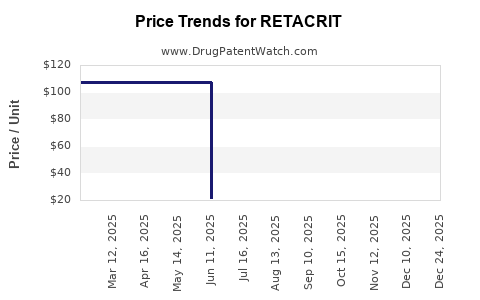
Average Pharmacy Cost for RETACRIT
| Drug Name | NDC | Price/Unit ($) | Unit | Date |
|---|---|---|---|---|
| RETACRIT 2,000 UNIT/ML VIAL | 00069-1305-10 | 21.98198 | ML | 2026-01-01 |
| RETACRIT 20,000 UNIT/ML VIAL | 00069-1311-10 | 219.39063 | ML | 2026-01-01 |
| RETACRIT 10,000 UNIT/ML VIAL | 00069-1308-10 | 109.97738 | ML | 2026-01-01 |
| RETACRIT 2,000 UNIT/ML VIAL | 00069-1305-10 | 21.45400 | ML | 2025-12-17 |
| RETACRIT 20,000 UNIT/ML VIAL | 00069-1311-10 | 214.12320 | ML | 2025-12-17 |
| RETACRIT 10,000 UNIT/ML VIAL | 00069-1308-10 | 107.33689 | ML | 2025-12-17 |
| >Drug Name | >NDC | >Price/Unit ($) | >Unit | >Date |
Market analysis and price projections for RETACRIT
Overview
RETACRIT (epoetin alfa-epbx) is a biosimilar formulation of erythropoietin used primarily for anemia associated with chronic kidney disease, chemotherapy, and certain surgical settings. Approved by the FDA in August 2021, it offers a lower-cost alternative to originator epoetin alfa brands. Market dynamics, competition, and pricing strategies influence its adoption and revenue potential.
Market Landscape
Therapeutic Market Size
- The global erythropoietin market was valued at approximately $4.7 billion in 2022.
- CAGR forecast: 7-8% over the next five years.
- Key segments: chronic kidney disease (CKD), chemotherapy-induced anemia, surgical interventions.
Key Competitors
| Product | Originator | Approval Year | Market Status | List Price (USD, approximate) |
|---|---|---|---|---|
| Epogen | Amgen | 1989 | Dominant | $10,000–$12,000 per 10,000 units vials (based on Medicare pricing) |
| Procrit | Johnson & Johnson | 1989 | Stable | Similar to Epogen |
| Retacrit (epoetin alfa-epbx) | Pfizer | 2021 | Growing | Around 20-30% lower than originators |
Retacrit is positioned as a cost-effective biosimilar, expected to capture a significant share within hospitals and clinics seeking reduced treatment costs.
Market Penetration and Adoption Factors
- Pricing Incentives: Biosimilar pricing discounts range from 15% to 35% compared to originator brands.
- Physician and Hospital Acceptance: Adoption depends on regulatory approvals, formulary inclusions, and physician confidence.
- Regulatory Environment: US and Europe facilitate biosimilar use via guidelines favoring cost savings.
- Reimbursement Policies: Medicare and commercial insurers are incentivizing biosimilar utilization through formulary preference.
Price Trends and Projections
- Current list price (2023): Approximately $7,000–$8,000 per 10,000 IU vial, reflecting a 25-30% discount relative to Epogen and Procrit.
- Short-term (1-2 years): Prices are expected to stabilize, with modest decreases driven by increased competition.
- Medium-term (3-5 years): Additional biosimilars entering the market could drive prices further down by 10-15%, to around $6,000–$7,000 per 10,000 IU.
- Long-term (5+ years): As biosimilar market penetration reaches maturity, prices may decline by up to 30% from initial biosimilar levels, potentially reaching $5,000–$6,000 per 10,000 IU.
Revenue Projections
Based on current market size estimations and assuming a gradual market share gain:
| Year | Estimated Biosimilar Sales (USD billions) | Assumed Market Share (%) |
|---|---|---|
| 2023 | $0.5–0.7 | 10–15 |
| 2025 | $1.0–1.3 | 20–25 |
| 2030 | $2.0–3.0 | 35–50 |
Given the rising acceptance, revenue from RETACRIT could reach $1 billion globally within 3 years, assuming sustained market share growth.
Key Market Drivers
- Cost savings for healthcare providers.
- Growing prevalence of CKD and cancer-related anemia.
- Favorable reimbursement policies.
- Expansion into emerging markets with cost-sensitive healthcare systems.
Challenges
- Physician reluctance due to trust issues with biosimilars.
- Potential regulatory delays or restrictions.
- Competition from other biosimilars and originators' pricing strategies.
Conclusion
RETACRIT's pricing remains below that of originators with expectations of gradual reductions. Its market potential hinges on biosimilar adoption rates driven by cost advantages, regulatory support, and payer preference. Long-term revenues could see significant growth, aligning with global trends toward biosimilar utilization.
Key Takeaways
- RETACRIT prices are around 20–30% lower than originator epoetin alfa brands, with prices around $7,000–$8,000 per 10,000 IU.
- The erythropoietin market is expanding at 7-8% CAGR, with biosimilars expected to capture increasing market share.
- Price reductions of up to 30% are possible within five years due to market competition.
- Revenue projections indicate potential global sales approaching $1 billion within three years.
- Adoption barriers include physician acceptance and regulatory hurdles, but reimbursement policies favor biosimilar uptake.
FAQs
-
What factors influence RETACRIT's pricing compared to originator products?
Biosimilar prices are driven by manufacturing costs, market competition, negotiated discounts with payers, regulatory guidelines, and formulary placements.
-
How quickly can RETACRIT gain market share?
Market share growth depends on provider confidence in biosimilar efficacy and safety, regulatory support, and payer policies. Adoption could range from 10% in the first year to over 50% in five years.
-
Are there any regulatory restrictions affecting RETACRIT's pricing?
Regulatory agencies like the FDA and EMA favor biosimilars to promote cost savings but may impose requirements that influence launch timelines and market entry strategies.
-
What is the expected impact of biosimilar competition on RETACRIT's price?
Competition from other biosimilars could push prices lower by an additional 10–15% over the next three years, encouraging further cost reductions.
-
What are the key growth markets for RETACRIT?
The US, Europe, and emerging markets such as Asia-Pacific and Latin America are primary targets, driven by rising CKD and cancer prevalence and increasing healthcare expenditure.
References
[1] Market Research Future, "Global Erythropoietin Market," 2023.
[2] IQVIA, "Global Biosimilar Market Data," 2022.
[3] FDA, "Erythropoietin Biosimilar Approval," 2021.
[4] Bloomberg Intelligence, "Biosimilars and Market Trends," 2023.
More… ↓
