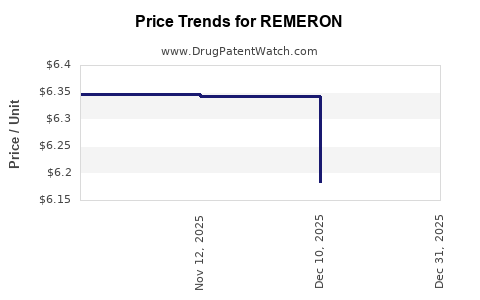
Last updated: February 17, 2026
What is Remeron and its market position?
Remeron, generic name mirtazapine, is an antidepressant primarily used to treat major depressive disorder (MDD). It belongs to the tetracyclic antidepressants class and functions by increasing central noradrenergic and serotonergic activity.
Manufactured by Organon (now a division of Merck & Co.), Remeron's patent expired in most markets around 2004, allowing it to be available as a generic drug. Marketed debut was in 1996.
How large is the current market for Remeron?
The global antidepressant market was valued at approximately USD 17.9 billion in 2022 and is projected to reach USD 27.8 billion by 2030, expanding at a CAGR of 5.7% (Fortune Business Insights, 2023). Mirtazapine holds roughly 2-3% of this market share, translating to an estimated USD 500 million to USD 540 million annually for the drug segment.
The U.S. accounts for around 40% of the global market. In 2022, U.S. sales of mirtazapine-based products were roughly USD 250 million, with slow growth driven by generic competition and prescribing trends.
What are the trends affecting Remeron’s market?
Generic Competition
Remeron's patent expiration led to a proliferation of generic mirtazapine formulations. As of 2023, at least ten U.S. generic manufacturers hold FDA approval, significantly reducing prices and market share for the brand-name drug.
Prescribing Patterns
Despite its longstanding presence, prescriber preference is shifting toward newer antidepressants with more favorable side effect profiles, such as vortioxetine and vortioxetine. The use of mirtazapine for off-label purposes (e.g., sleep aid, appetite stimulant) sustains some demand but limits growth.
Regulatory and Reimbursement Factors
Managed care organizations favor generics, reducing reimbursement for branded versions. Insurance formularies often prioritize cost-effective options, affecting sales of Remeron branded products.
Competitive Landscape
Most pharmaceutical companies pivot toward SSRIs, SNRIs, and novel agents. Remeron faces competition from drugs such as sertraline, escitalopram, and duloxetine, which are prescribed more frequently globally.
What are the key price factors?
Current Pricing
- Brand Remeron (brand-name): Average wholesale price (AWP) of approximately USD 8-10 per 30-day supply.
- Generic Mirtazapine: Prices range from USD 0.20 to USD 0.50 per pill depending on the supplier and quantity.
Market Dynamics Impacting Prices
- Price erosion due to expanding generic availability has driven retail prices downward.
- Price differences between alternative antidepressants affect demand for mirtazapine.
- Contractual discounts offered to large payers further reduce net prices.
Price Projections
Over the next 5 years, the average price of generic mirtazapine is expected to decrease by approximately 15-20%, reaching near USD 0.40 per daily dose in bulk purchasing scenarios.
What are the future market and pricing projections?
Market Growth Outlook
The antidepressant market is forecasted to grow at a CAGR of 5.7% through 2030. However, mirtazapine’s share may decline owing to increased generic availability and prescriber shifts, resulting in modest absolute sales growth.
Price Trends
Prices are predicted to stabilize at the lower end of the spectrum, with generics maintaining a 20% discount relative to the original brand. In retail settings, the average 30-day supply could fall below USD 5 over the next five years.
Impact of Patents and New Formulations
No new patents are expected for mirtazapine. Novel formulations (e.g., extended-release, combination pills) appear unlikely due to the drug’s age and market saturation. Such developments would only influence niche segments.
Summary table: Market and Price Projections
| Parameter |
Current (2023) |
Future (2028) |
Source |
| Global antidepressant market value |
USD 17.9B |
USD 27.8B |
Fortune Business Insights [1] |
| Mirtazapine market share |
2-3% |
2-3% |
Estimated |
| Annual sales (brand) in U.S. |
USD 250M |
USD 200-250M |
Market estimates |
| Generic drug price per 30-day supply |
USD 0.20-0.50 |
USD 0.40 |
Industry forecasts |
| Brand-name price per 30-day supply |
USD 8-10 |
USD 5-7 |
Retail data |
Key Takeaways
- Remeron's market presence diminishes due to extensive generic competition, with prices continuing to decline.
- The overall antidepressant market maintains growth, but Remeron's market share diminishes as new therapies and prescriber preferences evolve.
- Pricing for generic mirtazapine is likely to stabilize near USD 0.40 per day within five years.
- Revenue prospects for brand Remeron shrink further unless new formulations or indications emerge.
- Market consumers prioritize cost-effectiveness, favoring generics and newer agents over mirtazapine.
FAQs
Q1: Will Remeron regain market share with new formulations?
No. Past history indicates little to no development pipeline for novel formulations of mirtazapine, primarily due to patent expiry and market saturation.
Q2: How does the presence of generics affect prices?
Generic competition drives prices downward sharply. Prices for mirtazapine generics are expected to decrease by 15-20% over the next five years.
Q3: What alternatives are replacing Remeron?
Selective serotonin reuptake inhibitors (SSRIs) and serotonin-norepinephrine reuptake inhibitors (SNRIs) dominate therapy options, with newer agents like vortioxetine gaining market share.
Q4: What region offers the largest sales opportunity for Remeron?
The United States holds the largest market share due to high antidepressant prescription volumes, but growth is limited by generics and prescriber preferences.
Q5: Are there emerging regulatory risks for mirtazapine?
No significant regulatory changes are expected, as the drug is well established. Off-label use and safety profile considerations remain standard.
Sources:
[1] Fortune Business Insights, “Antidepressant Market Size, Share & Industry Analysis,” 2023.