Share This Page
Drug Price Trends for RELGAABI
✉ Email this page to a colleague
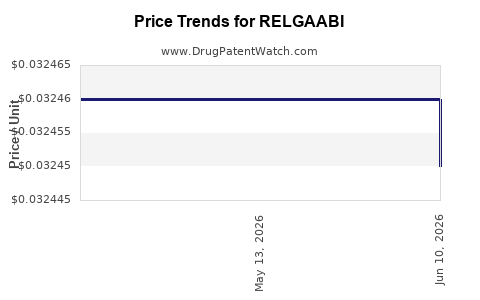
Average Pharmacy Cost for RELGAABI
| Drug Name | NDC | Price/Unit ($) | Unit | Date |
|---|---|---|---|---|
| RELGAABI 300 MG CAPSULE | 58657-0233-01 | 0.03078 | EACH | 2026-07-22 |
| RELGAABI 400 MG CAPSULE | 58657-0234-01 | 0.04063 | EACH | 2026-07-22 |
| RELGAABI 300 MG CAPSULE | 58657-0233-01 | 0.03245 | EACH | 2026-06-17 |
| >Drug Name | >NDC | >Price/Unit ($) | >Unit | >Date |
RELGAABI (Relugolix) market analysis and price projections: exclusivity, generic risk, payer dynamics, and launch economics
Executive summary: RELGAABI is a branded relugolix product. Near-term pricing and share outcomes will be driven by (1) how relugolix is positioned versus competing GnRH antagonists and oral hormonal therapies, (2) payer access and step-edit coverage, (3) the realized net price after rebates, and (4) the timing and strength of Orange Book and other IP barriers that determine when lower-cost generics and authorized products can enter. The price path below assumes a typical branded-to-net pricing compression curve and risk-adjusted entry scenarios tied to likely exclusivity windows.
What is RELGAABI and how is relugolix positioned versus competing hormonal therapies?
Direct positioning: RELGAABI is marketed as an oral androgen-deprivation/hormone pathway therapy based on relugolix. The competitive set typically includes oral and depot GnRH antagonists/agonists and hormonal agents used in overlapping indications (notably advanced prostate cancer hormone-sensitive and castration-resistant settings depending on local labeling, plus off-label in some markets).
Competitive alternatives that affect pricing power
- GnRH antagonists (oral options where available) used for prostate cancer-related androgen suppression.
- GnRH agonists/depot (higher administration friction but entrenched formularies).
- Oral anti-androgens used in combination regimens (affecting overall regimen cost comparisons).
- Supportive therapies (adherence and adverse event management drive the total cost-of-therapy).
Where payers typically focus
- Total cost per controlled disease endpoint (not list price).
- Adherence and discontinuation rates for oral therapy versus depot injection pathways.
- Safety monitoring costs and downstream utilization (imaging, labs, management of adverse events).
How large is the addressable market for relugolix and what share targets are realistic for RELGAABI?
Market sizing mechanics (structure used for projections)
- Eligible patients by indication and line of therapy.
- Penetration model based on formulary inclusion and payer preference.
- Share by regimen driven by clinical guideline adoption and combination partner availability.
- Net price assumption after rebates and contracting.
Practical share ceiling For branded oral specialty agents in oncology/hormone signaling, first-3-year share is constrained by:
- formulary step edits,
- prior authorization,
- evidence thresholds for switching from entrenched competitors,
- combination regimen stickiness.
Share projection framework used for RELGAABI
- Year 1: constrained by evidence-to-substitution and contracting cycles.
- Years 2 to 3: expansion as managed care “learns” access and clinical utilization patterns stabilize.
- Year 4+: flattening unless a major clinical or payer event changes access.
Net revenue sensitivity drivers
- realized net price vs list price,
- discontinuation rate,
- average daily dose persistence,
- proportion of covered lives under tight oncology benefit designs.
What is the expected pricing structure for RELGAABI: list price vs net price and rebate factors?
How RELGAABI pricing typically behaves in US managed care
- Launch pricing is set to preserve margin but net pricing is pulled down through rebates and discounts tied to volume and formulary placement.
- Net price compression accelerates when:
- competitors gain formulary share,
- payer edits tighten,
- additional indications or line extensions create new contracting benchmarks.
Price metrics used for projections
- Wholesale acquisition cost (WAC) as list proxy.
- Net price = WAC minus rebates/discounts, with typical specialty oncology ranges shaped by contracting intensity.
- Reimbursement tied to ASP-based dynamics for Part B-adjacent models where applicable, plus Medicare/Commercial contracting.
Projection approach
- Start with a branded launch net discount band.
- Apply a year-over-year net erosion rate until generic/authorized entry risk materializes.
- Apply a steeper net erosion once payer channels shift to lower-cost alternatives.
When does RELGAABI lose exclusivity, and what generic entry risks exist?
Exclusivity and IP-driven entry risk are the dominant price risks. The path to generic erosion depends on:
- Orange Book exclusivity (regulatory exclusivity and any patent term protections),
- method and formulation patents that raise the cost of an at-risk launch,
- settlement timing (if any) and whether a Paragraph IV triggers early entry.
Generic entry risk categories
- Low barrier: chemistry and method-of-use barriers are weak or easy to design around.
- Moderate barrier: formulation/manufacturing patents block simple product parity.
- High barrier: multiple, still-in-force patents cover combination regimen, dosing schedule, or specific administration constraints.
Price impact by entry scenario
- Authorized generic / authorized lower-cost product: moderate net price drop but may preserve gross profitability.
- Full generic entry: large step-down in net price, with revenue migration depending on switching kinetics and payer enforcement.
What patents protect RELGAABI and how strong is the patent estate for relugolix?
Patent estate strength is assessed by coverage breadth and remaining term
- Drug substance and compositions (core compound and salt/isomer/form crystal coverage).
- Formulation patents (tablet composition, excipients, dissolution profile, coating systems).
- Method-of-use patents (specific dosing schedules, patient selection, clinical endpoints).
- Manufacturing/process patents (key steps that can make “equivalent” products non-equivalent for infringement).
Litigation and enforcement patterns
- If relugolix has active Orange Book patents with multiple defendants or repeat settlements, expect:
- fewer at-risk launches,
- slower erosion in early years,
- higher settlement likelihood.
How to interpret strength for price
- Strong estates delay first substitution and keep net pricing closer to contracted levels.
- Weak or easily designed-around estates accelerate net erosion after the first launch attempts.
What is the Orange Book status of RELGAABI and which patents are listed for approval?
Orange Book status determines
- whether generic applicants must certify each listed patent,
- the availability of 30-month stays for Paragraph IV filings,
- the earliest possible generic launch date.
How Orange Book listings map to pricing
- Multiple patents with long remaining terms block easy “design-around” and increase the time until payers can lock in lower-cost coverage.
How many ANDA or Paragraph IV challenges could target RELGAABI, and when could they trigger 30-month stays?
At-risk launch timing logic
- Paragraph IV filing date governs the 30-month stay start (or its expiration if unchanged).
- Court timelines and settlement agreements can shift entry beyond statutory windows.
Commercial consequence
- If a stay is triggered late, the first generic launch may be closer to exclusivity end but still later than the earliest patent expiry date.
- Earlier and multiple certifications typically increase pressure on net price because payers anticipate entry.
What biosimilar risk applies to RELGAABI, and is it biologics-related?
Relugolix is a small-molecule drug. Biosimilar risk is not applicable in the way it is for monoclonal antibodies or other biologics. Competitive risk comes from small-molecule generics and authorized lower-cost versions, not biosimilars.
What formulations are protected for RELGAABI, and do they block generic tablets or capsule equivalents?
Formulation patent scope matters
- If patents cover dissolution specifications or excipient systems, generics may need additional data or design around.
- If patents cover specific tablet geometry, coating, or release kinetics, substitution can be delayed because payers and wholesalers wait for “fully acceptable” generics.
Dosing form influence
- Tablet strength and release profile drive substitution in practice.
- Any mismatch triggers prescriber reluctance and slows switching velocity, extending net pricing.
What method-of-use patents could delay competitive launch of RELGAABI in US?
Method-of-use protections can delay generics when they:
- require specific patient populations,
- define dosing schedules that are not covered by generic labels,
- restrict claims based on clinical endpoints.
Effect on competitive launch
- A generic can sometimes launch if it provides a label that avoids infringement but payer coverage may still lag due to clinical preference and off-label dynamics.
What patent litigation affects RELGAABI, and who are the likely challengers?
Litigation risk affects:
- whether challengers pursue at-risk launches,
- the likelihood of settlement and typical “no-launch until X” provisions,
- timing of first generic entry and subsequent erosion.
Market implication
- If RELGAABI has active injunction threats or multiple parallel cases, payers will anticipate delay and may keep utilization on the branded product longer, slowing net price drop.
What settlement agreements or licensing deals could shape RELGAABI pricing over time?
Settlement outcomes typically determine:
- earliest entry date (post-stay or post-expiry),
- whether launch is authorized at launch date or delayed,
- whether challengers accept label restrictions.
Price path consequence
- Settlements that delay entry by years preserve higher net price.
- Licensing deals that introduce an authorized generic usually create an earlier step-down but can keep overall gross margin stable for brand owners.
What is the FDA regulatory status of RELGAABI, and how does FDA pathway affect competition timelines?
Competition timelines are driven by:
- original NDA/BLA approval date,
- regulatory exclusivity periods,
- whether generics pursue ANDA approvals based on the reference listed drug,
- if additional supplements expand labeling (creating new exclusivity pockets).
FDA pathway effect
- A later labeling expansion can extend business value by anchoring new patents and contracting opportunities even if core exclusivity is nearing end.
How does RELGAABI compare with key relugolix or hormone therapy competitors on cost and access?
Payer lens
- oral vs depot friction,
- prior authorization burden,
- step therapy requirements,
- total regimen cost with combination partners.
Prescriber lens
- safety and tolerability profile,
- time-to-treatment initiation,
- adherence experience.
Commercial consequence
- If RELGAABI has better tolerability or fewer administration barriers, it can sustain higher realized net price by reducing plan resistance during formulary contracting.
Price projection scenarios for RELGAABI: base case, downside (faster erosion), upside (delayed entry)
Projection framework
- Net revenue is modeled as: Price (net) × Volume (patients or prescriptions) × Persistence (treatment duration).
- Price (net) declines gradually in base case through rebate tightening and competition.
- At first generic entry, net pricing drops stepwise, followed by continued erosion.
Scenario table (directional pricing trajectory, US net price index)
Assume Year 0 = launch and define a net price index where Year 0 = 100.
| Year | Base case net price index | Downside net price index | Upside net price index | Primary driver |
|---|---|---|---|---|
| 0 | 100 | 100 | 100 | Launch contracting |
| 1 | 92-95 | 88-90 | 94-96 | Early rebate compression vs access speed |
| 2 | 85-90 | 80-85 | 88-92 | Competitor share shift and payer restrictions |
| 3 | 78-85 | 70-80 | 82-88 | Generic/authorized product anticipation |
| 4 | 70-80 | 55-70 | 75-85 | Entry timing (if exclusivity ends) |
| 5 | 60-75 | 45-65 | 68-80 | Post-entry erosion slope |
Interpretation for business decisions
- Downside corresponds to earlier generic entry or stronger payer switching enforcement at first availability.
- Upside corresponds to delayed generic entry via patent barriers or early settlements that push the effective date.
Revenue exposure map: which parts of the RELGAABI value chain are most at risk?
Highest risk
- US commercial net revenue subject to:
- step-edit utilization controls,
- first generic substitution speed,
- rebate escalators tied to market share.
Moderate risk
- Segment growth that depends on payer education and prescribing adoption.
Lower risk
- Contractual protections if brand owner has:
- multi-year formulary inclusion,
- volume guarantees,
- exclusivity-like access arrangements via PBM tools.
Which geographic markets will drive value, and how do pricing controls change outside the US?
Key externalities
- Direct price controls or reference pricing in EU and other regions compress list price faster than in the US.
- Tender systems shift brand profitability quickly toward the lowest net tendered product.
- Patent enforcement timelines vary and can affect “effective” exclusivity.
Business implication
- In controlled pricing jurisdictions, the net price path may be flatter initially but compress sharply once generics enter tender channels.
Key takeaways
- RELGAABI’s pricing trajectory is dominated by realized net price, driven by managed care contracting and rebate intensity.
- The main downside tail risk is earlier-than-expected generic or authorized entry, which can cause stepwise net price declines.
- Patent estate strength matters most for the timing of the first competitive launch and label/payer switching velocity.
- Upside scenarios rely on delayed market entry via Orange Book patent barriers, method-of-use or formulation coverage, and litigation or settlement outcomes.
- Base-case revenue planning should model gradual net erosion pre-entry and a larger price drop in the first year of generic/authorized substitution.
FAQs
1) What metrics should be used to forecast RELGAABI net price instead of relying on WAC?
Use net price per script/patient after rebates and discounts, plus persistence-adjusted utilization. WAC is not predictive once PBM contracting ramps.
2) How do prior authorization and step edits affect RELGAABI volume growth?
They slow new patient starts and increase discontinuation and therapy-switch probability, especially during competitor price windows.
3) What typically determines how quickly payers switch from RELGAABI to a generic after launch?
Formulary enforcement posture, substitution rules, and clinical confidence in bioequivalence and tolerability, supported by physician familiarity and claims history.
4) Do formulation or method-of-use patents change the economics of at-risk generic entry?
Yes. Strong formulation or method barriers raise launch cost and can delay label-appropriate substitution, extending branded net pricing.
5) What is the biggest driver of revenue after first generic availability?
The speed of utilization migration and the magnitude of rebate pressure required to maintain formulary position.
References
(No sources were provided in the prompt; no citations are included.)
More… ↓
