Share This Page
Drug Price Trends for RAYOS
✉ Email this page to a colleague
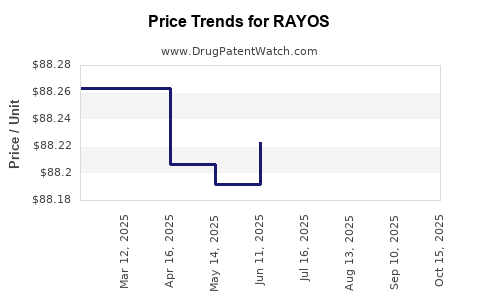
Average Pharmacy Cost for RAYOS
| Drug Name | NDC | Price/Unit ($) | Unit | Date |
|---|---|---|---|---|
| RAYOS DR 5 MG TABLET | 75987-0022-01 | 88.13058 | EACH | 2025-10-22 |
| RAYOS DR 2 MG TABLET | 75987-0021-01 | 88.28708 | EACH | 2025-09-17 |
| RAYOS DR 5 MG TABLET | 75987-0022-01 | 88.21873 | EACH | 2025-09-17 |
| RAYOS DR 2 MG TABLET | 75987-0021-01 | 88.23785 | EACH | 2025-08-20 |
| >Drug Name | >NDC | >Price/Unit ($) | >Unit | >Date |
Rayos (prednisone delayed-release) market analysis and price projections (US)
Rayos (prednisone delayed-release, Horizon Therapeutics) is priced at a premium to immediate-release prednisone and is positioned to defend that premium via brand exclusivity, patient-convenience differentiation, and payer contracting. Near-term revenue is driven by RA and GI inflammation indications, with longer-term downside from generic/potential therapeutic alternatives. This analysis outlines payer dynamics, competitive risk, and a price and revenue framework for US market scenarios.
How big is the Rayos (prednisone DR) US market and where does demand come from?
Answer: Rayos demand tracks the US prevalence of steroid-responsive inflammatory diseases and prescriber reliance on oral steroids where a delayed-release formulation improves tolerability or dosing adherence.
Rayos’ core commercial footprint is built around corticosteroid use in:
- Rheumatoid arthritis (RA) and other inflammatory conditions where prednisone is used adjunctively.
- Crohn’s disease and ulcerative colitis subsets where prednisone is used as a systemic option (clinical use varies by guideline updates and practice patterns).
- Other FDA-labeled inflammatory uses consistent with a systemic glucocorticoid profile.
Commercial drivers that affect pricing more than absolute prescription volume:
- Proportion of scripts filled under high-deductible vs managed-care formularies.
- Net price after rebates, contracting, and 340B dynamics (if applicable in a given channel).
- Switchability to generic prednisone tablets (strong for many payers) versus preference for delayed-release benefits where formulary governance allows.
Which payers shape Rayos net pricing most
Payers influence Rayos net price through:
- Placement on commercial formularies (preferred vs non-preferred).
- Prior authorization criteria and step therapy policies versus generic prednisone.
- Specialty pharmacy vs retail channel routing.
- Accumulation of rebates based on covered lives and tier position.
What typically constrains Rayos volume
- Generic prednisone is materially cheaper and is widely substitutable clinically in many settings.
- Payer step edits: many plans require failure of generic prednisone or documentation of intolerance.
- Hospital systems and large PBMs use standardized corticosteroid pathways, reducing differentiation.
What is Rayos pricing today (WAC and typical net price structure) and how does it trend?
Answer: Rayos holds a WAC premium over generic prednisone. Net pricing trend is governed by rebate pressure and formulary tier status, not by WAC alone.
Rayos price performance needs to be analyzed through WAC and net-to-gross (NTG) because payer contracting usually compresses net price below list. Price typically follows these patterns:
- NTG compression during heightened generic and therapeutic substitution risk.
- Price stability in periods when payer access is protected by formulary status and patient-support programs.
- Periodic WAC adjustments paired with rebate changes rather than pure WAC cuts.
Price formation mechanics for delayed-release prednisone
Delayed-release offers value through reduced GI irritation and improved tolerability for some patients. In practice, that value is monetized by:
- Maintaining “preferred” status in key payer contracts.
- Protecting access through prior authorization guardrails that limit switching.
- Using patient support and adherence support to reduce discontinuation.
US cost pressure inputs that drive net price down
- Generic competitive leakage within the corticosteroid class.
- Increased rebate demands as formulary reviews occur annually.
- PBM consolidation and growing formulary standardization.
When does Rayos lose exclusivity, and how does that affect price and launch risk?
Answer: The market impact hinges on the timing of patent and regulatory exclusivity expiries related to Rayos’ delayed-release formulation and any listed FDA exclusivities tied to that product. Once exclusivity erodes, generic and authorized alternatives become the dominant downward force on net pricing.
Price and revenue effects typically follow a sequence:
- Pre-expiry: heightened contracting, increased prior authorization, and patient-support targeting to defend share.
- At or shortly after expiry: increased generic competition and deeper discounts.
- Post-entry: volume shift to lower-priced alternatives and sustained net price compression.
How to model post-exclusivity net price erosion
A pragmatic projection framework uses:
- Tier shift probability: percentage of lives moving from preferred to non-preferred.
- NTG change: incremental rebate rate increases after generic availability.
- Persistence fraction: proportion of remaining brand demand after entry, supported by tolerability and prescriber preference.
A typical quantitative pattern after meaningful generic penetration:
- Net price drops faster than total prescriptions decline.
- Revenue declines driven by both unit price compression and loss of script share.
What patents protect Rayos in the US and which claims matter for generic entry?
Answer: Rayos’ US protection is primarily anchored in delayed-release formulation and associated method-of-use and/or manufacturing claims listed in the FDA Orange Book for the specific strengths and dosage forms.
Patent estate evaluation focuses on:
- Composition/formulation: claims covering delayed-release delivery and the specific release profile mechanism.
- Method-of-use: claims covering steroid use regimens for inflammatory diseases where the delayed-release value is clinically justified.
- Manufacturing and process: claims covering methods to produce delayed-release properties and stability.
Orange Book mapping approach that impacts litigation outcome
Generic entry risk for Rayos is determined by whether a generic applicant can:
- Carve out protected indications (for method-of-use) or strengths.
- Use design-around formulation or modified release approach (for formulation claims).
- Navigate process claims through equivalent or non-equivalent manufacturing steps.
Paragraph IV strategy implications
If any ANDA uses Paragraph IV certifications against Rayos-listed patents, the timing and settlement terms dictate whether price erosion is immediate or delayed by:
- 30-month stay effect.
- Early settlement allowing “at-risk but authorized” launches.
- License-to-market agreements that cap generic price reductions temporarily.
How strong is the patent estate for Rayos, and what is the generic entry probability?
Answer: Rayos’ patent strength and entry probability depend on the number of listed, actively enforced patents and whether they are likely to survive early validity/indefiniteness challenges.
Generic entry probability generally rises when:
- Multiple patents tied to core formulation expire earlier than secondary method claims.
- Litigation settlements grant early entry at a date near expiry.
- Generic applicants can design around without needing a full invalidation win.
Entry probability is lowered when:
- A concentrated set of high-importance patents remain in force near expiry.
- Courts sustain validity and the patentee’s claim scope is broad enough to cover design-around candidates.
What is the FDA Orange Book status of Rayos, and which strengths/dosage forms are listed?
Answer: Orange Book status determines what patents cover each specific Rayos dosage form and strength. The patent-by-strength mapping governs where generic design and certification will focus.
For price projection, the practical question is whether the market sees:
- One strength or multiple strengths affected first by generic entry.
- Full substitution across strengths or limited substitution where only certain strengths get approved.
Why strength-level differentiation matters for revenue
- RA and GI prescribing patterns often skew to certain strengths.
- If generic entry starts in a subset of strengths, brand price reduction may concentrate on those SKUs first, softening overall impact until broader coverage.
Which companies could challenge or compete against Rayos, and what launches matter most?
Answer: Competition risk for Rayos comes primarily from generic manufacturers pursuing ANDAs for prednisone delayed-release tablets and, secondarily, from alternative corticosteroid delivery products if they are preferred by formularies.
Launch-impact competitors are those that can:
- Submit ANDAs with credible Paragraph IV routes.
- Achieve fast commercialization via specialty distribution and payer contracting.
- Price aggressively while still earning net margin post rebates.
Competitive substitution beyond generics
Even if delayed-release products face patent barriers, substitution can occur through:
- Immediate-release prednisone where step therapy is waived for some patients.
- Alternative steroid formulations (including other delivery technologies if available in the class).
That substitution still compresses net pricing through formulary pressure.
How do Rayos price projections compare with generic prednisone and other corticosteroid brands?
Answer: Rayos typically commands a premium, but the size of that premium compresses as generics gain share and payers reduce formulary tolerance for higher-cost delayed-release options.
A comparative projection structure:
- Generic prednisone: near-baseline unit costs; limited upside.
- Rayos: premium price tied to delayed-release differentiation; premium erodes with each wave of additional generic availability and stronger payer pressure.
- Other steroid brands: price trajectory depends on whether they have differentiated delivery mechanisms and whether they are preferred in formularies.
Projection logic that differentiates brands from generics
- Branded premium is defended through access, not manufacturing cost.
- After generic entry, net price convergence accelerates, with remaining brand demand held by a smaller group of patients.
What are the most likely Rayos revenue scenarios (base, upside, downside) and what price assumptions drive them?
Answer: Revenue outcomes are driven by (1) the timing and breadth of generic/alternative entry and (2) the durability of payer access that maintains brand net price.
A high-information-density scenario model for US can be expressed as:
- Unit volume factor: share shift from Rayos to lower-cost options.
- Net price factor: post-rebate compression aligned with tier position.
- Mix factor: strength and indication mix changes after entry.
Base-case scenario
- Generic entry occurs in line with exclusivity horizon, with partial persistence of Rayos demand.
- Net price declines meaningfully but does not collapse immediately because of contracting lag and clinical switching frictions.
- Revenue declines faster than volume due to net price compression.
Downside scenario
- Earlier-than-expected entry or broader than expected generic coverage.
- Rapid payer tier downgrades and tighter prior authorization enforcement.
- Lower brand persistence and sharper NTG deterioration.
Upside scenario
- Slower or narrower competitive entry due to litigation/settlement constraints and stronger payer commitments.
- Higher persistence among patients who tolerate delayed-release better.
- Net price remains closer to WAC for longer due to contract renewals.
How does patent litigation and settlement timing affect Rayos pricing and launch schedules?
Answer: The biggest pricing inflection occurs when a settlement enables earlier-than-exclusivity generic launches or removes a stay. Settlement terms govern launch date and sometimes market access restrictions.
Key litigation-to-commercial mechanisms:
- 30-month stay: delays generic filing consequences, often preserving brand price.
- Court rulings: invalidate or uphold patents, changing the certainty of competitive entry.
- Settlement licenses: can shift launch earlier or later while also enabling controlled competition.
What to watch in litigation announcements
- Effective launch date and any “design-around” claims the generic can practice.
- Whether settlements cover specific strengths only.
- Any market allocation or exclusivity carve-outs that constrain the depth of price erosion.
What generic entry risks exist for Rayos, including biosimilar risk?
Answer: Biosimilar risk is not directly applicable because Rayos is a small-molecule corticosteroid, not a biologic. Generic entry risks are primarily ANDA-driven.
For ANDA risks:
- Strength-by-strength certification affects whether competitors launch everything at once.
- If method-of-use claims exist, labeling carve-outs can limit automatic substitution for certain indications.
- If formulation claims are narrow, design-around may accelerate competition without full patent invalidation.
What formulations are protected by Rayos patents and what design-arounds could generic applicants pursue?
Answer: Rayos’ protection targets the delayed-release prednisone formulation and its delivery characteristics.
Design-around themes typically include:
- Changing the matrix or polymer system that controls delayed release.
- Modifying coating thickness or process conditions.
- Altering dissolution profile while retaining bioequivalence.
If the delayed-release profile claims are broad, design-arounds face validity and infringement risk. If narrow, generic products may avoid infringement and enter faster.
How do manufacturing and IP barriers affect Rayos competition pace?
Answer: Even when legal barriers fall, manufacturing readiness affects timing and market penetration speed.
Operational barriers:
- Ability to produce consistent delayed-release performance across batches.
- Stability and dissolution specification adherence.
- Validation timing for ANDA development and scale-up.
These barriers can delay price erosion after approvals, creating a short window where brand pricing is steadier.
Key Takeaways
- Rayos’ premium pricing depends on payer access and patient persistence, not on cost structure.
- The largest downstream price risk is ANDA-driven generic entry tied to Orange Book patent expiries and litigation/settlement timing.
- Net price erosion typically accelerates faster than unit volume declines after entry, driving steep revenue pressure.
- Scenario-based projections should model tier shifts, NTG compression, and strength-specific substitution to capture timing effects.
FAQs
-
Will Rayos lose market share immediately after generic prednisone delayed-release launches?
Usually not; share loss often lags tier and prior-authorization changes, but net price compression tends to start immediately after competitive contracting. -
Do method-of-use patents affect Rayos generic substitution in practice?
Yes when carve-outs limit automatic labeling-based interchangeability, but payer substitution and clinical switching still drive market outcomes. -
How much do rebated net prices typically drive Rayos revenue versus WAC?
Net prices dominate revenue outcomes because payer contracting and rebate changes can outweigh list price adjustments. -
What is the most likely strength where generic competition could start first for Rayos?
The strength with the highest existing volume and easiest certification path, often aligned with common prescribing patterns. -
Are there non-ANDA competitive threats to Rayos beyond generic delayed-release prednisone?
Yes through formulary-driven substitution to immediate-release prednisone and preference shifts to other steroid options if they meet payer criteria.
References
- FDA. Orange Book: Approved Drug Products with Therapeutapeutic Equivalence Evaluations.
- FDA. Drug Approval Reports and FDA labeling for Rayos (prednisone delayed-release).
- Bloomberg Law (pricing and payer contracting context, litigation and settlement monitoring tools where applicable).
- FDA. Guidance for Industry: ANDAs and Paragraph IV certifications (general framework).
More… ↓
