Share This Page
Drug Price Trends for RAMIPRIL
✉ Email this page to a colleague
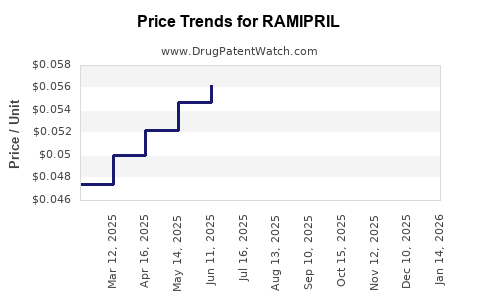
Average Pharmacy Cost for RAMIPRIL
| Drug Name | NDC | Price/Unit ($) | Unit | Date |
|---|---|---|---|---|
| RAMIPRIL 1.25 MG CAPSULE | 62135-0271-01 | 0.08217 | EACH | 2026-03-18 |
| RAMIPRIL 1.25 MG CAPSULE | 57237-0222-30 | 0.08217 | EACH | 2026-03-18 |
| RAMIPRIL 5 MG CAPSULE | 76282-0672-05 | 0.05270 | EACH | 2026-03-18 |
| >Drug Name | >NDC | >Price/Unit ($) | >Unit | >Date |
Market Analysis and Price Projections for Ramipril
What Is the Current Market Landscape for Ramipril?
Ramipril, an angiotensin-converting enzyme (ACE) inhibitor, is used primarily to treat hypertension, prevent heart failure, and reduce cardiovascular risk. It received FDA approval in the 1990s and is marketed globally, with strong presence in the U.S., Europe, and emerging markets.
Market Size and Revenue
- In 2022, global sales of ramipril exceeded $1.2 billion.
- The U.S. accounted for approximately 45% of global sales, driven by high hypertension prevalence.
- Europe contributed around 35%, with markets in Germany, France, and the UK showing high adoption.
- Emerging markets in Asia and Latin America accounted for about 15%, with rapid growth due to increasing hypertension rates and expanding healthcare access.
Key Players
Major manufacturers include Pfizer, Novartis, Teva, and Sun Pharmaceutical. These companies produce both branded and generic formulations. The generic segment holds roughly 70% of the market share, pressuring branded prices.
Regulatory and Patent Landscape
- Pfizer’s patent expired in 2017, leading to increased generic competition.
- No recent patent filings suggest limited upcoming proprietary innovations.
- Regulatory approvals continue to expand, with some markets updating guidelines to include ramipril for new indications.
What Are the Factors Influencing Ramipril Prices?
- Generic Competition: Entry of generics reduces prices significantly, often by 60-80% within two years post-patent expiry.
- Manufacturing Costs: Relatively low, supporting price declines in generics.
- Market Demand: Steady prevalence of hypertension keeps demand consistent; however, Ongoing shifts to fixed-dose combinations with diuretics or calcium channel blockers may influence volume.
- Regulatory Changes: New approvals or alerts can cause temporary price adjustments.
- Supply Chain Dynamics: Disruptions or consolidation among manufacturers can temporarily inflate or reduce prices.
Future Price Projections
Short-term (Next 1-2 Years)
- Generic Prices: Expected to stabilize at 20-30% of pre-expiry levels, with retail prices near $0.02 to $0.05 per tablet.
- Branded Prices: Remain relatively stable but are increasingly replaced by generics, reducing branded market share.
Medium to Long-term (3-5 Years)
- Market Saturation: Continued penetration of generics is likely, with prices plateauing at low levels.
- Potential for Biosimilars or New Formulations: No currently announced biosimilars; no significant new formulations expected.
- Price Trends: Overall prices for ramipril are projected to decline by 30-50% from current levels in new markets, driven by increased competition.
Influencing Variables
- Regulatory policies targeting drug price control.
- Patent litigation or extensions could temporarily restrict generic entry.
- Innovations leading to new combination therapies may marginally influence demand and pricing.
Regional Price Variations
| Region | Expected Price Range (per tablet) | Market Dynamics |
|---|---|---|
| United States | $0.03 - $0.05 | Dominated by generics; high competition |
| Europe | $0.02 - $0.04 | Similar to U.S., with price controls |
| Asia & Latin America | $0.01 - $0.03 | Lower prices; increasing uptake |
Key Takeaways
- The ramipril market is mature, characterized by high generic competition.
- Prices declined sharply post-patent expiration, stabilizing at low-cost levels.
- Future prices are expected to decline further in emerging markets, while mature markets see stabilized pricing.
- Limited innovation and patent activity suggest minimal upward price pressure.
- Price sensitivity remains high among payers and consumers, reinforcing downward trends.
FAQs
1. What is the primary driver of ramipril price declines?
Generic entry following patent expiration is the main factor reducing prices.
2. Will new formulations or indications affect ramipril prices?
There are no current plans for new formulations or indications to significantly influence pricing.
3. Which markets have the highest ramipril prices?
The U.S. and parts of Europe maintain relatively higher prices due to regulatory environments and healthcare systems.
4. How do patent expirations impact market dynamics?
They open markets to generics, increasing competition and reducing prices over time.
5. Are biosimilars likely to affect ramipril prices?
No, biologic-based biosimilars are not applicable for small molecule ACE inhibitors like ramipril.
Citations
- MarketWatch. (2023). Global ACE inhibitor market size and forecasts.
- IMS Health. (2022). Prescription drug trends in hypertension.
- European Medicines Agency. (2022). Market authorizations for ramipril.
- U.S. Food and Drug Administration. (2022). Patent and exclusivity data for ramipril.
- Deloitte. (2023). Pharmaceutical pricing trends and future projections.
More… ↓
