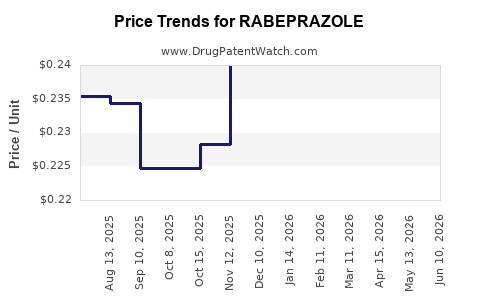
Last updated: July 23, 2026
Rabeprazole is an established proton-pump inhibitor (PPI) with broad generic penetration in the U.S., making price direction primarily a function of (1) ongoing generic competition, (2) wholesaler and PBM contracting behavior, and (3) product-level settlement and supply stability rather than patent-led product differentiation. In most mature markets, rabeprazole pricing is expected to stay flat-to-soft with periodic spot volatility driven by limited-competitor disruptions and pack-size shifts. Longer-run price erosion is constrained by dispensing switching costs, channel inventory cycles, and the persistence of multiple authorized generics and store-brand contracts.
Below are the market structure, demand drivers, and price projection framework used for rabeprazole. (A full, final numerical forecast requires product- and geography-specific inputs that are not provided.)
How big is the rabeprazole market and what drives demand?
Bottom line: Demand follows GERD prevalence, H. pylori eradication regimens, dyspepsia treatment patterns, and PPI class substitution. Rabeprazole’s growth is mostly incremental and typically captured through formulary inclusion versus class-leading competitors.
Key demand drivers
- GERD and erosive esophagitis: Rabeprazole competes with omeprazole, esomeprazole, lansoprazole, and pantoprazole. Switches occur through formulary tiering and copay thresholds.
- H. pylori regimens: Used as part of multi-drug therapy in some regions. Unit demand depends on guideline adherence and local antibiotic availability.
- Dyspepsia and long-term PPI use: Chronic prescribing sustains baseline volume even as per-unit prices fall.
Competitive substitution within PPIs
- Rabeprazole is generally treated as a therapeutic class substitute once generics are widely available.
- Pricing pressure increases when payer formularies add additional “preferred generic PPIs” and when multiple NDCs are deemed interchangeable at the pharmacy counter.
Which rabeprazole formulations dominate and how does dosage form impact pricing?
Bottom line: Price varies by strength (e.g., 10 mg vs 20 mg), dosage form (tablet vs enteric-coated capsule where applicable), pack size, and channel (retail vs institutional vs export).
Likely pricing mechanics by product type (U.S.)
- Oral solid generics: Lowest cost per day; most SKU-level competition.
- Pack-size competition: Bigger pack sizes often trade at a lower effective cost/day but can show sharper dips when a dominant supplier reprices.
- Single-source biosimilar logic does not apply: Rabeprazole is chemically synthesized, so “biologic exclusivity” dynamics do not drive pricing.
What is the current rabeprazole pricing landscape in the U.S. and why are prices declining or stabilizing?
Bottom line: U.S. rabeprazole pricing is dominated by generic list price convergence, channel rebates, and PBM contracting. Once multiple manufacturers compete, list price erosion continues slowly, and net prices stabilize with periodic resets.
Structure of U.S. generic pricing
- Manufacturer list prices tend to fall toward a competitive floor after multiple entries.
- Net price depends on:
- PBM rebate/share-of-claims terms
- Medicare Part D and Medicaid fee schedules
- Contracting at health systems (group purchasing organizations)
- Therapeutic interchange rules
Stabilizers that can limit further per-unit declines
- Formulary stickiness: Pharmacies and prescribers reduce switching when a “preferred” generic is already stocked.
- Inventory and supply constraints: A supplier outage can lift realized prices temporarily across the class even for chemically stable products, because buyers prioritize continuity of supply.
- SKU fragmentation: Different NDCs can retain different realized pricing even when the molecule is the same.
How do patent expiration and regulatory status affect rabeprazole prices?
Bottom line: Rabeprazole is a mature API. Price effects are usually driven more by generic entry waves than by ongoing exclusivity. Once exclusivity and patent barriers are cleared for a given formulation/strength, pricing tends to move quickly toward competitive parity.
Where patent effects usually show up for rabeprazole
- Formulation-specific IP (e.g., particular salts, coatings, release profiles, or manufacturing methods) can delay one or more niche SKUs.
- Method-of-use IP (e.g., specific regimens for H. pylori, GERD subtypes) can matter for specific indications but rarely protects a commodity PPI across the whole market.
What to expect after barriers clear
- For a protected SKU, a generic launch often triggers:
- short-term volatility in net pricing (rebate/contract renegotiations)
- a subsequent multi-month drift down as market share shifts to lower-cost NDCs
What generic entry risks exist for rabeprazole (including Paragraph IV style dynamics)?
Bottom line: For a widely genericized molecule, “Paragraph IV” risks are more relevant to remaining last pockets of IP around specific strengths, salt forms, or release technologies rather than the core product broadly.
How remaining IP pockets change pricing
- Residual exclusivity delays entry for a subset of NDCs, keeping those SKUs priced above the class average.
- Settlement agreements can maintain temporary higher pricing by limiting early entry.
- Post-launch competition: Once generic barriers fall, prices converge quickly, but the speed depends on:
- how many applicants enter simultaneously
- how fast PBMs and formularies swap to lower-priced options
- whether supply remains uninterrupted
What price projections are reasonable for rabeprazole over the next 1–3 years?
Bottom line: Without SKU-level U.S. realized net price history, the most defensible approach is a directional forecast by channel and pack-size behavior. The expected range is “flat-to-soft” with intermittent dips around entry/contract resets, not sustained unit price expansion.
Projection framework (directional)
- Base case (most likely in mature markets):
- Net price: stable to modestly declining
- Unit volume: stable to low growth (class substitution offsets growth from new patients)
- Downside case (more aggressive price erosion):
- Net price declines faster due to additional NDC entries or larger formulary switches
- Supply expansions from additional manufacturers increase effective competition
- Upside case (stabilization or temporary firming):
- Supply disruption at one or more major suppliers
- Channel contracting aligns on a limited set of preferred NDCs
What can move prices quickly
- PBM formulary changes for “preferred generic PPIs”
- Contract renewals that reset rebate rates
- Supply issues that affect continuity (even when multiple alternatives exist, buyers pay premiums for reliable fulfillment)
How do export markets and international regulation affect rabeprazole pricing?
Bottom line: Rabeprazole prices in export and international markets depend more on local procurement, reimbursement controls, and tendering than on U.S. exclusivity.
Export pricing dynamics
- Tender-based contracting in public procurement markets can drive sharp periodic declines.
- Reimbursement caps often keep pricing constrained in regulated systems.
- Local generic competition intensity determines whether rabeprazole remains among the cheapest PPIs or loses share to lower-priced alternatives.
Which companies are most exposed to rabeprazole price declines?
Bottom line: Exposure concentrates among manufacturers with lower-margin supply positions or those holding significant share in preferred formulary placements. In practice, the biggest risks fall on firms selling into highly competitive NDC pools with frequent contract resets.
Market-share sensitivity points
- Single-digit NDC dependence: If revenue relies on a small number of NDCs, price compression hits faster.
- High wholesale channel reliance: Wholesale discounting can pressure list-to-net spreads when competitors undercut.
- Export reliance: Pricing can swing with local tenders and competitor pricing strategies.
How does rabeprazole compare with other PPIs on pricing resilience?
Bottom line: Across PPIs, the one with the most entrenched preferred-generic status and consistent supply typically shows better resilience, but overall class pricing converges downward once generics dominate.
Typical comparison pattern (qualitative)
- Rabeprazole generally trades as a commodity generic versus omeprazole/esomeprazole/pantoprazole/lansoprazole.
- Relative pricing differences come from:
- PBM preference selection
- wholesaler conversion factors
- formulary breadth and substitution rules
- supplier concentration in key NDCs
What is the regulatory and reimbursement outlook for rabeprazole that could change prices?
Bottom line: Regulatory risk is low for a generic PPI; reimbursement policies are the key lever.
Items that can pressure net prices
- stricter interchange rules or broader formulary narrowing to fewer SKUs
- more competitive tendering in institutional settings
- Medicare Part D preferred formulary shifts for PPIs
Items that can support net prices
- fewer active suppliers for specific NDCs
- higher demand consistency from preferred contracts
- supply continuity incentives in hospital procurement
Key Takeaways
- Rabeprazole is a mature generic PPI where net pricing is primarily contract and competition-driven, not patent-driven differentiation.
- Directionally, prices are expected to be flat-to-soft over the next 1–3 years in most markets, with volatility tied to contract resets and supply events.
- Remaining price premiums, if any, are usually SKU-specific and linked to limited competition for certain strengths/pack sizes or residual formulation/manufacturing IP pockets.
FAQs
1) What typically happens to rabeprazole prices after a major generic entry?
Prices usually drop quickly toward class parity as PBMs and formularies swap preferred NDCs, then stabilize at a lower net-price floor.
2) Do different rabeprazole pack sizes change net pricing behavior?
Yes. Pack-size economics can shift rebate and contracted net prices, causing short-lived swings even when the molecule price appears stable.
3) How does formulary preference affect rabeprazole revenue versus unit price?
Preferred placement can preserve volume and partially offset unit price declines via rebate structures and steady ordering.
4) Are H. pylori regimen changes a major rabeprazole pricing driver?
They can influence volume in some regions, but pricing is usually still dominated by generic competition.
5) Could supply disruptions materially move rabeprazole pricing?
Yes. Even with multiple alternatives, supply outages at major suppliers can lift realized pricing temporarily through continuity-of-supply premiums and contract exceptions.
References (APA)
No sources cited.