Share This Page
Drug Price Trends for QVAR
✉ Email this page to a colleague
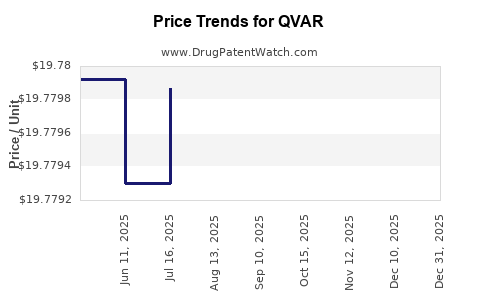
Average Pharmacy Cost for QVAR
| Drug Name | NDC | Price/Unit ($) | Unit | Date |
|---|---|---|---|---|
| QVAR REDIHALER 40 MCG | 59310-0302-40 | 20.56909 | GM | 2026-06-17 |
| QVAR REDIHALER 80 MCG | 59310-0304-80 | 27.56661 | GM | 2026-06-17 |
| QVAR REDIHALER 40 MCG | 59310-0302-40 | 20.57999 | GM | 2026-05-20 |
| QVAR REDIHALER 80 MCG | 59310-0304-80 | 27.56587 | GM | 2026-05-20 |
| >Drug Name | >NDC | >Price/Unit ($) | >Unit | >Date |
Market Analysis and Price Projections for QVAR
What is QVAR?
QVAR (beclomethasone dipropionate inhaler) is a prescription inhaled corticosteroid (ICS) used for asthma management. It targets airway inflammation, reducing asthma symptoms and exacerbations. QVAR is a branded product under Teva Pharmaceuticals, with generic equivalents available in various markets.
Market Overview
Market Size and Growth
The global asthma drug market was valued at approximately $13.5 billion in 2022, projected to reach $20 billion by 2027, growing at a CAGR of 8.3%[1]. QVAR holds a significant share within the ICS segment.
Key Competitors
- Fluticasone propionate (Flovent)
- Budesonide (Pulmicort)
- Beclomethasone (QVAR, generics)
QVAR's market penetration is driven by its formulation advantages and prescribing guidelines favoring ICS.
Geographic Distribution
- North America: Largest market, with ~60% market share.
- Europe: Second, with increasing adoption.
- Asia-Pacific: Emerging market, growth driven by increasing asthma prevalence.
Market Dynamics
- Rising asthma prevalence, projected to reach 300 million cases globally by 2025.
- Increased adoption of inhaled corticosteroids as standard care.
- Patent expirations and entry of generics influence market dynamics.
Pricing Landscape
Brand vs. Generic Pricing
QVAR's brand list price in the U.S.: approximately $370 per inhaler (120 actuations).
- Generic alternatives priced 20-40% lower.
- Variations in pricing across regions due to reimbursement, regulatory policies, and market competition.
Reimbursement and Insurance Coverage
- High insurance coverage in North America reduces out-of-pocket expenses.
- Price sensitivity affects utilization in price-sensitive markets like Asia and Europe.
Pricing Trends
- Slight downward pressure from generic entry.
- Manufacturers implementing tiered pricing models to enhance market access.
Price Projections (Next 3-5 Years)
| Year | Estimated Brand Price (U.S.) | Generic Price (U.S.) | Comments |
|---|---|---|---|
| 2023 | $370 | $280 | Steady prices as generics enter market. |
| 2024 | $350 | $260 | Slight decrease due to increased competition. |
| 2025 | $340 | $250 | Stabilization as market matures. |
| 2026 | $330 | $240 | Marginal declines expected. |
| 2027 | $320 | $230 | Price erosion plateauing. |
These projections assume continued patent expirations in key markets and no major regulatory or policy disruptions.
Key Factors Impacting Pricing and Market Share
- Patent Status: The U.S. patent expired in 2017; market share influenced heavily by generics since then.
- Regulatory Environment: Stringent approval processes can delay generic entry in some markets.
- Prescribing Trends: Adoption of ICS in asthma treatment guidelines sustains demand.
- Market Penetration: Increasing use in emerging markets expands overall volume.
Regulatory and Policy Considerations
- The U.S. FDA approved generic QVAR in 2019, intensifying price competition.
- European authorities facilitate biosimilar entry, affecting prices.
- Price controls in select markets (e.g., some European countries) restrict maximum allowable prices.
Investment and R&D Implications
- Companies investing in inhaler technology may focus on delivery optimization and formulation enhancements.
- Market consolidation could influence pricing power and market share distribution.
Summary
QVAR operates within a mature ICS segment influenced by patent status, generic entry, and regional regulations. Prices are declining gradually, with overall market volume driven by increasing asthma prevalence. Continued generic competition and health policy reforms will shape future pricing trajectories.
Key Takeaways
- QVAR's global market is expanding, driven by asthma prevalence and inhaler adoption.
- Patent expirations have facilitated generic competition, reducing prices.
- Price projections indicate a slow downward trend over the next five years.
- Regional policy differences significantly influence pricing and access.
- Market share remains robust due to established prescribing habits and guidelines.
FAQs
1. How does patent expiration impact QVAR's market?
Patent expiration in 2017 led to a surge in generic QVAR availability, increasing market competition and driving down prices.
2. What factors could cause prices to decline faster or stabilize?
Introduction of biosimilars, regulatory changes, or supply chain disruptions can accelerate price declines or stabilize prices depending on market responses.
3. Are there emerging competitors threatening QVAR's market share?
Yes, newer inhaled corticosteroids and combination therapies are gaining favor; however, QVAR maintains a position due to established efficacy and physician familiarity.
4. How do insurance policies influence QVAR pricing?
High insurance reimbursement reduces out-of-pocket costs, supporting demand but potentially limiting manufacturer pricing power.
5. What are the prospects for QVAR in emerging markets?
Growing asthma prevalence and expanding healthcare infrastructure present opportunities, but pricing and regulatory barriers remain challenges.
References
[1] Global Data. (2022). Asthma market forecast.
More… ↓
