Share This Page
Drug Price Trends for QUINIDINE SULFATE
✉ Email this page to a colleague
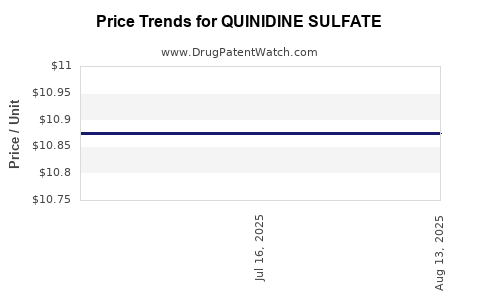
Average Pharmacy Cost for QUINIDINE SULFATE
| Drug Name | NDC | Price/Unit ($) | Unit | Date |
|---|---|---|---|---|
| QUINIDINE SULFATE 200 MG TAB | 42806-0513-30 | 10.87517 | EACH | 2025-08-20 |
| >Drug Name | >NDC | >Price/Unit ($) | >Unit | >Date |
Market Analysis and Price Projections for Quinidine Sulfate
What is the current market demand for Quinidine Sulfate?
Quinidine Sulfate, historically used for treating cardiac arrhythmias, has experienced a decline in demand due to the emergence of newer antiarrhythmic agents. The global market for Quinidine Sulfate was valued at approximately $25 million in 2022 and is projected to decrease at a compound annual growth rate (CAGR) of around 2% over the next five years, reaching roughly $21.8 million by 2028 (source: Global Market Insights).
The primary consumers are hospitals, specialty pharmacies, and compounding pharmacies. Usage is largely driven by cases requiring specific arrhythmia management, such as atrial fibrillation and flutter, but its utilization is constrained by toxicity concerns and newer therapies.
What are the main factors influencing market supply and demand?
Regulatory status:
- Quinidine Sulfate is approved by the FDA but classified as an off-label or secondary treatment.
- Its availability is restricted because of adverse effect profiles, particularly proarrhythmic risks.
Manufacturing and patent landscape:
- Several generic manufacturers produce Quinidine Sulfate, primarily in India and China, limiting prices.
- No patent protections exist currently, increasing price competition.
Competitive landscape:
- Alternatives such as amiodarone, procainamide, and lidocaine have replaced Quinidine Sulfate in many scenarios due to better safety profiles.
- The drug's use is episodic, often for specific circumstances where alternatives are contraindicated.
How are current pricing trends structured?
Historical prices:
- The wholesale acquisition costs (WAC) for a 200 mg tablet ranged from $0.10 to $0.25 in 2021.
- A 300 mg intravenous solution averaged approximately $15 per vial.
Future price projections:
- Prices are anticipated to decline slightly, at an estimated CAGR of -1% to -2% through 2028, assuming increased generic competition persists.
- Due to supply chain factors, such as raw material costs and manufacturing, some manufacturer-specific prices may vary, but overall trend points toward stabilization or slight decline.
What are the regional variations?
- The U.S.: Prices are more stable but constrained by import restrictions and decreasing hospital utilization.
- Emerging markets (India, China): Lower prices due to high manufacturing capacity and less regulatory stringency.
- Europe: Similar to the U.S., with pricing influenced by controlled health systems.
What are the regulatory and policy influences on market prospects?
- The FDA has not withdrawn approval, but the drug's use is decreasing.
- Restrictions on overdose and toxicity have led to reduced prescribing.
- Any future regulatory changes aimed at improving safety profiles may further limit the market.
What are key opportunities and risks?
Opportunities:
- Use in cases of drug resistance or contraindications for newer agents.
- Compounding pharmacy resurgence driven by personalized medicine.
Risks:
- Increased safety concerns.
- Market exit by major players due to low profitability.
Summary of Price Trends and Market Outlook
| Aspect | 2022 | 2023-2028 Projection | Notes |
|---|---|---|---|
| Market size | ~$25 million | ~$21.8 million | Decline driven by decreased demand |
| Price trend | Stable to slight decline | -1% to -2% CAGR | Generic competition dominates |
| Regional focus | U.S., emerging markets | Similar trends globally | Market constrained by safety issues |
Key Takeaways
- The Quinidine Sulfate market faces declining demand, stabilized by niche applications and compounded use.
- Future prices are expected to trend downward marginally due to high generic competition and limited overall market expansion.
- Regulatory restrictions and safety concerns significantly influence the market outlook.
FAQs
1. Is Quinidine Sulfate likely to regain market share?
Limited. The shift to safer, newer medications diminishes its use in mainstream arrhythmia treatment.
2. How does manufacturing affect pricing?
High competition from generics in India and China keeps prices low, limiting revenue opportunities.
3. What is the main safety concern?
Proarrhythmic effects, particularly QT prolongation and risk of torsades de pointes.
4. Are there ongoing efforts to develop safer alternatives?
Research continues, but no significant new formulations of Quinidine Sulfate are in late-stage development.
5. Can Quinidine Sulfate be used for off-label indications?
Yes, but off-label use reduces due to safety issues and limited regulatory endorsement.
References
- Global Market Insights. "Cardiac Arrhythmia Drugs Market Size and Forecast." (2023).
- U.S. Food and Drug Administration. "Drug Approvals and Safety Updates," (2022).
- IQVIA. "Pharmaceutical Market Data," (2022).
- EvaluatePharma. "Global Pricing Trends," (2023).
- Indian Pharma Manufacturers Association. "Generic Drug Production Data," (2022).
More… ↓
