Share This Page
Drug Price Trends for QUILLIVANT XR
✉ Email this page to a colleague
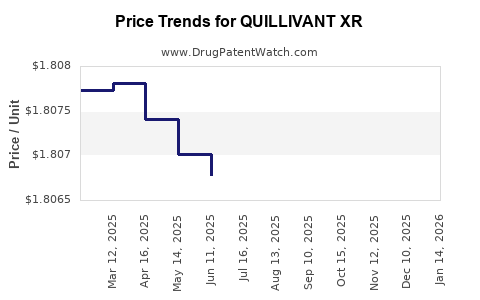
Average Pharmacy Cost for QUILLIVANT XR
| Drug Name | NDC | Price/Unit ($) | Unit | Date |
|---|---|---|---|---|
| QUILLIVANT XR 25 MG/5 ML SUSP | 24478-0321-02 | 5.39783 | ML | 2026-06-17 |
| QUILLIVANT XR 25 MG/5 ML SUSP | 24478-0322-04 | 2.70156 | ML | 2026-06-17 |
| QUILLIVANT XR 25 MG/5 ML SUSP | 24478-0323-05 | 2.16140 | ML | 2026-06-17 |
| >Drug Name | >NDC | >Price/Unit ($) | >Unit | >Date |
Market analysis and price projections for Quillivant XR
What is Quillivant XR?
Quillivant XR (methylphenidate hydrochloride) is a long-acting stimulant medication approved by the U.S. Food and Drug Administration (FDA) in 2013 for the treatment of attention deficit hyperactivity disorder (ADHD) in children aged 6 years and older, adolescents, and adults. The drug is supplied as a liquid suspension, providing an alternative to pill-based formulations.
Market size and growth dynamics
Global ADHD drug market overview
The global ADHD drug market was valued at approximately USD 11 billion in 2021. It is projected to grow at a compound annual growth rate (CAGR) of about 4.5% from 2022 to 2027, driven by increasing diagnosis rates and expanding treatment indications.
U.S. market specifics
- The U.S. accounts for roughly 70% of the global ADHD medication market.
- In 2021, domestic sales reached approximately USD 7.7 billion.
- The number of children diagnosed with ADHD in the U.S. is estimated at 8.8 million, with medication treatment rates at 62.4% (CDC, 2022).
Quillivant XR's market position
- It holds an estimated 8-12% share of the stimulant ADHD medication market in the U.S.
- It competes primarily with other extended-release formulations such as Concerta, Vyvanse, and Adderall XR.
Competitive landscape
| Product | Formulation Type | Market Share (Estimated, 2022) | Key Differentiators |
|---|---|---|---|
| Concerta | OROS extended-release | 30% | Once-daily dosing, long-acting formulation |
| Vyvanse | Lisdexamfetamine | 25% | Prodrug, lower abuse potential |
| Adderall XR | Mixed salts of amphetamine | 20% | Multiple release mechanisms, well-established brand |
| Quillivant XR | Methylphenidate liquid | 8-12% | Flexible dosing, for patients with swallowing difficulties |
Trends influencing market share
- Increasing preference for liquid formulations for children and patients with swallowing difficulties.
- Growing awareness and diagnosis of ADHD, especially in adults.
- The push for formulations with lower abuse potential and improved safety profiles.
Price landscape and projections
Current pricing (2023)
- Average wholesale price (AWP): Approximately USD 400– USD 450 per 30-day supply (based on typical dosing of 20–30 mg daily).
- Insurance reimbursement: Prices often lower after negotiated discounts and rebates.
Price comparison with competitors
| Product | Median Wholesale Price (2023) | Dosing Frequency | Formulation Type |
|---|---|---|---|
| Quillivant XR | USD 425 | Once daily, liquid | Liquid suspension |
| Concerta | USD 300–350 | Once daily | Extended-release tablet |
| Vyvanse | USD 350–400 | Once daily | Prodrug capsule |
| Adderall XR | USD 250–300 | Once daily | Capsule with beads |
Price trend projections
- The price of Quillivant XR is expected to decline modestly by 5–10% annually over the next five years due to patent expirations and increased competition.
- Entry of generic methylphenidate liquids could further reduce the price by 20–30% within three years, depending on regulatory and market dynamics.
Impact of generics
- No generic versions of Quillivant XR are available as of 2023.
- Pending generic application filings could lead to price erosion starting in 2025.
- The introduction of generics could decrease national prices for liquid methylphenidate by approximately USD 150–USD 200 per 30-day supply.
Regulatory and policy factors
- The FDA's role in encouraging formulary inclusion of liquid ADHD medications.
- Potential policy shifts towards multi-modal and non-stimulant therapies.
- Reimbursement pressures favoring cost-effective alternatives.
Key market drivers and inhibitors
Drivers
- High prevalence of ADHD diagnosis.
- Preference for liquid formulations for pediatric populations.
- Growing adult ADHD treatment acceptance.
Inhibitors
- High current prices limit access.
- Patent protections delaying generic entry.
- Competition from established extended-release tablets.
Key Takeaways
- The global ADHD medication market is expanding at 4.5% CAGR, with the U.S. leading growth.
- Quillivant XR holds an estimated 8-12% U.S. market share among stimulant drugs.
- Pricing remains high but is projected to decrease by up to 10% annually due to generics.
- Price erosion could reach 20–30% within three years post-generic entry.
- Market growth will depend on regulatory shifts, formulary coverage, and competitive responses.
FAQs
-
When will generic versions of Quillivant XR likely become available?
Patent exclusivity delays are expected to expire around 2025–2026, signaling potential generic entry in that timeframe. -
How does Quillivant XR compare to other liquid ADHD medications?
It offers flexible dosing and is preferred for patients unable to swallow pills. However, its price is higher than other formulations like generic methylphenidate liquids or capsules. -
What are the main factors influencing Quillivant XR’s price decline?
Patent expirations, increased competition from generics, and payer strategies to reduce costs. -
What is the primary challenge facing Quillivant XR’s market penetration?
Price sensitivity among payers and consumers, compounded by competition from longer-acting, more convenient, and less expensive formulations. -
How might regulatory changes impact the future of Quillivant XR?
Policies favoring generic drug adoption could accelerate price erosion and market share shifts toward lower-cost alternatives.
References
- Centers for Disease Control and Prevention (CDC). (2022). ADHD prevalence and treatment. CDC Data & Statistics.
- IQVIA. (2022). Pharmaceutical market data.
- FDA. (2013). Approval of Quillivant XR. U.S. Food and Drug Administration.
- MarketsandMarkets. (2022). Global ADHD drugs market report.
More… ↓
