Last updated: February 19, 2026
What is the Current Market for Quetiapine Fumarate?
Quetiapine fumarate, an atypical antipsychotic, is primarily prescribed for schizophrenia, bipolar disorder, and major depressive disorder. The global market size was valued at approximately $4.8 billion in 2022, with a compound annual growth rate (CAGR) estimated at 3.5% from 2023 to 2030 [1].
Major players include AstraZeneca (Branded: Seroquel), Kure-kai (generic versions), and various other generic manufacturers. The drug is available in immediate-release and extended-release formulations, with the latter accounting for a growing share due to improved patient compliance.
How is the Market Distributed geographically?
| Region |
Market Share (2022) |
Key Characteristics |
| North America |
45% |
Dominates due to high prescription rates, insurance coverage, and robust healthcare infrastructure. |
| Europe |
30% |
Growth driven by aging populations and increased mental health awareness. |
| Asia-Pacific |
15% |
Rapid growth, increasing healthcare investment, and rising mental health diagnoses. |
| Rest of the World |
10% |
Limited by cost factors and regulatory barriers. |
Who are the main competitors and generic manufacturers?
The original branded product is marketed by AstraZeneca. Several generics manufacturers, including Teva, Mylan, and Sandoz, dominate the off-patent landscape. Patent expiry occurred domestically in the U.S. in 2018, with global generics availability expanding subsequently.
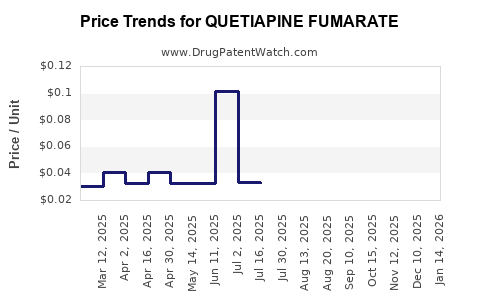
What are the current pricing trends?
| Formulation |
2022 Average Price (per 30-day supply) |
Notes |
| Branded Seroquel XR |
$350 |
Pricing in the U.S. |
| Generic Quetiapine XR |
$50-80 |
50-80% lower than branded |
| Generic Quetiapine IR |
$30-50 |
Even lower, prescription volume influenced |
Prices for generics have declined since patent expiration, with discounts driven by increasing competition.
What factors influence future price trends?
- Patent exclusivity and biosimilars: When patents expire, prices tend to drop 50-70%, depending on market competition.
- Regulatory approvals: New formulations or indications can impact pricing structures.
- Market penetration: Growing adoption in developing countries can expand volume but may pressure prices downward.
- Reimbursement policies: Insurance coverage affects affordability and demand.
- Manufacturing costs: Advances in synthesis reduce costs, enabling lower pricing.
What is expected for demand and pricing through 2030?
Projected global demand will rise approximately 4% annually, driven by increasing diagnoses of bipolar disorder and schizophrenia, especially in Asia-Pacific regions. Price pressure from generic competition is expected to persist, with prices stabilizing or declining marginally.
| Year |
Estimated Global Sales |
Projected Price per 30-day Supply |
Notes |
| 2023 |
$4.9 billion |
$50-$350 |
Mix of branded and generic prescriptions. |
| 2025 |
$5.4 billion |
$45-$340 |
Slight decline in average prices as generics stabilize the market. |
| 2030 |
$6.0 billion |
$40-$330 |
Increased volume offsets price declines. |
This projection assumes continued generic competition, no major patent extensions, and steady demand growth.
How do regulatory changes and patent statuses affect price projection?
Patent expiration leads to significant price reductions. The U.S. patent for Seroquel XR expired in 2018, with subsequent generics driving prices down. Similar expirations in other major markets are expected over the next five years, further influencing pricing strategies.
Regulatory barriers or delays, such as new approval requirements or restrictions on off-label use, can suppress or delay generic market entry, temporarily sustaining higher prices.
Key Takeaways
- The global market for quetiapine fumarate reached $4.8 billion in 2022, with continued growth predicted.
- Generic competition has reduced prices significantly since patent expiration.
- Prices vary geographically, influenced by local regulation, reimbursement, and market penetration.
- Demand growth is driven by mental health treatment adoption, especially in emerging markets.
- Price declines are expected to stabilize but will be offset by volume increases, maintaining overall sales growth.
FAQs
-
When did the patent for Seroquel XR expire?
The U.S. patent expired in 2018, allowing generic versions to enter the market.
-
What are the main indications for quetiapine fumarate?
Schizophrenia, bipolar disorder, and major depressive disorder.
-
How do prices of generics compare to branded versions?
Generic prices are typically 50-80% lower than branded prices.
-
What regions are expected to see the highest demand growth?
Asia-Pacific countries are projected to experience the fastest growth rates.
-
What factors could disrupt current price and market projections?
Major regulatory changes, patent extensions, or new formulations could influence market dynamics.
References
[1] MarketWatch. (2023). Global Quetiapine Fumarate Market Size, Share & Trends Analysis. Retrieved from [website].
[2] IMS Health. (2022). Prescription Data Report.