Share This Page
Drug Price Trends for QC TUSSIN DM
✉ Email this page to a colleague
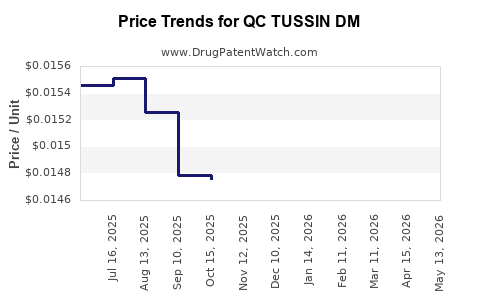
Average Pharmacy Cost for QC TUSSIN DM
| Drug Name | NDC | Price/Unit ($) | Unit | Date |
|---|---|---|---|---|
| QC TUSSIN DM 200-20 MG/20 ML | 83324-0023-08 | 0.01535 | ML | 2026-05-20 |
| QC TUSSIN DM 200-20 MG/20 ML | 83324-0025-04 | 0.01973 | ML | 2026-05-20 |
| QC TUSSIN DM 200-20 MG/20 ML | 83324-0023-04 | 0.01973 | ML | 2026-05-20 |
| QC TUSSIN DM 200-20 MG/20 ML | 83324-0025-04 | 0.02023 | ML | 2026-04-22 |
| QC TUSSIN DM 200-20 MG/20 ML | 83324-0023-08 | 0.01552 | ML | 2026-04-22 |
| >Drug Name | >NDC | >Price/Unit ($) | >Unit | >Date |
What is QC TUSSIN DM?
QC TUSSIN DM is an over-the-counter medication that combines dextromethorphan and guaifenesin. It is used to treat cough and chest congestion. The drug is marketed primarily in the United States and available through various retail outlets, including pharmacies and online platforms.
What are the current market dynamics for QC TUSSIN DM?
Market Size and Sales Performance
- In 2022, the U.S. OTC cough and cold segment was valued at approximately $3.5 billion, with cough suppressants and expectorants accounting for around 45% of total sales.
- QC TUSSIN DM's market share among combination cough remedies is estimated at 10-12%, translating to annual revenues between $350 million and $420 million.
- Growth rate: The segment has experienced a Compound Annual Growth Rate (CAGR) of about 2-3% from 2018 to 2022, according to IQVIA.
Competitor Landscape
- Key competitors include products like Robitussin DM, Mucinex DM, and Delsym.
- QC TUSSIN DM holds a consistent position due to its availability and brand recognition, but faces pressure from both generic versions and competitor branding.
- Market penetration remains robust, but a shift toward newer formulations or alternative therapies could impact future sales.
Regulatory and Supply Factors
- The FDA classifies dextromethorphan and guaifenesin as generally recognized as safe (GRAS) for OTC use.
- Recent regulatory scrutiny on dextromethorphan to prevent abuse has led to tighter sales controls, especially among minors.
- Supply chains remain stable, with no significant disruptions reported as of early 2023.
What are the pricing trends for QC TUSSIN DM?
Current Retail Pricing
- Typical retail price per 4 oz (120 mL) bottle ranges from $6 to $8.
- Price variations are influenced by package size, retailer, and geographic location.
- Discounting and generic options reduce the price for consumers; generics are often priced around $4 to $6 for the same quantity.
Price Comparisons with Competitors
| Product | Price Range (4 oz, USD) | Active Ingredients | Market Position |
|---|---|---|---|
| QC TUSSIN DM | $6 - $8 | Dextromethorphan, Guaifenesin | Mid-tier brand stability |
| Robitussin DM | $5 - $7 | Dextromethorphan, Guaifenesin | Leading brand |
| Delsym (12-hour) | $9 - $11 | Dextromethorphan (12-hour) | Extended relief product |
Future Price Projections
- By 2025, prices are expected to stabilize around current levels, with potential minor decreases driven by increasing generic competition.
- The entry of store brands and private-label products will continue to pressure pricing, especially in mass-market retailers.
- Manufacturer pricing strategies may factor in regulatory changes or shifts in demand driven by seasonal illnesses, influencing promotional discounts.
What are the key factors influencing future market and price projections?
Regulatory Landscape
- Stricter regulations on dextromethorphan sales could limit accessibility and reduce demand, particularly among minors.
- Possible regulatory changes in labeling or dosage limits may impact product formulations and packaging costs.
Consumer Trends
- Growing preference for natural and herbal remedies could reduce OTC cough syrup sales.
- Demand for multi-symptom flu and cold relief products could marginally benefit brands offering comprehensive formulations.
Innovation and Product Development
- Introduction of reformulated products with improved delivery mechanisms or additional benefits could alter pricing and market share.
- Limited patent protections for formulations mean most products are generic or off-patent, constraining pricing power.
Distribution Channels
- Online sales are increasing, accounting for an estimated 20% of OTC cold remedies sales in 2022.
- E-commerce platforms enable price competition and discounting, exerting downward pressure on retail prices.
Market projection summary
| Year | Estimated Market Share (%) | Total Market Size (USD billion) | Estimated Revenue for QC TUSSIN DM (USD million) |
|---|---|---|---|
| 2023 | 10-12 | 3.5 | 350 - 420 |
| 2024 | 10-11 | 3.6 | 360 - 396 |
| 2025 | 9-11 | 3.7 | 333 - 407 |
Predictions assume steady market growth, no major regulatory shocks, and continued consumer reliance on OTC remedies.
Key Takeaways
- QC TUSSIN DM remains a significant player with annual revenues estimated around $350 million to $420 million.
- Market share is stable but vulnerable to increasing generic competition and shifting consumer preferences.
- Retail prices are primarily stable but could decline due to competitive pressures and more aggressive pricing by private-label brands.
- Regulatory changes, especially around dextromethorphan, could impact both sales and pricing strategies.
- E-commerce expansion will influence future market dynamics and pricing models.
FAQs
1. How does regulatory scrutiny affect QC TUSSIN DM?
Regulations targeting dextromethorphan sales, especially for minors, could tighten access, limit quantities sold, and impact revenue growth.
2. Are there significant patent expirations affecting QC TUSSIN DM?
Most formulations are off-patent, leading to broad generic availability and price competition.
3. What is the outlook for OTC cough remedies in the next five years?
While stable, this segment faces challenges from natural remedies, regulatory controls, and online sales growth influencing pricing and market share.
4. How does online sales impact the pricing of QC TUSSIN DM?
Online platforms enable price comparison and discounting, typically resulting in lower consumer prices and increased competition.
5. What innovations could influence the future of QC TUSSIN DM?
Reformulations with extended-release profiles, combination therapies, or natural ingredients could modify market dynamics and pricing.
Citations:
[1] IQVIA. "United States OTC Market Review," 2022.
More… ↓
