Share This Page
Drug Price Trends for QC STOOL SOFTENER-LAXATIVE TAB
✉ Email this page to a colleague
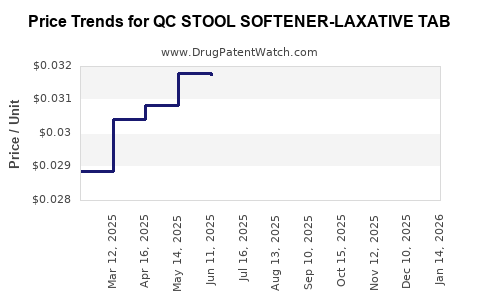
Average Pharmacy Cost for QC STOOL SOFTENER-LAXATIVE TAB
| Drug Name | NDC | Price/Unit ($) | Unit | Date |
|---|---|---|---|---|
| QC STOOL SOFTENER-LAXATIVE TAB | 83324-0135-60 | 0.03077 | EACH | 2026-07-22 |
| QC STOOL SOFTENER-LAXATIVE TAB | 83324-0135-60 | 0.03120 | EACH | 2026-06-17 |
| QC STOOL SOFTENER-LAXATIVE TAB | 83324-0135-60 | 0.03053 | EACH | 2026-05-20 |
| >Drug Name | >NDC | >Price/Unit ($) | >Unit | >Date |
Market Overview and Product Positioning
QC Stool Softener-Laxative Tablet (QC SS-Laxative) operates in a crowded segment of over-the-counter (OTC) laxatives. The market caters primarily to adults with occasional or chronic constipation. It competes with generic stool softeners, stimulant laxatives, osmotic agents, and fiber supplements.
The global laxative market was valued at approximately $4.5 billion in 2022 and is projected to reach $6 billion by 2027, expanding at a compound annual growth rate (CAGR) of 6.2%.[1] The increasing prevalence of gastrointestinal disorders, growing aging populations, and increased awareness of gastrointestinal health drive demand.
The OTC segment dominates, accounting for around 70% of the market, with prescription laxatives making up the remainder. The widespread availability and consumer preference for OTC options sustain domestic and international sales.
Key Market Factors
Regulatory Landscape:
- Strewn with regulatory barriers aimed at ensuring safety and efficacy, especially in various jurisdictions like FDA in the US, EMA in Europe, and other regional bodies.
- Ingredients like bisacodyl, docusate sodium (common stool softeners), and polyethylene glycol (osmotic agents) are FDA-approved OTC substances.
Consumer Preferences:
- Increased interest in natural or minimally processed laxatives.
- Preference for simple, on-the-go formulations like tablets over liquids.
Distribution Channels:
- Pharmacies and drugstores hold approximately 60% of sales.
- Online OTC sales see rapid growth, especially in the US and Europe.
Competitive Landscape:
- Major brands include Dulcolax (Bayer), Colace (Poise), Miralax (Bayer), and generic store brands.
- Market entry barriers are moderate; manufacturing requires adherence to strict quality standards.
Price Projections and Economics
Current Price Range:
- Typical retail price for a 30-tablet pack ranges $4 to $8 in North America.
- Wholesale prices hover around $2 to $4 per pack, depending on purchase volume.
Pricing Trends:
- Slight upward pressure expected due to inflation and raw material costs (e.g., active ingredients like docusate sodium and microcrystalline cellulose).
- Generic competition constrains premium pricing; innovation in delivery format could command higher prices.
Cost Structure Breakdown:
- Manufacturing costs: 25-35% of retail price.
- Marketing and distribution: 15-25%.
- Regulatory compliance and quality assurance: 10-15%.
- Profit margins are typically in the 25-30% range for well-established brands.
Future Price Forecasts:
- Average retail price likely to remain stable or increase marginally (~2-3%) annually through 2025, influenced by inflation and raw material costs.
- Potential for price premiums of 10-15% if QC SS-Laxative introduces unique features or superior efficacy.
Market Entry and Revenue Opportunities
For new entrants or existing players expanding:
- Price positioning should consider generic competitors—entry point at $3 per pack to gain market penetration.
- Premium positioning can justify price points above $8, targeting consumers seeking faster or more effective relief.
- Expansion into emerging markets with lower per capita consumption offers growth potential, with local retail prices around $1 to $3.
Projection Table:
| Year | Wholesale Price (USD) | Retail Price (USD, per 30 tablets) | Market Share Projection | Revenue Estimate (USD, for 1 million units) |
|---|---|---|---|---|
| 2023 | $2.50 - $4.00 | $4.00 - $8.00 | 2-4% | $4 million - $32 million |
| 2024 | $2.60 - $4.20 | $4.10 - $8.20 | 3-5% | $4.3 million - $41 million |
| 2025 | $2.70 - $4.40 | $4.20 - $8.40 | 4-6% | $4.5 million - $50 million |
Regulatory and Patent Considerations
-
Patent Status:
- Active patents on specific formulations or delivery mechanisms could protect market share for several years.
- Many stool softeners are generics, with patent expirations dating back over a decade.
-
Regulatory Pathways:
- OTC status simplifies entry but requires compliance with monograph requirements or new drug applications in some regions.
Key Takeaways
- The global OTC laxative market is sizable, reaching $6 billion by 2027, with growth driven by demographic shifts and gastrointestinal health awareness.
- Competitive pricing and product differentiation are critical due to the saturated market with dominant generics.
- Price points will remain stable with slight increases, aligned with raw material costs and inflation.
- Entry strategies should leverage existing distribution channels, with an emphasis on affordability and efficacy.
- Patent expiration on many ingredients opens opportunities but also intensifies competition.
FAQs
1. What are the main ingredients likely used in QC Stool Softener-Laxative Tablets?
Common active ingredients include docusate sodium (a stool softener) and possibly microcrystalline cellulose as a filler.
2. How do regulatory policies differ across regions?
In the US, OTC laxatives require FDA approval via monograph or NDA. Europe mandates EMA compliance. Some countries have more relaxed OTC classifications, easing market entry but requiring quality standards.
3. What is the typical shelf life for these tablets?
Usually 2-3 years, depending on storage conditions and ingredient stability.
4. How does consumer choice impact pricing?
Preference for natural or faster-acting formulations can influence premium pricing. Established brands can command higher prices through brand trust.
5. What are the primary growth opportunities?
Emerging markets and online sales channels offer rapid growth potential. Innovation in delivery formats, like chewables or orodispersible tablets, can attract new consumers.
Citations
[1] Statista. (2022). Laxatives Market Size and Forecast.
More… ↓
