Last updated: February 15, 2026
Market Overview
QC NIGHTTIME COLD-FLU SOFTGEL is a consumer healthcare product designed to alleviate symptoms associated with cold and flu, primarily targeting nighttime relief. Its formulation likely includes a combination of analgesics, antihistamines, decongestants, and sleep aids. The product's positioning in the over-the-counter (OTC) cold and flu segment puts it amid a competitive landscape with both branded and private-label alternatives.
Market Size and Segmentation
The global OTC cold and flu medicine market was valued at approximately USD 11.8 billion in 2022 and is projected to grow at a compound annual growth rate (CAGR) of 3.5% from 2023 to 2030 [1]. North America accounts for 40% of the total market, driven by high consumer health awareness and established regulatory frameworks.
Within this, the segment focusing on nighttime relief formulations, especially in softgel or capsule forms, is expanding. Softgels are preferred for their quicker absorption and ease of swallowing, especially among older consumers.
Competitive Landscape
Key brands include Tylenol Nighttime, NyQuil, Advil Nighttime, and Walgreens or CVS store brands. These products typically retail at USD 8-12 per package of 12-20 softgels, depending on formulation complexity and branding.
Private-label options are increasingly capturing market share by offering similar efficacy at lower prices, often USD 6-10 per package.
Regulatory Considerations
The OTC status of cold/flu formulations involves compliance with regulations from agencies like the FDA (U.S.) or EMA (Europe). In the U.S., the formulation must adhere to monographs or undergo new drug application (NDA) approval if it contains novel combinations or ingredients.
Product labeling and safety monitoring influence pricing strategies, with higher regulatory costs potentially translating into higher retail prices.
Pricing Strategies and Projections
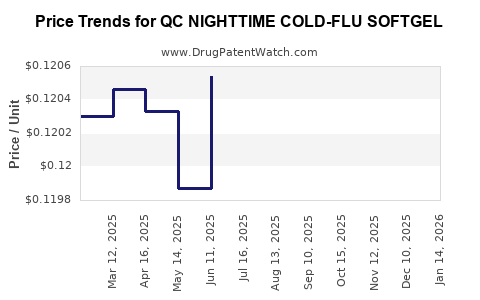
Current retail pricing for similar products ranges from USD 8 to USD 12 per package in the U.S., with margins typically around 30-50%. The price of QC NIGHTTIME COLD-FLU SOFTGEL will likely be influenced by:
- Formulation complexity: Combining multiple active ingredients increases costs.
- Brand positioning: Established brands command higher prices.
- Distribution channels: Pharmacy and online channels can command premiums.
- Market demand: Seasonal peaks in cold and flu seasons impact pricing flexibility.
Based on historical data and competitive positioning, the initial retail price is projected at USD 9-10 per package for a 12-20 softgel pack.
Future Price Trends
Over the next five years, the following factors will influence price trends:
- Market growth: A steady CAGR of 3.5%, with increased demand during colder months.
- Ingredient costs: Fluctuations in active ingredient prices could lead to price adjustments.
- Regulatory changes: Stricter labeling or safety requirements might raise costs.
- Competitive pressure: Private-label expansion could compress margins, stabilizing or reducing prices.
Expect prices to remain within USD 8-12 range, with minor fluctuations based on seasonality and market dynamics.
Potential Impact of New Entrants and Innovation
Introduction of novel formulations or sustained release softgels may command premium pricing (USD 12-15), especially if clinical trials demonstrate enhanced efficacy or safety. Conversely, commoditized formulations are likely to push prices downward due to generic and private-label competition.
Summary
| Factor |
Effect on Price |
| Formulation complexity |
Slight increase |
| Brand strength |
Higher pricing |
| Distribution channel |
Escalates price via pharmacy/online |
| Competitive landscape |
Pushes towards lower end |
| Ingredient costs |
Variable, may raise costs |
Key Takeaways
- The OTC cold/flu softgel market is mature, with established brands dominant.
- Expected retail price for QC NIGHTTIME COLD-FLU SOFTGEL: USD 9-10 per package.
- Price stability expected, with potential slight reductions due to private-label competition.
- Regulatory and ingredient cost fluctuations may influence future pricing.
- Innovation and product differentiation could command premiums.
FAQs
What is the primary competitive advantage of QC NIGHTTIME COLD-FLU SOFTGEL?
Its formulation, targeting nighttime symptom relief, combined with softgel delivery, appeals to consumers seeking quick absorption and convenience.
How do ingredient costs influence retail prices?
Rising costs for active ingredients, especially if sourced globally, may force manufacturers to increase retail prices or absorb costs.
What role do regulatory policies play in pricing?
Stricter regulations can elevate compliance expenses, potentially raising retail prices, especially if new safety standards are introduced.
Will private-label products impact pricing?
Yes. Private-labels tend to be priced 10-20% lower than branded counterparts, pressuring branded products to maintain competitive prices.
What is the forecast for product innovation in this segment?
Innovations like sustained-release softgels or natural ingredient blends could justify higher prices but depend on clinical efficacy and regulatory acceptance.
Sources
[1] Grand View Research, "Over-the-Counter (OTC) Cold & Flu Medicine Market Size, Share & Trends Analysis," 2022.