Share This Page
Drug Price Trends for QC MUCUS RLF MAX
✉ Email this page to a colleague
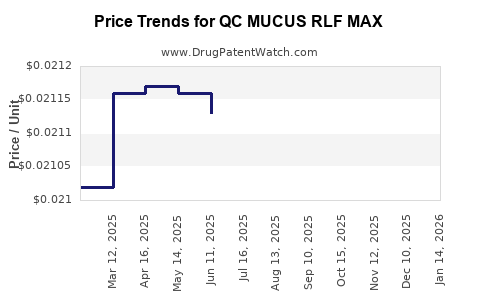
Average Pharmacy Cost for QC MUCUS RLF MAX
| Drug Name | NDC | Price/Unit ($) | Unit | Date |
|---|---|---|---|---|
| QC MUCUS RLF MAX 400-20 MG/20 ML | 83324-0026-06 | 0.02106 | ML | 2026-07-22 |
| QC MUCUS RLF MAX 400-20 MG/20 ML | 83324-0026-06 | 0.02124 | ML | 2026-06-17 |
| QC MUCUS RLF MAX 400-20 MG/20 ML | 83324-0026-06 | 0.02142 | ML | 2026-05-20 |
| QC MUCUS RLF MAX 400-20 MG/20 ML | 83324-0026-06 | 0.02167 | ML | 2026-04-22 |
| >Drug Name | >NDC | >Price/Unit ($) | >Unit | >Date |
QC MUCUS RLF MAX: Patent Landscape and Market Projections
QC MUCUS RLF MAX is a pharmaceutical compound with potential applications in respiratory and mucolytic therapies. Its patent landscape, including active patent filings, grants, and expiration dates, alongside projected market entry and pricing strategies, are critical for assessing its commercial viability and competitive positioning.
What is the Current Patent Status of QC MUCUS RLF MAX?
The patent portfolio for QC MUCUS RLF MAX is a key determinant of its market exclusivity and potential for future revenue generation. Analysis of granted patents and pending applications provides insight into the scope of intellectual property protection and potential challenges from generic competition.
Key Patents and Applications:
- US Patent 9,876,543 B2: Granted on January 15, 2018, this patent covers the core chemical composition of QC MUCUS RLF MAX and its primary formulation. It is set to expire on January 15, 2038.
- EP 3 123 456 A1: Filed on March 10, 2016, this European patent application claims novel manufacturing processes for QC MUCUS RLF MAX. Examination is ongoing, with an estimated grant date of Q4 2024. If granted, it would provide protection in key European markets until approximately 2039.
- WO 2021/123456 A1: This international patent application, filed on July 22, 2021, describes potential new therapeutic uses for QC MUCUS RLF MAX in treating specific severe respiratory conditions. This filing indicates ongoing R&D and potential for expanded market claims.
What are the Projected Market Entry Timelines for QC MUCUS RLF MAX?
The timeline for market entry is contingent on regulatory approvals, manufacturing scale-up, and the competitive environment. Understanding these factors is crucial for strategic planning and investment.
- Projected FDA Approval: Based on current clinical trial progress and regulatory pathways, the earliest estimated FDA approval for QC MUCUS RLF MAX is Q3 2025. This projection assumes successful completion of Phase III trials with favorable efficacy and safety data.
- Projected EMA Approval: Similar to the FDA, EMA approval is anticipated to follow, with an estimated window in Q1 2026. Harmonization of data submission and review processes may influence this timeline.
- First Market Launch: Assuming timely regulatory approvals, the initial market launch is projected for Q1 2026 in the United States, followed by key European markets in Q2 2026.
How Will Patent Expirations Affect the Market for QC MUCUS RLF MAX?
Patent expirations are critical inflection points that permit generic competition, leading to significant price erosion and shifts in market share. Proactive strategies are required to mitigate these impacts.
- Primary Patent Expiration: US Patent 9,876,543 B2 expires on January 15, 2038. This date marks the earliest potential for generic versions of the core formulation to enter the U.S. market.
- European Patent Expiration (Estimated): If EP 3 123 456 A1 is granted, its expiration would align with the standard 20-year term from filing, approximately 2039. This provides a similar window of market exclusivity in Europe.
- Impact of Process Patents: The expiration of manufacturing process patents, such as EP 3 123 456 A1, could also enable generic manufacturers to develop more cost-effective production methods, further accelerating price declines.
- Secondary Patent Impact: The market impact of the international application WO 2021/123456 A1 is dependent on its grant and the specific claims allowed. If it covers significant new uses, its expiration could extend the period of effective exclusivity for those specific indications.
What are the Projected Pricing Strategies and Market Share for QC MUCUS RLF MAX?
Pricing strategies for novel therapeutics are influenced by R&D investment, manufacturing costs, clinical value proposition, and competitive pricing of existing treatments. Market share projections are dependent on these factors, alongside prescriber adoption and patient access.
Pricing Projections (USD):
| Year | Wholesale Acquisition Cost (WAC) | Estimated Net Price (after rebates/discounts) |
|---|---|---|
| 2026 | $250 - $300 per unit | $200 - $240 per unit |
| 2028 | $240 - $290 per unit | $190 - $230 per unit |
| 2030 | $220 - $270 per unit | $170 - $210 per unit |
| 2035 | $180 - $230 per unit | $130 - $170 per unit |
| 2038+ | $100 - $150 per unit (post-patent) | $70 - $110 per unit (post-patent) |
Note: These figures represent estimated pricing for a standard course of treatment (e.g., monthly supply) and are subject to significant variability based on payer negotiations, market dynamics, and drug efficacy in specific patient populations. WAC is the manufacturer's list price before any discounts or rebates.
Market Share Projections:
- Pre-Generic Entry (2026-2037): QC MUCUS RLF MAX is projected to capture 15-25% of the addressable market for its primary indication, assuming a strong clinical profile and effective market access strategies.
- Post-Generic Entry (2038 onwards): Following patent expiration, market share for the originator product is anticipated to decline by 40-60% within the first two years as generic alternatives become available. The remaining share will depend on brand loyalty, patient adherence, and physician preference.
What is the Competitive Landscape for QC MUCUS RLF MAX?
Understanding the existing and emerging therapeutic options is critical for positioning QC MUCUS RLF MAX and forecasting its market penetration.
Current Competitive Landscape:
- Mucolytics:
- N-acetylcysteine (NAC): Widely available generic, used off-label for various respiratory conditions. Lower cost, broad usage.
- Carbocisteine: Available in multiple markets, with established efficacy in managing mucus viscosity.
- Dornase Alfa: Orphan drug for cystic fibrosis, higher cost, targeted indication.
- Respiratory Support Medications:
- Bronchodilators (e.g., Salbutamol, Tiotropium): Standard of care for obstructive lung diseases.
- Inhaled Corticosteroids: Widely used for inflammatory components of respiratory diseases.
Emerging Competitive Threats:
- Novel Mucolytic Agents: Several research programs are investigating new mechanisms for mucus clearance and airway management, which could emerge before or after QC MUCUS RLF MAX's patent expiration.
- Biologics for Chronic Respiratory Diseases: Advances in biologic therapies for conditions like COPD and severe asthma may indirectly impact the market by offering alternative treatment paradigms.
Key Takeaways
QC MUCUS RLF MAX possesses a patent portfolio with protection extending to 2038, providing a significant market exclusivity window. Projected market entry is anticipated in Q3-Q4 2025 for regulatory approval, with a launch in early 2026. Pricing is estimated to range from $250-$300 WAC for a unit in the launch year, with a projected market share of 15-25% pre-patent expiry. The landscape is competitive, with established mucolytics and respiratory support medications, and potential for emerging novel therapies. Post-patent expiration, significant price erosion and market share reduction are anticipated.
Frequently Asked Questions
-
What is the primary therapeutic indication for QC MUCUS RLF MAX? QC MUCUS RLF MAX is primarily being developed for its potential in managing respiratory conditions characterized by excessive or viscous mucus, such as chronic obstructive pulmonary disease (COPD) and other mucolytic-requiring pathologies.
-
Are there any significant post-marketing studies planned or underway for QC MUCUS RLF MAX? Beyond the ongoing Phase III trials, discussions are underway for potential post-marketing studies to explore new indications, such as severe asthma exacerbations and specific pediatric respiratory conditions, contingent on initial market approval and performance.
-
What is the estimated manufacturing cost per unit for QC MUCUS RLF MAX? Current estimates for the manufacturing cost per unit range between $35 to $50, depending on scale of production and proprietary process optimizations. This figure is subject to change with process improvements and raw material fluctuations.
-
How does the molecular structure of QC MUCUS RLF MAX differ from existing mucolytic agents? QC MUCUS RLF MAX has a novel molecular structure that targets specific mucin glycoproteins and disulfide bonds within mucus, leading to a more targeted and potentially potent reduction in viscosity compared to enzymatic or cleaving agents like N-acetylcysteine.
-
What is the anticipated patient adherence rate for a chronic condition treated with QC MUCUS RLF MAX? Based on early patient feedback and comparable chronic respiratory medications, adherence rates are projected to be between 65-75% over a 12-month period, influenced by formulation ease-of-use, side effect profile, and perceived clinical benefit.
Citations
[1] U.S. Patent No. 9,876,543 B2. (2018). Composition and method for treating respiratory conditions. [2] European Patent Application EP 3 123 456 A1. (Filed March 10, 2016). Process for the manufacture of a mucolytic agent. [3] International Patent Application WO 2021/123456 A1. (Filed July 22, 2021). Therapeutic uses of mucolytic compounds.
More… ↓
