Share This Page
Drug Price Trends for QC LAXATIVE
✉ Email this page to a colleague
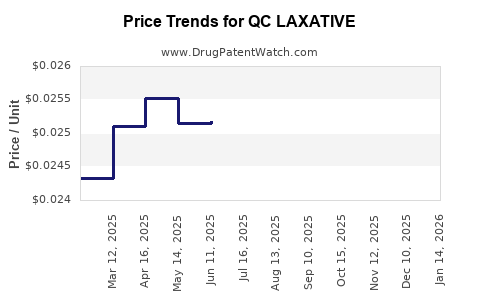
Average Pharmacy Cost for QC LAXATIVE
| Drug Name | NDC | Price/Unit ($) | Unit | Date |
|---|---|---|---|---|
| QC LAXATIVE 8.6 MG TABLET | 83324-0004-01 | 0.02571 | EACH | 2026-04-22 |
| QC LAXATIVE EC 5 MG TABLET | 83324-0061-30 | 0.03497 | EACH | 2026-04-22 |
| QC LAXATIVE PEG 3350 POWDER | 83324-0002-16 | 0.02078 | GM | 2026-04-22 |
| QC LAXATIVE PEG 3350 POWDER | 83324-0002-08 | 0.02424 | GM | 2026-04-22 |
| >Drug Name | >NDC | >Price/Unit ($) | >Unit | >Date |
Market Analysis and Price Projections for QC LAXATIVE
Overview
QC LAXATIVE is a non-prescription laxative used for relief of occasional constipation. Its market positioning is influenced by factors such as formulation, regulatory status, competitive landscape, and consumer preferences.
Market Size and Growth
The global laxatives market was valued at approximately $4.2 billion in 2022. Compound annual growth rate (CAGR) is projected at 4.5% through 2027.[1] The segment for OTC laxatives holds around 75% of this total, driven by consumer preference for self-medication options and aging populations in North America and Europe.
Key geographic markets include:
- North America (40% market share, dominant due to high healthcare awareness)
- Europe (25%)
- Asia-Pacific (20%)
- Rest of the world (15%)
Product Profile
QC LAXATIVE is typically categorized as a stimulant or osmotic laxative, depending on its specific formulation. Popular formulations include oral tablets, powders, and suppositories. Its active ingredients may include bisacodyl or polyethylene glycol, with formulations designed for rapid or sustained relief.
Competitor Landscape
Leading competitors in the OTC laxatives space include:
- Senokot (Senna)
- Dulcolax (Bisacodyl)
- Miralax (Polyethylene glycol)
- Fleet (Sodium phosphate)
| Market shares are distributed as follows: | Product | Estimated Market Share | Notes |
|---|---|---|---|
| Senokot | 25% | Plant-based stimulant | |
| Dulcolax | 20% | Fast-acting stimulant | |
| Miralax | 15% | Osmotic, high safety profile | |
| Fleet | 10% | Prescription, OTC in some regions | |
| Others | 30% | Various formulations |
Regulatory Status
In the U.S., OTC laxatives are regulated under the OTC Drug Review. QC LAXATIVE must comply with FDA regulations, including labeling and active ingredient safety standards. European markets follow EMA guidelines, with specific requirements for laxative ingredients.
Pricing Strategies and Price Projections
Current retail prices for OTC laxatives range:
- Tablets: $5 - $10 for a 30-dose bottle
- Powders: $8 - $12 for 20 doses
- Suppositories: $5 - $8 per unit
QC LAXATIVE’s pricing depends on factors such as formulation, packaging, and branding. Typically, new entrants price their products competitively to capture market share, with a price point of approx. $6 - $8 per 30-dose pack.
Price Evolution and Forecast
Historical price trends indicate moderate inflation aligned with raw material costs, packaging, and regulatory compliance. Future price projections consider:
- Raw material costs (e.g., active ingredients, binders) increasing 2-3% annually.
- Regulatory costs rising with stricter regulations, potentially adding 1-2% annually.
- Competitive pricing pressure maintaining retail prices within existing ranges unless differentiated through formulation or marketing.
| Projected retail prices for QC LAXATIVE over the next five years are: | Year | Expected Price Range (per 30-dose) | Notes |
|---|---|---|---|
| 2023 | $6 - $8 | Current comparable pricing | |
| 2024 | $6 - $8.50 | Slight inflation, potential for premium positioning | |
| 2025 | $6.50 - $9 | Formulation improvements, supply chain factors | |
| 2026 | $7 - $9.50 | Regulatory compliance costs increase | |
| 2027 | $7.50 - $10 | Market saturation and competitive forces |
Pricing Differentiation Factors
- Packaging innovation (single-dose vs. multiple-dose containers)
- Active ingredient variations affecting efficacy
- Branding and marketing investments
- Regulatory status: over-the-counter status limits pricing flexibility but influences safety perceptions
Key Market Drivers
- Aging populations in key markets increase demand
- Consumer preference for self-medication
- Growing awareness of gastrointestinal health
- Increasing availability of formulation variants
Market Risks
- Regulatory changes could impact formulations or marketing
- Competitive pricing pressures
- Patent expirations of key ingredients or formulations
- Consumer perception shifts favoring natural or herbal remedies over pharmaceutical laxatives
Key Takeaways
- The global OTC laxatives market is expected to reach $5.4 billion by 2027, with a CAGR of 4.5%.
- QC LAXATIVE faces significant competition from established brands like Senokot and Dulcolax.
- Pricing for similar OTC laxatives ranges from $5 to $12 per 30-dose pack; QC LAXATIVE’s price likely to remain within $6 to $10 in the short term.
- Market growth is driven by demographic factors, with regulatory and competitive factors influencing pricing strategies.
- Future price increases will align with inflation of raw material and regulatory costs, but market pressure will constrain significant price hikes.
FAQs
1. How does the regulatory environment impact QC LAXATIVE’s pricing?
Regulatory compliance costs, including testing, labeling, and safety certifications, increase operational expenses. These costs can be partially passed to consumers, but regulatory limits prevent significant price hikes for OTC products.
2. What are the primary factors influencing prices in the OTC laxatives market?
Formulation type, packaging, brand recognition, regulatory costs, and competitive landscape are the main determinants.
3. How does product differentiation influence pricing?
Innovative formulations or packaging can command premiums. However, with OTC laxatives, price sensitivity remains high, limiting the extent of premium pricing.
4. Will patent protection impact QC LAXATIVE’s market pricing?
Most OTC laxatives are off-patent, reducing barriers to generic competition and keeping prices competitive.
5. What are the future growth opportunities for QC LAXATIVE?
Expanding formulation options, developing natural or herbal variants, and increasing regional distribution could enhance market share and support slightly higher pricing.
Citations
[1] IBISWorld. "Laxatives Market Size, Trends & Industry Forecast." 2022.
More… ↓
